Chapter 7: The Woman Behind the Gate
Karen had lived in Lakeview Estates for eighteen years.
She and Richard had purchased their home shortly after he retired from his job as a civil engineer.
The house stood on a quiet street overlooking the western edge of the lake.
It had a wide front porch, white shutters, and a garden Richard had designed himself.
For years, their life had been comfortable.
Richard enjoyed fishing.
Karen organized neighborhood events.
They hosted Thanksgiving dinners for friends whose families lived far away.
Every December, Richard decorated the porch with warm white lights, while Karen prepared homemade cookies for the neighbors.
People remembered those years.
They remembered Karen laughing.
They remembered her helping elderly residents carry groceries.
They remembered a woman who had once cared deeply about the community.
After Richard died, something changed.
At first, Karen buried herself in volunteer work.
Then she ran for HOA president.
She told friends she needed something meaningful to do.
But over time, the position became more than a responsibility.
It became her identity.
Every complaint felt like a personal attack.
Every disagreement seemed like disrespect.
Every rule became something she had to enforce to prove that she still mattered.
Her daughter, Melissa, had noticed the change.
Melissa was thirty-four, a physical therapist living two hours away with her husband and two children.
She loved her mother.
But their relationship had grown strained.
Karen criticized Melissa’s parenting, complained about her visits, and repeatedly insisted that nobody appreciated her sacrifices.
After the highway incident, Melissa called several times.
Karen refused to answer.
Finally, Melissa drove to Lakeview Estates.
She found her mother sitting on the back porch, staring at the water.
The garden had become overgrown.
Richard’s old fishing chair stood empty beside the railing.
Melissa sat down.
For several minutes, neither woman spoke.
Then Karen began describing the investigation.
She complained about the reporters, the board members, and the residents who had turned against her.
Melissa listened.
When Karen finished, her daughter asked a simple question.
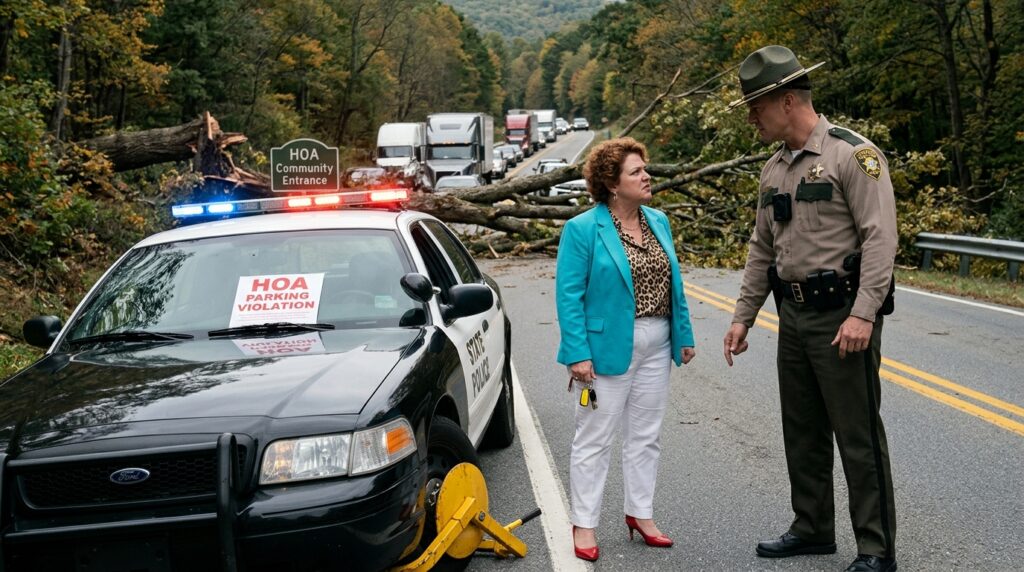
“Mom, why did you put those trees in the road?”
Karen looked away.
“I was protecting the neighborhood.”
“From what?”
“Outsiders. Trucks. People who don’t respect our property.”
Melissa waited.
Karen struggled to explain.
She spoke about strangers parking near the entrance, drivers using the shoulder, and the feeling that the neighborhood was changing.
But as she continued, her reasons began sounding smaller.
A truck turning around.
A tourist taking photographs.
A stranger stopping to check directions.
None of those things justified blocking a public highway.
Melissa reached for her mother’s hand.
“Dad spent his whole career designing roads and bridges. He believed they were supposed to bring people together.”
Karen’s eyes filled with tears.
She remembered Richard’s stories about engineering projects in small towns.
He had been proudest of a bridge he helped design after a flood destroyed the only safe crossing between two rural communities.
For Richard, public infrastructure had always been about people.
Farmers getting crops to market.
Children reaching school.
Families reaching hospitals.
Karen had forgotten that.
Melissa continued gently.
“You’ve been so afraid of losing control that you’ve pushed everybody away.”
Karen wanted to argue.
But she couldn’t.
She looked toward the lake.
The water was calm.
A pair of ducks moved slowly along the shoreline.
For years, she had spent her mornings searching for violations and her evenings writing warning letters.
She had stopped enjoying the place she claimed to love.
Later that afternoon, Melissa helped her mother sort through Richard’s belongings.
Inside an old desk drawer, they found a small notebook.
Richard had used it to record household projects and reminders.
On one page, written in his familiar handwriting, was a note about the neighborhood entrance.
Talk to Karen about working with the state on safer road access. The gate isn’t worth anyone getting hurt.
Karen stared at the words.
Richard had written them years before his death.
She remembered the conversation.
He had suggested replacing the oversized decorative gate with a simpler entrance and better road markings.
Karen had dismissed the idea.
She had insisted that the impressive gate protected property values.
Richard had disagreed, but he had not pushed.
Now his words felt painfully clear.
Karen closed the notebook.
She finally understood that she had not been defending Richard’s legacy.
She had been fighting against the very values he believed in.
The next morning, she called her attorney.
She wanted to discuss accepting responsibility.
Not because she expected forgiveness.
But because she was tired of pretending she had done nothing wrong.