Chapter 2: A Road That Could Not Wait
By the time the first state police cruiser arrived, traffic had backed up nearly two miles.
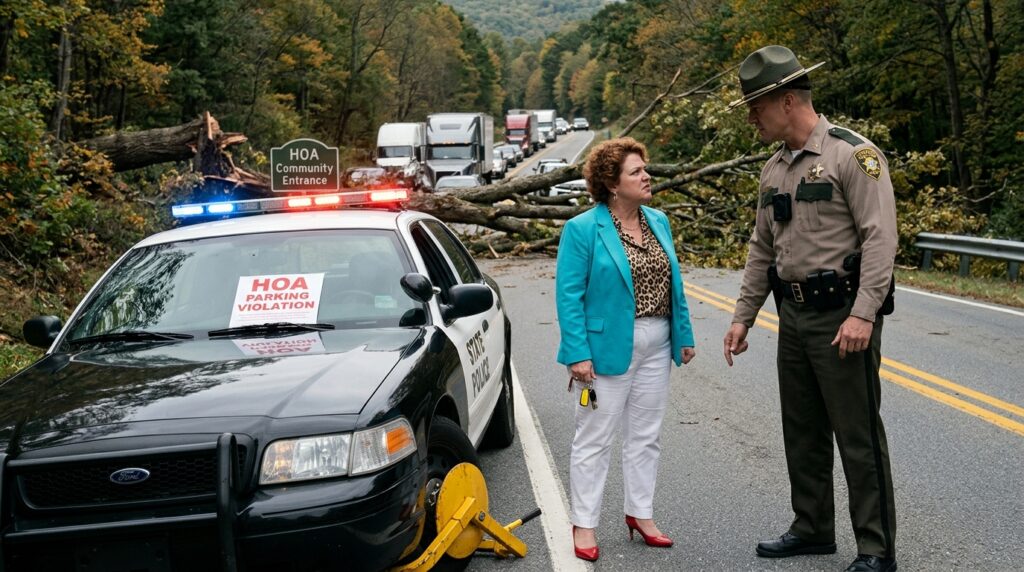
Officer Rebecca Hayes, a veteran state trooper with twenty-three years of service, stepped out of her patrol car and surveyed the scene.
She had expected a fallen-tree emergency.
Instead, she found three enormous oak trunks arranged across both lanes, a yellow tractor parked at an angle, a damaged private gate, and an angry woman demanding that the police arrest a truck driver.
Karen marched toward her.
“Officer, I’m the president of this community. That man threatened me, and my property has been destroyed.”
Rebecca glanced at Daniel, who stood beside his truck.
Then she looked at the steel cable.
“Who was operating the tractor?”
Karen hesitated.
“I was supervising necessary security work.”
“That’s not what I asked.”
Karen folded her arms.
“I was operating it.”
Rebecca took out her notebook.
“Do you have authorization from the state transportation department to close this highway?”
Karen lifted her chin.
“The road runs directly beside our entrance.”
“That doesn’t answer my question.”
“We pay enormous property taxes.”
Rebecca remained patient.
“Ma’am, this is a public state highway. Your homeowners association does not have the authority to close it.”
Karen opened her mouth, then shut it.
For years, she had settled neighborhood disputes by quoting HOA regulations, threatening fines, and sending formal violation notices.
But the woman standing in front of her wasn’t a frightened homeowner.
She was a state trooper.
And she was not impressed.
Rebecca ordered Karen to shut down the tractor and step away from the equipment.
Then she radioed for highway maintenance crews and additional traffic control.
Daniel approached and explained what he had witnessed.
He showed Rebecca a video recorded by the dashboard camera on his truck.
The footage clearly captured Karen pulling the oak trunk across the highway and continuing after Daniel warned her about the gate.
Rebecca watched without comment.
Then she asked Daniel to preserve the original recording.
As the officers began directing traffic away from the obstruction, a second problem emerged.
A white ambulance appeared at the back of the traffic jam.
Its emergency lights flashed between the stopped vehicles.
The driver repeatedly sounded the siren.
But there was nowhere to go.
The highway had narrow shoulders bordered by drainage ditches and thick woodland.
The three semi-trucks could not move forward.
Vehicles behind them could not turn around.
And the fallen trees blocked the only direct route toward the county hospital.
Rebecca hurried toward the ambulance.
Inside was seventy-three-year-old Harold Peterson, a retired electrician who had suffered a suspected heart attack at his farmhouse twelve miles west of Lakeview Estates.
His wife, Eleanor, sat beside him, holding his hand.
They had been married for forty-eight years.
Harold had spent most of those years repairing electrical systems, raising two children, and helping neighbors whenever storms damaged their homes.
Now he lay pale and frightened on a stretcher.
The paramedics were monitoring his heart and communicating with the hospital.
Every unnecessary delay mattered.
Rebecca immediately coordinated an emergency passage.
Highway workers were still some distance away, so she arranged for a fire-rescue crew approaching from the opposite direction to help clear a narrow route.
Daniel and the other truck drivers repositioned their vehicles where possible.
One driver guided cars backward, slowly creating space.
Another helped officers keep impatient motorists away from the unstable trunks.
Karen watched from beside her ruined gate.
She had expected the police to defend her community.
Instead, everyone was working to undo what she had done.
When she learned about the ambulance, she became defensive.
“How was I supposed to know somebody would have a medical emergency?”
Rebecca turned toward her.
“That’s why private citizens cannot decide to close public highways.”
The words struck harder than Karen expected.
She looked toward the ambulance.
Through its rear window, she could see Eleanor Peterson sitting beside her husband.
Eleanor’s gray hair was neatly pinned back. Her hands were clasped so tightly that her knuckles had turned white.
For a moment, Karen looked uncomfortable.
Then she looked away.
It took nearly forty minutes to create a safe passage.
The ambulance finally continued toward the hospital under police escort.
Harold was still alive when it departed.
But nobody at the scene knew what would happen next.
By late afternoon, highway crews had begun removing the trunks, and a towing company was preparing to secure the damaged gate.
Rebecca issued Karen a citation and informed her that investigators would review the road obstruction, property damage, and any applicable criminal violations.
Karen protested.
She threatened to call the governor.
She demanded the officer’s badge number.
Rebecca calmly provided it.
Then she told Karen that the tractor and cable would be documented as evidence.
As the sun began dropping behind the lake, Daniel returned to his truck.
He was already hours behind schedule.
His refrigerated load had a delivery deadline.
But before leaving, he noticed something strange.
A pile of freshly cut branches lay near the entrance.
Their cut ends were smooth.
These weren’t trees that had simply fallen in a storm.
Someone had deliberately brought them down.
And Karen had not been working alone.