Chapter 10: What Really Makes a Home
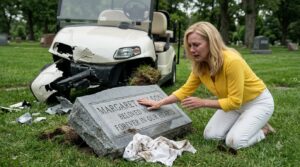
One year after the highway incident, Karen stood beside her husband’s grave.
The cemetery was quiet.
A gentle breeze moved through the trees.
She carried a small bouquet of yellow roses, Richard’s favorite flowers.
For several minutes, she said nothing.
Then she knelt and placed the roses beside the headstone.
She had spent the past year learning how to live without the authority that once defined her.
The transition had not been easy.
Some neighbors still avoided her.
Others remained openly angry.
A few had accepted her apologies but preferred to keep their distance.
Karen understood.
Trust could not be restored by a single speech or a court appearance.
It had to be earned through consistent behavior.
She had stopped attending HOA meetings unless she had a genuine reason to participate.
She no longer inspected other people’s lawns.
She no longer photographed vehicles parked in driveways.
And she had learned that most disagreements did not require a formal complaint.
Melissa visited more often now.
Her grandchildren had begun spending weekends at the lake again.
They helped Karen plant flowers in the garden Richard had designed.
Sometimes they left toys scattered across the porch.
Karen no longer complained.
She had discovered that a house could be perfectly maintained and still feel terribly empty.
And that a home filled with laughter was worth a little disorder.
At the cemetery, Karen brushed a fallen leaf from Richard’s headstone.
She remembered his words about roads, bridges, and neighbors.
He had spent his career connecting communities.
She had nearly destroyed one by trying to keep people apart.
“I finally understand,” she whispered.
There was no dramatic answer.
Only the wind moving through the branches.
Later that afternoon, Karen drove to the county community center.
Her court-ordered service had ended months earlier, but she continued volunteering twice a week.
She helped organize transportation information for older residents, prepared activity rooms, and occasionally delivered groceries to people who could no longer drive.
She had learned that privacy and dignity mattered deeply to people who were aging.
Nobody wanted to feel helpless.
Nobody wanted a stranger deciding what was best for them without listening.
It was a lesson Karen wished she had understood years earlier.
That evening, she returned to Lakeview Estates.
As she approached the entrance, she slowed her car.
The new sign stood beside a bed of flowering shrubs.
The improved roadway curved gently past the lake.
A delivery truck was turning safely onto the shoulder farther ahead.
Karen waited patiently until it completed its maneuver.
Then she drove through the entrance.
Near the clubhouse, she noticed George Bennett struggling to lift a bag of potting soil from his trunk.
She pulled over.
George looked surprised when she approached.
For years, they had barely spoken except during arguments over HOA rules.
Karen offered to help.
George hesitated, then accepted.
Together, they carried the bag to his front porch.
He thanked her.
Karen nodded.
Neither mentioned the highway.
Neither mentioned the gate.
There was no grand reconciliation.
Just two neighbors helping each other on an ordinary evening.
And somehow, that felt more meaningful than any public apology.
As Karen walked back to her car, she noticed several families gathered near the lake.
Children chased each other across the grass.
An elderly couple sat on a bench watching the sunset.
A young father helped his daughter learn to ride a bicycle.
The neighborhood looked much as it had when she and Richard first moved there.
But Karen saw it differently now.
For years, she had believed that protecting Lakeview Estates meant keeping outsiders away, enforcing every regulation, and maintaining an impressive entrance.
She had measured success through control.
She had mistaken fear for respect.
And she had nearly cost an innocent man his life because she believed her authority mattered more than everyone else’s safety.
The consequences had been painful.
She had lost her presidency, her reputation, and a significant portion of her savings.
She had damaged relationships that might never fully recover.
But the experience had also forced her to confront a truth she had spent years avoiding.
A community was not a possession.
It was a shared responsibility.
Its streets belonged to the people who traveled them.
Its homes belonged to the families who lived in them.
And its strength came from neighbors who respected one another, especially when they disagreed.
Karen reached her driveway just as the sun disappeared behind the lake.
She parked, stepped onto her porch, and looked toward the quiet street.
A neighbor across the road raised a hand in greeting.
Karen waved back.
Then she went inside to prepare dinner for Melissa and the grandchildren, who were arriving the next morning.
For once, she wasn’t worried about whether the neighborhood looked perfect.
She was simply grateful to be part of it.
And on State Highway 47, traffic continued moving freely past Lakeview Estates.
Cars carried families home.
Trucks delivered food and supplies.
Ambulances traveled toward the hospital whenever someone needed help.
The road served everyone, just as it was meant to.
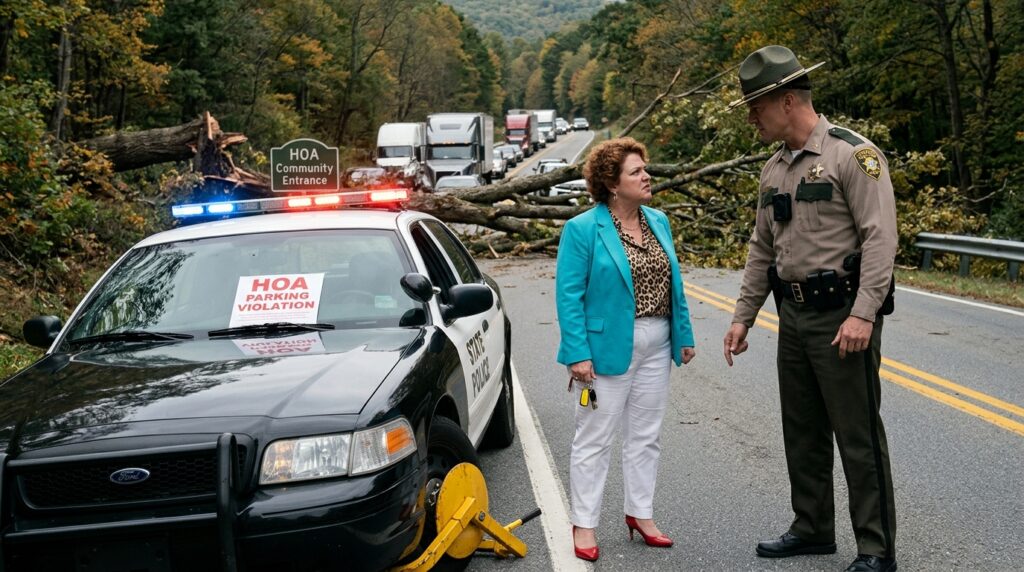
The enormous iron gate that Karen had once considered the symbol of her power was gone.
In its place stood something quieter, simpler, and far more valuable.
A safe entrance.
An open road.
And a community slowly learning that the best way to protect a home is not to build higher barriers, but to treat the people around it with dignity and respect.