Chapter 3: The Secrets Behind the Stone Pillars
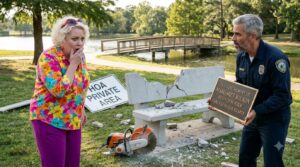
The following morning, Lakeview Estates looked like a community recovering from a natural disaster.
Yellow caution tape surrounded the entrance.
The right-hand iron gate lay twisted beside the driveway.
The southern stone pillar had been reduced to a jagged stump.
Residents entered through a temporary opening while contractors inspected the remaining structure.
Karen stood nearby wearing a lavender jacket and oversized sunglasses.
She had barely slept.
Her phone had rung throughout the night.
Neighbors wanted explanations.
Insurance representatives wanted photographs.
The HOA’s property manager wanted to know who had authorized the roadwork.
And a local television station had already obtained video of the collapse.
By eight o’clock, the footage was circulating across social media.
The headline was humiliating.
HOA PRESIDENT BLOCKS STATE HIGHWAY, DESTROYS OWN COMMUNITY GATE
Karen refused to watch it.
Instead, she called an emergency meeting of the HOA board.
The meeting took place inside the Lakeview Estates clubhouse, a handsome brick building overlooking the water.
Five board members sat around a polished conference table.
Karen occupied the chair at the head.
To her right sat Thomas Whitaker, the association’s seventy-year-old treasurer.
Thomas was a retired accountant who had lived in Lakeview Estates since its earliest years.
He was quiet, careful, and respected by nearly everyone.
He had never liked Karen’s confrontational management style.
But until now, he had believed her aggressive behavior was mostly harmless.
That belief was beginning to change.
Karen opened the meeting by announcing that the association had been the victim of an unfortunate construction accident.
She proposed filing an immediate insurance claim.
She also wanted the HOA to cover the tractor rental, emergency legal expenses, and the replacement gate.
Thomas adjusted his reading glasses.
“Who approved the work?”
Karen waved a hand.
“It was an emergency security measure.”
“What emergency?”
“Unauthorized commercial traffic.”
Thomas opened the HOA’s financial records.
He had searched through the previous six months of board minutes.
There was no approved project involving the highway.
No authorization for tree removal.
No contract with a licensed roadwork company.
No board vote permitting Karen to rent construction equipment.
And no emergency resolution.
Thomas placed the documents on the table.
“Karen, you didn’t have approval.”
She stiffened.
“As president, I have discretionary authority.”
“Not to close a state highway.”
The room fell silent.
Karen stared at him.
Thomas continued carefully.
“The association may be facing serious liability. We need to establish exactly what happened before we spend a dollar of homeowners’ money.”
Karen accused him of undermining her leadership.
But another board member, sixty-four-year-old Linda Carver, spoke up.
Linda had spent thirty-five years working as a public school principal.
She had little patience for intimidation.
“My daughter was caught in that traffic jam yesterday. She had my two grandchildren in the car.”
Karen turned toward her.
“Nobody was hurt.”
“We don’t know that yet.”
Linda’s voice remained steady.
“And that’s the problem.”
The meeting ended without approving Karen’s requested payments.
Instead, the board voted to hire independent legal counsel and preserve all records related to the incident.
Karen left furious.
But Thomas remained behind.
He had noticed an unusual expense in the association’s accounts.
Three weeks earlier, a payment of $8,750 had been made to a small landscaping company called Green Ridge Outdoor Services.
The invoice described the work as emergency vegetation management.
Thomas recognized the company.
Its owner, Travis Cole, was a local contractor who occasionally trimmed trees around Lakeview Estates.
But the payment seemed unusually large.
Thomas called the property manager and requested the supporting documents.
An hour later, an email arrived.
Attached was a work order signed by Karen.
The instructions were brief.
Remove selected oak trees along the highway boundary.
Transport trunks to the entrance.
Prepare temporary barriers to discourage unauthorized traffic.
Thomas read the document twice.
Then he noticed a handwritten note at the bottom.
Complete before county inspection on Thursday.
He checked the calendar.
The highway obstruction had occurred on Wednesday.
Why had Karen been so determined to finish the work before Thursday?
Thomas opened another folder.
Inside was a letter from the county transportation office, dated two months earlier.
The letter concerned a proposed safety improvement near the Lakeview Estates entrance.
State engineers wanted to evaluate the shoulder, drainage ditch, and sightlines around the community driveway.
The county had requested cooperation from the HOA.
Karen had responded that the association would not permit any alteration affecting its private entrance.
Thomas read the correspondence with growing concern.
The roadwork had not been an impulsive decision.
Karen had been planning it.
And the timing suggested she was trying to prevent something.
He printed the documents and placed them in a folder.
Then he called Linda.
“I think we need to speak with the investigators.”