Chapter 8: A Place to Sit
By early spring, Harbor Point Estates looked much as it always had.
The azaleas bloomed along the clubhouse walkway.
Fishing boats moved across the distant water.
Neighbors waved from their driveways.
But beneath the familiar appearance, important things had changed.
The association adopted stronger financial controls.
Major expenditures required documented approvals and clearer separation of responsibilities.
Board meeting packets became easier for residents to access.
The association established a written process for reviewing disputed violations before additional penalties could be imposed.
A volunteer committee began evaluating long-term maintenance needs and potential funding options.
The clubhouse roof still needed repairs.
The pool equipment still required attention.
Nobody pretended those problems had vanished.
But residents now understood that responsible management required both practical decisions and transparent procedures.
The redevelopment proposal was formally abandoned.
The board confirmed that the memorial lawn would remain available for community remembrance activities, subject to the governing documents and ordinary safety requirements.
The association’s attorney continued addressing the disputed consulting payments.
After negotiations, the association reached a documented settlement recovering part of the money and resolving the remaining contractual claims without prolonged litigation.
The final accounting was shared with homeowners.
The recovered funds did not cover every expense connected with the dispute.
Legal and accounting costs had been real.
So had the damage to trust.
But the association had avoided entering a long-term commercial lease that lacked the required approvals.
Patricia no longer held any HOA office.
She continued living in Harbor Point, though she rarely attended community gatherings.
Walter occasionally saw her at the grocery store.
They did not speak.
He felt no need to pursue her.
Accountability had been necessary.
Revenge was not.
As Memorial Day approached, Linda proposed a small improvement to the remembrance area.
The existing folding chairs were old, uneven, and difficult for some residents to use.
She suggested purchasing several sturdy, accessible outdoor chairs with armrests and stable legs.
Frank supported the idea immediately.
He had nearly fallen twice while trying to rise from a folding chair.
Margaret suggested adding a short, level path between the walkway and the memorial bench.
Thomas helped prepare a modest budget.
This time, the proposal was discussed openly.
Residents reviewed the cost.
The board approved the project through the proper process.
Several homeowners contributed voluntary donations for additional improvements.
Rebecca arranged for a local veterans’ organization to provide guidance on accessibility and seating.
By late May, the work was finished.
Six new chairs stood near the memorial bench.
They were simple, dark green, weather-resistant chairs with broad armrests.
Nothing fancy.
Nothing expensive.
But they were comfortable, stable, and available to anyone who needed them.
Walter arrived early for the dedication.
He wore his navy veteran cap and the dark jacket Eleanor had bought him years earlier.
Frank was already there.
He sat in one of the new chairs, testing the armrests.
“Well,” Frank said, pushing himself upright, “this one doesn’t try to kill me.”
Walter laughed.
“That’s a considerable improvement.”
Linda stood nearby arranging small American flags.
Margaret carried a tray of homemade cookies.
Thomas checked that the pathway was clear.
Rebecca arrived with her husband and two teenage grandchildren.
Walter watched the children walk toward the memorial bench.
His granddaughter, Emily, paused to read the bronze plaque.
She had visited Harbor Point many times, but Walter realized he had never fully explained the memorial’s history to her.
She asked him who had built it.
Walter told her about the neighbors who donated money, the carpenter who volunteered his time, and Eleanor’s work collecting contributions.
Emily listened carefully.
Then she asked whether the names on the remembrance display belonged to people he had known.
Some did.
Walter spoke about a young sailor named Daniel Brooks, who had served aboard his ship.
Daniel had been twenty-one, always smiling, and hopeless at playing cards.
He had died years later after struggling with injuries connected to his service.
Walter remembered him every Veterans Day.
Emily took her grandfather’s hand.
For a moment, Walter couldn’t speak.
He looked toward the water and waited for the tightness in his throat to pass.
Then he told her something Eleanor used to say.
“Remembering people is one way of keeping our promises to them.”
Emily nodded.
The dedication began shortly afterward.
Martin Caldwell thanked the volunteers and explained that the improvements represented more than new furniture.
They reflected the community’s commitment to making shared spaces welcoming, accessible, and respectful.
He also acknowledged that Harbor Point had experienced a difficult period.
Mistakes had been made.
Trust had been damaged.
But residents had worked through the problems using the association’s procedures, independent review, and democratic participation.
Walter appreciated that Martin did not pretend everything had been simple.
The truth mattered.
When Linda invited Walter to say a few words, he hesitated.
He had not prepared a speech.
He looked at the chairs.
Then at the memorial bench.
Then at the neighbors gathered around him.
“I’ve lived here a long time,” he began.
He spoke about the first Veterans Day ceremony in 1998.
He remembered the cold weather, the borrowed folding chairs, and Eleanor passing out cinnamon rolls.
Several longtime residents smiled.
Walter described how the ceremony had changed over the years.
Some faces were missing.
Some voices had grown quieter.
But the purpose remained.
The community gathered to remember service, sacrifice, and the people who had helped build their lives.
He did not mention Patricia by name.
He did not describe the padlock.
Everyone already knew that story.
Instead, he looked toward the new chairs.
“A chair doesn’t seem like much,” he said. “Until you’re the person who needs one.”
He paused.
“Sometimes respect is simply making sure there’s a place for somebody to sit.”
The gathering remained silent for a moment.
Then Martin thanked him.
After the dedication, Walter stayed behind while neighbors enjoyed coffee and cookies.
Rebecca joined him beside the memorial bench.
She looked at the new pathway and the chairs.
“Mom would have loved this,” she said.
Walter nodded.
“She would have had opinions about the color.”
Rebecca laughed.
“She absolutely would.”
They sat together for a while.
The spring breeze moved through the flags.
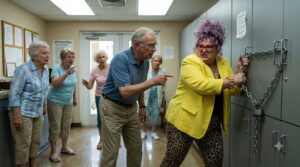
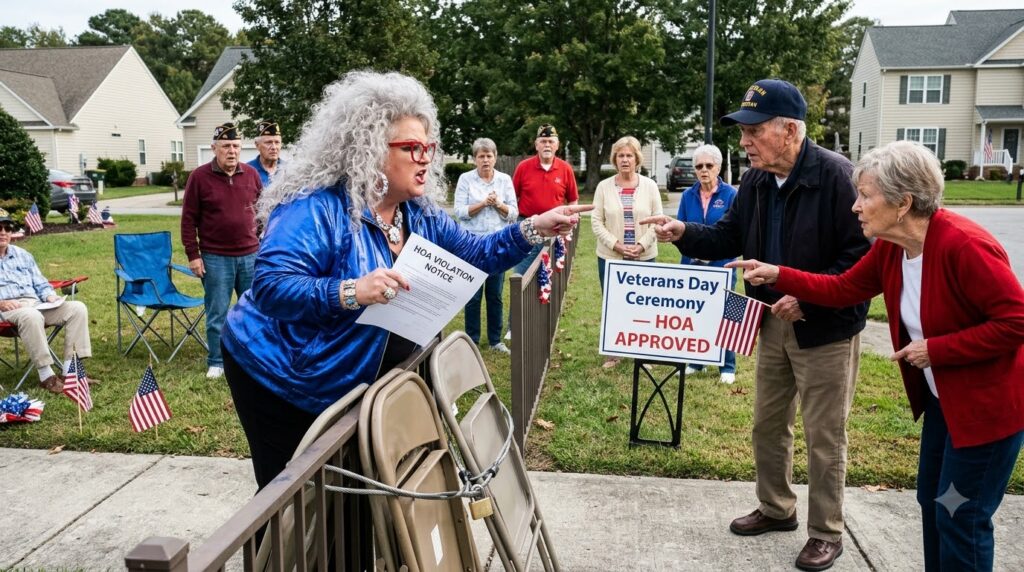
Walter thought about the morning Patricia had dragged three chairs across the pavement.
He remembered the scraping metal, the angry shouting, and the cold determination in her face.
At the time, the incident had seemed like an ugly interruption to a peaceful ceremony.
He hadn’t known it would uncover questionable spending, an unauthorized development plan, and years of neglected community oversight.
He hadn’t known how much work would be required to put things right.
But he had learned something.
A community wasn’t protected merely by having rules.
It was protected when the people responsible for those rules remembered whom they were supposed to serve.
That November, one year after the confrontation, Harbor Point held its annual Veterans Day ceremony.
The morning was cool and clear.
Residents arrived carrying small flags.
Children helped arrange programs.
The new chairs were placed in two neat rows beside the memorial bench.
Frank Delaney took the first seat.
Harold Price sat beside him.
Walter arrived with Rebecca and Emily.
He paused near the fence where Patricia had once fastened the steel cable.
There was no cable now.
No padlock.
Only the quiet sound of neighbors greeting one another.
Linda approached with a folded program.
“Ready, Walter?”
He looked toward the flagpole.
Then he smiled.
“Just about.”
He took his seat.
Behind him, families gathered beneath the autumn trees.
Some residents had lived in Harbor Point for thirty years.
Others had moved in only recently.
They came from different backgrounds, held different opinions, and didn’t always agree about how their neighborhood should be managed.
But on that morning, they shared one simple understanding.
The people who had served their country deserved a place of dignity in the community they called home.
As the American flag rose against the pale Virginia sky, Walter held his small flag against his chest.
He thought of Eleanor.
He thought of Daniel Brooks.
He thought of the friends who were no longer there to stand beside him.
Then he looked at the empty chair next to his own.
It was waiting for whoever might need it.
Walter smiled.
For the first time in a long while, that seemed like enough.
The End.