Chapter 4: The Price of Speaking Up
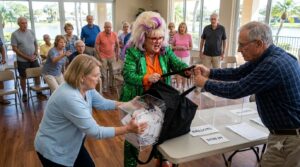
The next HOA board meeting drew the largest crowd Harbor Point Estates had seen in years.
Residents filled the clubhouse chairs, lined the back wall, and stood near the entrance.
Some carried copies of their violation notices.
Others held photographs of the Veterans Day ceremony.
Walter arrived with Linda, Frank, and Thomas Reed.
Rebecca had driven down from Richmond to attend.
She sat beside her father, quietly reviewing the documents they had organized.
Patricia entered fifteen minutes late.
This time she wore a bright magenta coat with enormous gold buttons and a matching scarf.
Her silver curls were piled high above her red glasses.
She moved toward the board table without acknowledging the crowded room.
Douglas Harlan followed several steps behind.
He wore a navy suit and carried a leather portfolio.
The meeting began with routine financial reports.
Patricia attempted to move quickly through the agenda.
Then Thomas requested discussion of the Veterans Day incident.
Patricia’s expression hardened.
She announced that the matter involved an active enforcement dispute and should not be discussed publicly.
Thomas disagreed.
The question, he explained, was not merely Walter’s individual fine.
It concerned the board’s authorization of a community event and the attempted restriction of common-area facilities.
Residents began shifting in their seats.
Rebecca watched her father.
Walter had prepared a statement, but he wasn’t comfortable speaking before a crowd.
He had spent decades following orders and giving practical instructions.
Public confrontation was different.
Still, when Thomas invited him forward, Walter rose.
He walked slowly to the microphone.
His hands were steady.
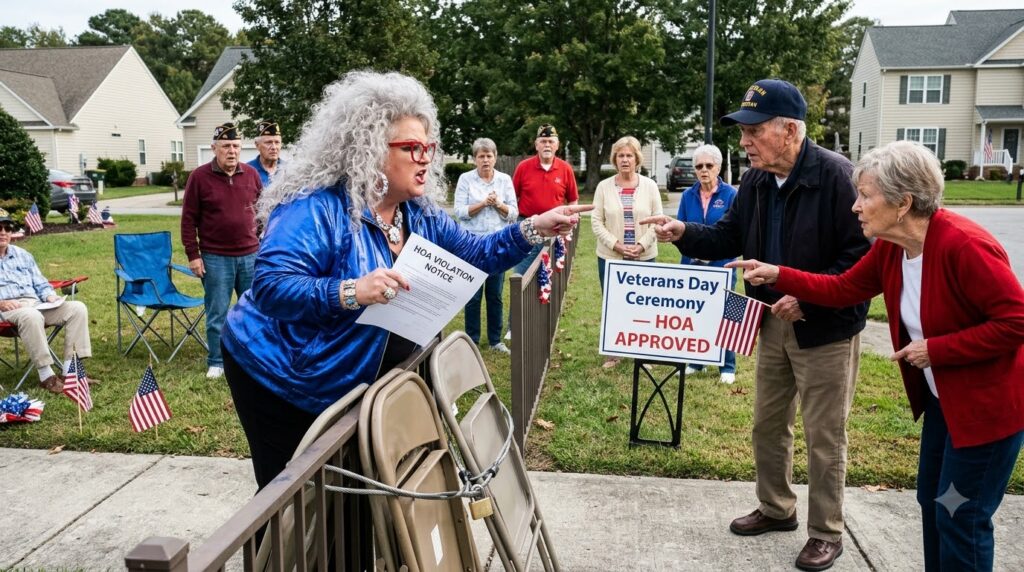
He explained that the ceremony had been approved in writing.
He described the chairs being dragged across the pavement and locked to the fence.
He told the board that several elderly veterans had been expected to use those chairs.
Then he placed the approval notice on the table.
He did not insult Patricia.
He did not raise his voice.
He simply asked why the association had punished residents for attending an authorized event.
Patricia leaned toward her microphone.
Her response was immediate and angry.
She claimed that emergency safety concerns had required her intervention.
She suggested that unsecured folding chairs could create hazards during public gatherings.
Walter listened.
Then Thomas asked why the chairs had been secured to the fence rather than safely stored.
Patricia did not answer directly.
Instead, she accused Walter and Linda of undermining the board’s authority.
The room grew restless.
Douglas Harlan stepped forward.
He offered to explain the proposed redevelopment.
According to Douglas, the private terrace would generate revenue for Harbor Point Estates and reduce future maintenance costs.
The project would also modernize an underused section of the property.
Several residents looked confused.
They had come to discuss locked chairs.
Now they were hearing about a commercial development proposal.
A woman near the back raised her hand.
Her name was Margaret Collins, a seventy-four-year-old retired nurse.
“Underused?” she asked. “My husband sat on that memorial bench every Veterans Day until he died.”
Douglas hesitated.
He began explaining projected financial benefits.
Margaret shook her head.
“That wasn’t my question.”
Patricia struck the table with her palm.
She warned that continued interruptions could result in the meeting being adjourned.
But Thomas remained calm.
He requested that the board review the original project authorization and related expenditures.
Patricia refused to produce the documents that evening.
She said they were confidential negotiating materials.
Then she announced that the meeting was over.
The residents didn’t leave immediately.
Small groups gathered near the entrance.
Walter heard anger, confusion, and disappointment.
But he also heard something encouraging.
People were asking questions.
For years, many had treated HOA meetings as unpleasant obligations best avoided.
Now they wanted to know how their money was being spent and what was happening to their common property.
Two days later, Walter received another letter.
His original fine remained in place.
A second $150 penalty had been added for what the notice described as continued noncompliance.
The association also warned that unpaid assessments and fines could trigger further collection procedures under its governing documents and applicable law.
Rebecca read the letter at Walter’s kitchen table.
“This is retaliation,” she said.
Walter wasn’t ready to make that legal conclusion.
But the timing was difficult to ignore.
He had challenged the board publicly.
Now the penalties were increasing.
The following week, Linda received a notice questioning her eligibility to organize future community events.
Frank was warned about leaving personal property near common areas, even though his folding chair had been removed immediately after the ceremony.
Margaret received a landscaping citation for flowerpots that had stood on her porch for eleven years.
The pattern became impossible to overlook.
Residents who had spoken against Patricia were suddenly receiving enforcement letters.
Others began avoiding the clubhouse.
A few privately advised Walter to stop fighting.
They worried that legal expenses would increase everyone’s HOA fees.
Walter understood their fear.
He had lived long enough to know that standing up for a principle could carry a real cost.
One evening, he sat alone on his back porch.
The wind smelled of salt water.
Eleanor’s garden had gone dormant for winter.
He wondered whether he was asking too much of his neighbors.
Then his phone rang.
It was Thomas.
His voice sounded strained.
“I found something in the financial records.”
Walter sat upright.
“What?”
“The consultant’s invoice was paid.”
Walter waited.
Thomas continued.
“And there’s another payment. Much larger.”
The second payment had been recorded under a maintenance improvement account.
It was for $42,000.
The recipient was a company Thomas had never heard of.
Harbor Shore Project Services LLC.
Thomas had checked the public business registration.
Douglas Harlan was listed as its manager.
Walter stared into the darkness beyond his porch.
The chairs had been only three pieces of metal furniture.
But the money involved was becoming very real.