Chapter 6: The Agreement Behind Closed Doors
The turning point came from Raymond Ellis.
For nearly two weeks, the HOA treasurer had avoided calls from Thomas, Linda, and several concerned residents.
Then, on a rainy Thursday afternoon, Raymond appeared at Walter’s front door.
He wore a gray windbreaker and carried a large manila envelope.
His face looked exhausted.
Walter invited him inside.
Raymond refused coffee.
He sat at the dining table and placed the envelope between them.
“I should have come sooner,” he said.
Walter waited.
Raymond explained that Patricia had approached him in late summer with a proposal she described as financially urgent.
According to her, Harbor Point Estates faced significant future maintenance costs.
A private hospitality operator was interested in leasing part of the common area.
The arrangement, she claimed, would generate income without requiring residents to pay a special assessment.
Raymond had been skeptical.
But Patricia presented financial projections and repeatedly insisted that the board had already agreed in principle.
She also claimed the association’s attorney had reviewed the arrangement.
Raymond had not independently verified that statement.
When Patricia asked him to approve the consulting payments, she described them as necessary preliminary expenses.
He authorized them.
Now he regretted it.
Walter opened the envelope.
Inside were copies of invoices, email exchanges, and a draft lease agreement.
The proposed tenant was Chesapeake Leisure Partners, a small hospitality company associated with Douglas Harlan.
The agreement contemplated a fifteen-year lease of the memorial lawn and adjacent paved area.
It also granted the tenant rights to install outdoor dining facilities and restrict public access during operating hours.
Walter read that section twice.
The place where residents gathered to honor their dead could become an area they needed a business’s permission to enter.
The proposed annual rent appeared modest compared with the development costs described in the documents.
Several projected benefits depended on assumptions that had not been independently verified.
Most importantly, the agreement had not received the formal approvals that Caroline believed might be required.
Raymond pointed to a signature page.
Patricia had signed a preliminary authorization letter identifying herself as president of the association.
But she was not president.
She was a board member who chaired the property standards committee.
The actual president, Martin Caldwell, had been recovering from surgery and had missed several meetings.
Patricia had taken advantage of his absence to present herself as the person directing association business.
Raymond admitted that he had gone along with it.
“She kept saying there wasn’t time to wait.”
Walter looked at him.
“Why?”
Raymond swallowed.
“Because the developer wanted the site cleared before the end of November.”
The Veterans Day ceremony had been an obstacle.
A public gathering would draw attention to the lawn just as Patricia wanted to demonstrate that it was ready for redevelopment.
Raymond believed she had intended to create a record of alleged unauthorized use, then cite enforcement problems as justification for restricting access.
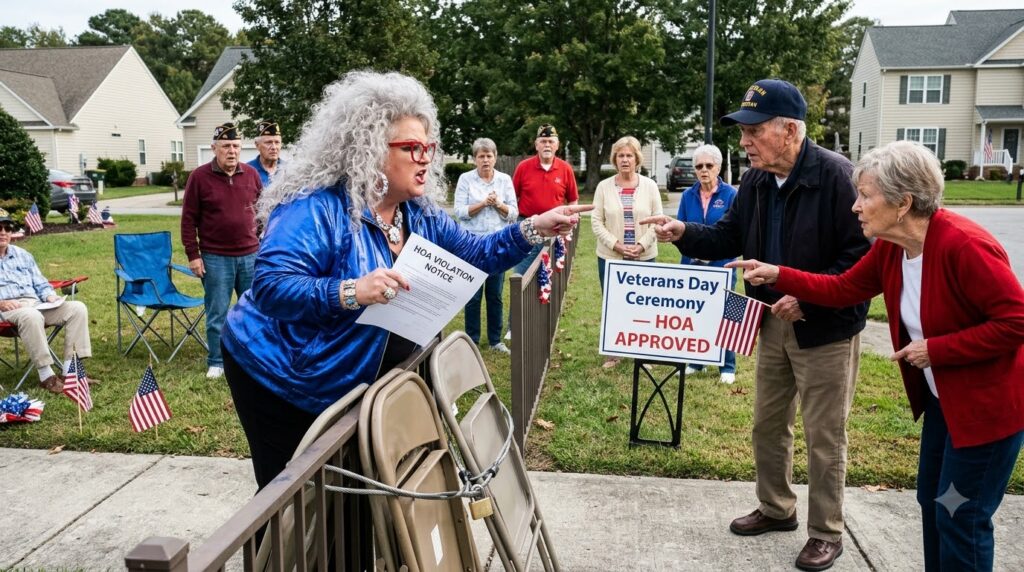
The locked chairs were not part of any formal board-approved plan.
They were Patricia’s own attempt to make the area unusable.
Walter sat quietly.
The explanation made the incident more disturbing, not less.
A day intended to honor service had been treated as an inconvenience to a commercial schedule.
Raymond then revealed another detail.
Patricia had asked the management company to prepare a resident announcement describing the redevelopment as already approved.
The announcement was scheduled for distribution after the agreement’s proposed effective date.
Residents would have been informed after the critical decisions appeared to have been made.
Walter thanked Raymond for bringing the records.
But he did not promise that the matter would disappear.
Raymond understood.
He said he was willing to cooperate with an independent review and explain his actions to the full board.
That evening, Rebecca scanned the documents and forwarded them to Caroline.
The attorney reviewed them the following morning.
Her response was measured but serious.
The draft agreement raised substantial concerns about authorization, governance, and the association’s financial obligations.
She advised that the board should immediately suspend further action until the documents could be properly reviewed.
Thomas contacted President Martin Caldwell.
Martin was seventy-three, a retired civil engineer.
He had recently returned home after knee surgery.
When he learned what had happened, he requested an emergency board meeting.
Patricia objected.
She argued that the matter was already too advanced to reconsider.
Martin refused to accept that explanation.
As president, he insisted that the board receive all relevant records.
Douglas Harlan was notified that no additional site work should proceed without proper authorization.
The management company was instructed to preserve financial and communication records.
For the first time, Patricia’s control over the process began to weaken.
But the dispute had already damaged the community.
Neighbors who once exchanged holiday cards were now arguing over property values and legal expenses.
Some believed the redevelopment could still provide needed revenue.
Others feared that the association had been manipulated into an expensive arrangement.
Walter understood both concerns.
He didn’t oppose every improvement.
He opposed making decisions in secret and punishing people who asked questions.
At the emergency meeting, Martin reviewed the records.
He then asked Patricia whether she had represented the redevelopment as fully approved.
Patricia insisted that she had acted in the association’s best interests.
Martin asked for the board resolution authorizing the agreement.
She could not produce one.
He asked for the legal opinion she had claimed to possess.
She said it was still being finalized.
He asked why the veterans’ chairs had been locked.
Patricia responded with another explanation about safety.
Martin placed the ceremony approval on the table.
Then he placed the proposed redevelopment schedule beside it.
The dates told their own story.
The room became very quiet.
By the end of the meeting, the board had voted to suspend the project, order an independent financial review, and place all disputed enforcement actions on hold pending examination.
Patricia voted against every motion.
She left before the meeting adjourned.
Walter watched her walk through the clubhouse doors.
He felt no triumph.
The community still had a long way to go.
But for the first time since Veterans Day, the rules were being applied to the people who enforced them.