Chapter 3: A Neighborhood Built on Promises
Harbor Point Estates had never been a wealthy community.
It was a collection of modest coastal homes built in stages during the late 1980s and early 1990s, when the land beyond the highway was still mostly marsh grass and pine trees.
Many original residents had been teachers, mechanics, nurses, shipyard workers, and retired military personnel.
They weren’t people who expected luxury.
They wanted quiet streets, reasonable fees, and neighbors who looked after one another.
Walter and Eleanor had purchased their home in 1994.
Their daughter Rebecca had just started college, and the house represented a new chapter after years of moving between Navy assignments.
Eleanor loved the view of the water.
Walter loved the small garage where he could repair old radios and build wooden birdhouses.
The community lawn had become important almost by accident.
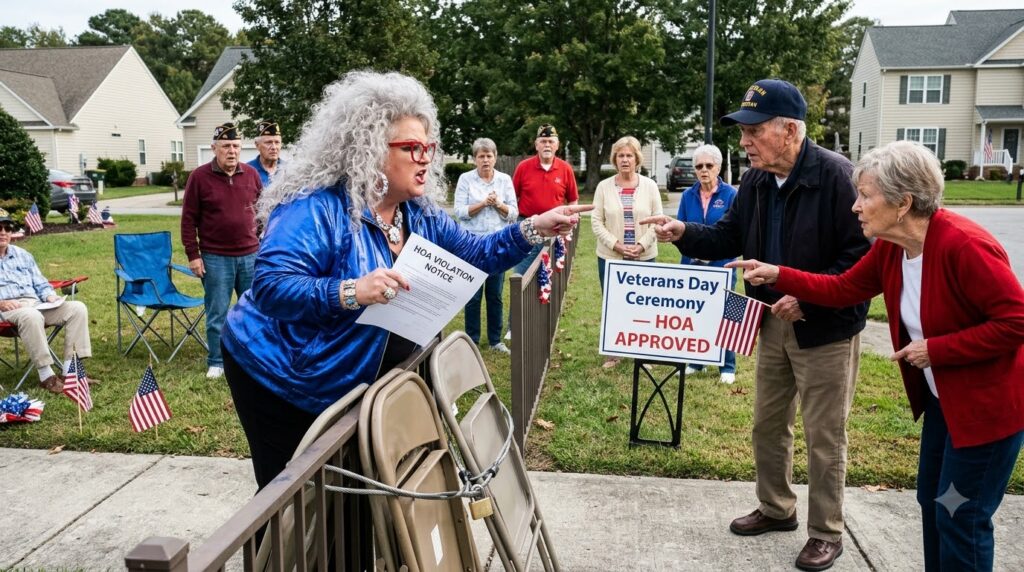
In 1998, several residents had proposed installing a flagpole and memorial bench to honor veterans who lived in Harbor Point.
Residents donated money.
A local carpenter built the bench.
The association approved the project.
And on Veterans Day that year, forty-three people gathered for the first ceremony.
Walter had helped raise the flag.
Eleanor had baked two trays of cinnamon rolls.
Over the years, the gathering became a tradition.
Some veterans passed away.
Others moved closer to their children.
New residents joined.
The ceremony remained small, but it mattered.
For Walter, it was one of the few places where he could speak about old friends without feeling that he was burdening someone.
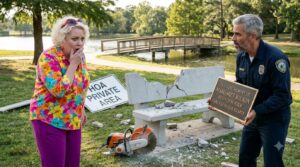
The bench carried a bronze plaque.
IN HONOR OF THOSE WHO SERVED, AND IN MEMORY OF THOSE WHO NEVER CAME HOME.
The plaque had been purchased through private donations.
Eleanor had helped collect them.
Now, sitting in his living room with Linda and Frank Delaney, Walter wondered how a place built through so many small acts of generosity could suddenly be treated as unused property.
Frank examined the proposed redevelopment drawing.
His hands were swollen from arthritis, and he held the paper carefully.
“They’re calling this an improvement?”
Linda nodded reluctantly.
“That’s what the draft says.”
Frank pointed to the empty space where the memorial bench should have been.
“Improvement for whom?”
Nobody answered.
Walter decided they needed more information before making accusations.
The next morning, he visited Thomas Reed, the association secretary.
Thomas was seventy-one, a retired accountant who had served on the board for six years.
He lived in a tidy brick house near the community entrance.
When Walter arrived, Thomas was sweeping leaves from his driveway.
Walter explained what they had found.
Thomas listened without interrupting.
Then his expression grew troubled.
“I signed the ceremony approval,” he confirmed.
“Did the board ever revoke it?”
“No.”
“Did the board approve a redevelopment agreement?”
Thomas rested the broom against his garage.
“Not that I’m aware of.”
Walter showed him the drawing.
Thomas studied it for a long time.
“I’ve seen an earlier version of this,” he said. “Patricia presented it as a preliminary concept.”
“Was there a vote?”
“No formal vote.”
“Then how could there be an agreement?”
Thomas folded the paper.
“That is an excellent question.”
Inside his house, Thomas opened a filing cabinet and removed several meeting packets.
He had kept paper copies because he didn’t fully trust the association’s online records system.
The minutes from September showed that Patricia had introduced the possibility of leasing part of the common area to a private hospitality operator.
Several board members had expressed concerns.
The matter had been tabled pending a legal review and resident consultation.
The October minutes contained no approval.
Neither did the early November records.
But Thomas remembered an unusual request.
Patricia had asked him to sign a document authorizing her to negotiate on behalf of the association.
He had refused because the board had not approved the underlying proposal.
“She wasn’t happy,” Thomas admitted.
Walter almost smiled.
He could imagine that conversation.
Then Thomas retrieved a second document.
It was a copy of an invoice from Harlan Coastal Development Consulting.
The amount was $18,500.
The description read:
Site planning, stakeholder coordination, and preliminary commercial transition services.
Walter looked at Thomas.
“Did the board approve this expense?”
Thomas shook his head.
“I don’t remember seeing it.”
The invoice had been submitted for payment through the HOA management company’s accounting system.
Thomas had noticed it while reviewing monthly expenses but had not yet received the supporting paperwork he requested.
Now he looked deeply uncomfortable.
“I should have pushed harder.”
Walter didn’t criticize him.
People made mistakes.
The question was what they did after discovering them.
Thomas promised to request the full payment history and any agreements connected to the proposed redevelopment.
He also agreed to help Walter challenge the fine.
But before Walter left, Thomas said something that changed the nature of the situation.
“Patricia told me last month that the memorial lawn was becoming a liability.”
Walter stopped at the doorway.
“A liability?”
“She said older residents were creating accessibility problems and that the association needed to reduce its exposure.”
Walter looked down at his cane.
He rarely used it inside the house, but he carried it on longer walks.
The irony was difficult to ignore.
A lawn created to honor aging veterans was being described as a problem because aging veterans used it.
Walter thanked Thomas and stepped outside.
The afternoon sunlight had begun to fade.
Across the street, an American flag moved gently above a front porch.
He thought about Eleanor, the memorial bench, and the neighbors who had gathered there for nearly three decades.
He had no intention of allowing a private business proposal to erase that history without an honest conversation.
But he still didn’t know how far Patricia had already gone.