
Chapter 8: The Evidence No One Could Explain Away
The federal investigation did not move as quickly as Patricia expected.
There were interviews, document requests, technical assessments, and discussions about the proper charges.
The recovered utility boat had to be inspected.
The cost of repairs had to be documented.
Investigators needed to determine whether the incident involved only property damage or broader interference with government operations.
They also needed to establish intent.
That part proved less difficult.
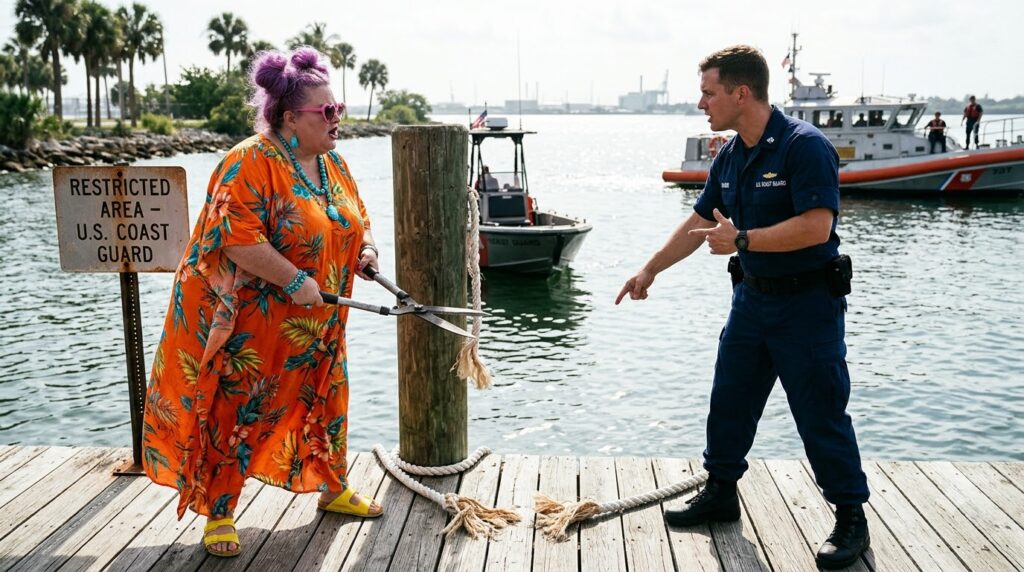
The security footage showed Patricia arriving with the shears.
It showed her examining the mooring post.
It showed her cutting the rope.
And it showed her refusing to acknowledge the danger as the vessel drifted away.
Her own words had been recorded.
The investigators also obtained a series of messages between Patricia and Victor Lang.
Several were ordinary discussions about waterfront property.
Others were more revealing.
Victor had repeatedly encouraged Patricia to create public pressure around the docking dispute.
He had suggested inviting reporters and staging a protest.
Patricia had replied that she intended to make the government move its boat.
Victor had warned her not to damage anything.
That message complicated the question of his responsibility for the rope-cutting.
He had encouraged confrontation, but the available evidence did not establish that he had instructed her to sever the line.
Investigators were careful not to confuse suspicion with proof.
The financial records raised a separate issue.
The HOA’s independent accountant found that Patricia had approved consulting payments without the required board authorization.
Some invoices described services that could not be adequately documented.
The association referred those findings to its attorney.
Victor’s company was asked to provide supporting records.
He eventually produced several research memoranda and correspondence files, but the materials did not fully account for the fees charged.
The HOA demanded repayment of the disputed amounts.
Victor denied wrongdoing.
He argued that he had performed the work Patricia requested.
Patricia, meanwhile, began blaming Victor for the entire situation.
She told her attorney that he had convinced her the waterfront belonged to the HOA.
But her attorney had to confront an uncomfortable distinction.
Even if Patricia genuinely misunderstood the property boundary, she had knowingly cut a rope securing a government vessel.
The act itself was not an accident.
She had brought the shears.
She had used them.
She had watched the boat drift away.
Her attorney explained that claiming confusion about ownership would not erase the physical evidence.
Patricia listened in silence.
Then she asked whether she could still sue the Coast Guard for preventing her from docking.
Her attorney closed his folder.
He advised her to focus on the legal problems already in front of her.
Weeks later, Patricia appeared in federal court after prosecutors filed charges arising from the intentional damage and interference.
The proceedings were serious but orderly.
The government presented the recorded evidence and described the operational disruption.
The defense acknowledged that Patricia had cut the rope but challenged some of the government’s claims about the extent of the resulting damage.
The judge made clear that the court would decide the case on evidence, not public anger.
Patricia had never been in a courtroom as a defendant.
She was accustomed to sitting at the front of HOA meetings, looking down at residents who had to explain themselves.
Now she sat beside her attorney while others examined her conduct.
The reversal was painful.
She could not interrupt witnesses.
She could not threaten fines.
She could not dismiss unfavorable documents as neighborhood gossip.
The courtroom operated under rules that applied to everyone.
For once, her title meant nothing.
Outside the courthouse, reporters waited.
Patricia avoided them.
But Daniel Mercer, who had provided testimony about the incident, was asked whether he wanted to see her punished severely.
He declined to speculate about the sentence.
He said the important issue was that emergency equipment had been put at risk and that the public needed to understand why restricted operational facilities were protected.
His answer disappointed reporters hoping for an angry confrontation.
It also revealed the difference between Daniel and Patricia.
She had treated authority as a way to control other people.
He treated it as a responsibility.
And the consequences of that difference were about to become unmistakable.








