Chapter 1: The Rope That Snapped
The sound was like a gunshot.
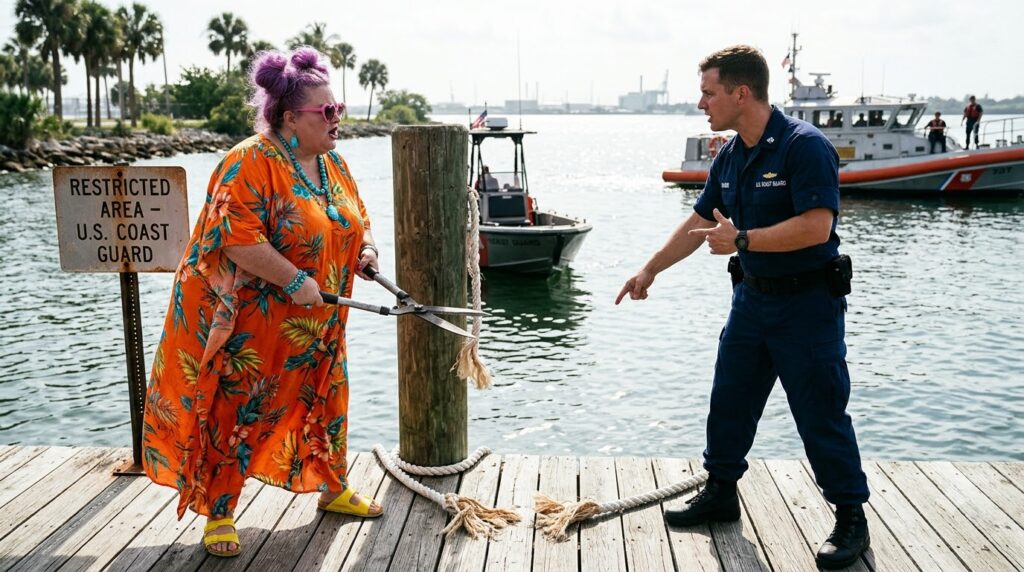
A thick white mooring rope snapped apart under the crushing blades of an enormous pair of steel shears. Frayed fibers flew across the weathered wooden dock, and the small United States Coast Guard utility boat began sliding away from its berth.
Standing beside the severed rope was Patricia “Karen” Whitmore, a 49-year-old Florida homeowner who had spent the better part of three years convincing herself that rules were for other people.
She wore a flowing orange tropical-print caftan, bright yellow sandals, oversized pink heart-shaped sunglasses, and enough turquoise jewelry to announce her arrival before she opened her mouth. Her purple hair was arranged in two enormous messy buns. Her heavy frame occupied most of the narrow dock, and she seemed determined to occupy the rest with her personality.
She had just committed an act that would change her life.
And she looked pleased with herself.
“Your government boat can wait! Mine comes first!”
Petty Officer Daniel Mercer, thirty-two, had been checking equipment near the station building when he heard the rope snap.
He turned and saw the utility boat drifting sideways.
For half a second, he could hardly believe what he was seeing.
The vessel was government property. It carried emergency response equipment, medical supplies, and communications gear. Earlier that morning, its crew had returned from assisting a fishing boat that had lost power several miles offshore.
Now it was moving away from the dock without anyone aboard.
Daniel ran toward the mooring post.
“You cut our line! That boat’s drifting!”
Karen stepped into his path, holding the massive shears across her body.
She pointed toward a brightly decorated civilian party boat waiting beyond the station’s restricted dock area.
Her boat was called Queen of Paradise.
It was thirty feet long, painted white with pink trim, and decorated with artificial tropical flowers. Karen had purchased it six months earlier and had already received three complaints about unauthorized docking.
She believed those complaints were evidence that the government was persecuting her.
Daniel moved around her.
The utility boat had drifted several feet beyond the dock. A light coastal breeze was pushing its bow toward the channel.
Karen kicked the severed rope aside.
She seemed more irritated by Daniel’s urgency than concerned about the loose vessel.
Then a powerful horn sounded across the water.
A larger Coast Guard patrol boat was approaching the station.
Its crew had spotted the drifting utility boat.
Two uniformed sailors pointed toward the unmanned vessel while another moved toward the patrol boat’s stern.
Karen turned at the sound.
For the first time, uncertainty crossed her face.
“Get that boat back! I need this dock!”
Daniel looked at the severed rope, then at the heavy shears in her hands.
He had served in the Coast Guard for eleven years. He had dealt with frightened boaters, angry fishermen, drunken tourists, and people who believed their personal inconvenience justified ignoring maritime safety rules.
But he had never seen someone deliberately cut a government vessel loose because she wanted its parking space.
He reached for his radio.
“Station command, this is Mercer. Unsecured utility vessel drifting from the east dock. Suspected intentional interference. Request immediate assistance.”
The response came quickly.
The approaching patrol boat altered course to intercept the drifting vessel.
Karen folded her arms.
She still appeared convinced that the entire situation would end with someone apologizing to her.
What she did not know was that the station’s security cameras had recorded everything.
And what Daniel did not yet know was that the severed rope was only the beginning of a much larger problem.
Because Karen had not arrived at the dock that afternoon by accident.
She had come with a plan.
And somewhere inside her enormous handbag was a document she believed gave her the authority to carry it out.