
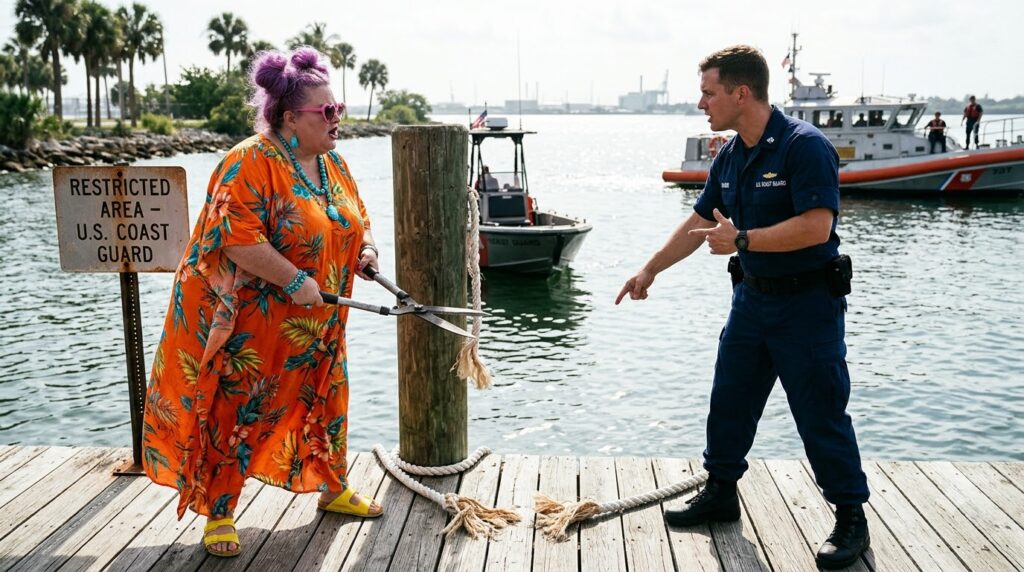
Chapter 2: The Woman Who Believed She Owned the Waterfront
Patricia Whitmore lived in Pelican Point Estates, an expensive waterfront neighborhood on Florida’s Gulf Coast.
Her two-story house had white columns, a screened swimming pool, and a private dock overlooking a narrow inlet.
Her late husband, Robert Whitmore, had purchased the property fifteen years earlier after retiring from a successful marine equipment business.
Robert had been a quiet man.
He believed in paying his bills, keeping his promises, and treating the people who worked on the water with respect.
Patricia had inherited his house, his savings, and his boat.
Unfortunately, she had not inherited his judgment.
Within two years of Robert’s death, Patricia had become president of the Pelican Point Homeowners Association.
She won the position largely because nobody else wanted it.
Most residents were retired couples who had moved to Florida for sunshine, fishing, and peaceful afternoons on their porches.
They had little interest in spending their retirement arguing about landscaping violations or mailbox colors.
Patricia saw things differently.
She viewed the HOA presidency as a position of considerable personal authority.
She issued warnings about lawn decorations, complained about children’s bicycles, and demanded that neighbors obtain permission before hosting family gatherings.
She once threatened a seventy-four-year-old widow with a fine because the woman’s American flag was six inches larger than Patricia believed appropriate.
The widow, Eleanor Brooks, had responded by contacting an attorney.
The fine disappeared.
Patricia never forgave her.
Over time, residents learned to avoid Patricia whenever possible.
But her latest obsession was not about lawns or flags.
It was about the waterfront.
Pelican Point Estates bordered a narrow stretch of coastal property near a small Coast Guard station. The government dock occupied a protected section of shoreline where federal vessels could be maintained and deployed.
The location was convenient, sheltered, and close to the main navigation channel.
Patricia wanted it.
More specifically, she wanted exclusive access to the eastern side of the dock for Queen of Paradise.
Her private dock was perfectly functional, but she considered it inconvenient.
At low tide, maneuvering her boat required patience. The Coast Guard dock offered deeper water and easier access.
She had written several letters demanding permission to use it.
Each request had been denied.
The station commander, Lieutenant Commander Rebecca Hayes, had explained that the dock was part of a restricted federal facility.
Civilian recreational vessels could not simply occupy operational berths.
Patricia interpreted the answer as a personal insult.
Then she discovered an old neighborhood development map.
The map, printed nearly twenty years earlier, showed a proposed community waterfront access route near the land that eventually became the Coast Guard station.
Patricia took the map to a local print shop.
She enlarged it, highlighted a section in yellow, and placed it inside a folder labeled:
PELICAN POINT WATERFRONT ACCESS RIGHTS
She began telling neighbors that the federal government had stolen their community’s waterfront.
Most residents dismissed the claim.
One man, however, listened carefully.
His name was Victor Lang.
Victor was a sixty-one-year-old real estate consultant who had recently purchased a vacant lot in Pelican Point.
He had expensive shoes, a polished smile, and a talent for making questionable proposals sound like opportunities.
He told Patricia that waterfront access could dramatically increase property values.
He also suggested that the HOA might be able to negotiate special docking privileges.
Patricia loved the idea.
She began imagining herself presiding over a private marina, with residents paying substantial fees for exclusive access.
Victor encouraged her.
He offered to prepare a proposal.
He even suggested that a dramatic public demonstration might force federal officials to take the HOA seriously.
Patricia took that suggestion much further than he expected.
Three days before the incident, she purchased the oversized steel shears from a commercial marine supply store.
The cashier remembered her because she complained that the tool was not large enough.
On the morning of the confrontation, she placed the shears aboard Queen of Paradise, along with her highlighted map and a handwritten notice declaring that the HOA was reclaiming waterfront access.
Then she headed toward the Coast Guard station.
She believed she was about to make history.
Instead, she was about to create evidence.








