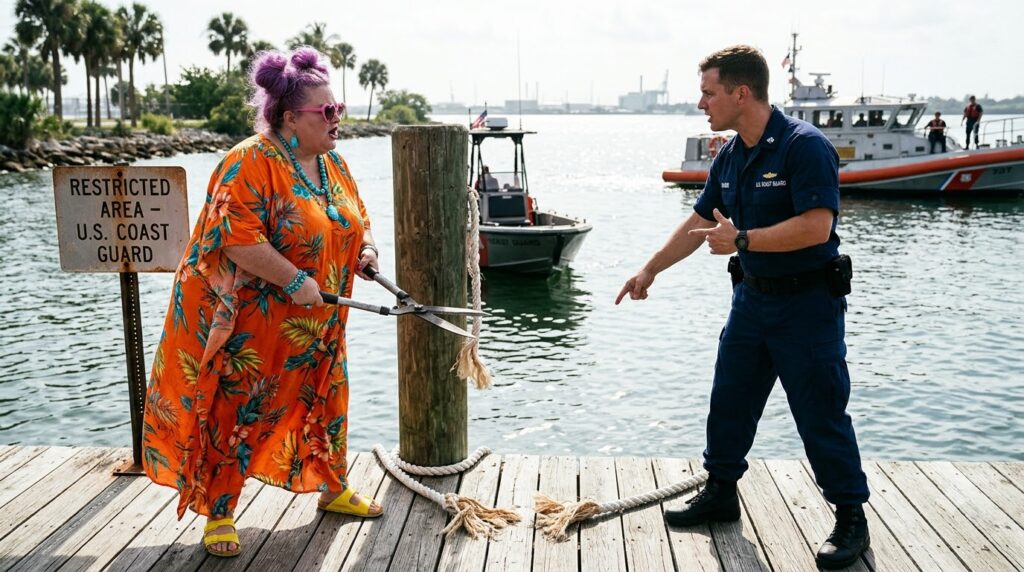
Chapter 5: The Price of One Woman’s Authority
Patricia Whitmore had never enjoyed being questioned.
For years, her position as HOA president had allowed her to control meetings, issue notices, and make residents feel that disagreeing with her would bring unnecessary trouble.
But the morning after the video spread, her phone would not stop ringing.
A local reporter requested an interview.
Two homeowners demanded her resignation.
The association’s insurance representative asked whether she had acted in an official capacity.
Her attorney advised her not to make public statements.
Patricia ignored that advice.
She posted a long message accusing the Coast Guard of occupying community property and describing her actions as a peaceful protest.
The word peaceful attracted particular attention.
Viewers could plainly see the enormous steel shears.
Several residents responded with questions about the HOA’s involvement.
Patricia deleted their comments.
Then she announced that anyone spreading negative information about the board could face fines.
That was the moment Martin Keller decided he had seen enough.
He called an emergency board meeting under the association’s governing procedures.
Patricia attempted to cancel it.
The remaining directors proceeded after confirming that proper notice had been given.
The meeting took place in the neighborhood clubhouse.
Nearly sixty homeowners attended.
Some had not participated in HOA business for years.
Eleanor sat near the front, carrying a notebook.
She was not interested in humiliating Patricia.
She wanted answers.
Martin opened the meeting by reviewing the association’s financial records.
He explained the payments to Gulf Horizon Development Advisors.
He described the absence of board approval.
Then he displayed copies of the invoices.
The room became quiet.
One resident asked whether the money came from regular dues.
Martin confirmed that it did.
Another asked whether the board had authorized Patricia to negotiate for a marina.
No one could produce such authorization.
Patricia arrived twenty minutes late.
She entered wearing a bright green dress, enormous gold earrings, and the same pink sunglasses from the dock incident.
Her purple hair was still arranged in two buns.
She walked directly to the front.
She accused Martin of organizing a conspiracy.
She claimed the homeowners were too shortsighted to understand her vision.
Then she announced that Victor Lang would explain everything.
Victor stood near the back of the room.
Until that moment, he had been watching quietly.
He was not prepared to become the center of attention.
When Martin asked about the consulting payments, Victor described them as legitimate research expenses.
He said Patricia had authorized the work.
Martin asked whether Victor had received formal board approval.
Victor hesitated.
Then he said he had relied on Patricia’s representation that she possessed the necessary authority.
The answer did not satisfy anyone.
Eleanor asked whether Victor had ever told Patricia that the old development map granted access to the Coast Guard dock.
Victor denied making any definitive legal claim.
Patricia turned toward him.
Her expression changed.
She had expected him to defend her.
Instead, he was distancing himself.
She pulled a folded letter from her handbag.
It carried the Gulf Horizon letterhead.
The document described the possibility of asserting historical waterfront access rights and suggested that a public demonstration could draw attention to the issue.
Victor immediately objected to the way she characterized it.
The room erupted.
Martin called for order.
He then introduced a motion to suspend Patricia from exercising board authority pending a formal review, as permitted by the association’s governing documents, and to begin the process of removing her from the presidency.
The directors voted.
Patricia lost her authority to act for the board.
The room remained silent for several seconds.
She stared at the result.
For the first time in years, she could not end a disagreement by threatening someone with an HOA violation.
She gathered her papers and left.
But the most damaging discovery came after the meeting.
A homeowner approached Martin with an email Patricia had sent three weeks earlier.
It contained a proposed marina layout.
The drawing showed private boat slips extending toward the Coast Guard station.
And one of the proposed slips was marked:
P. WHITMORE — RESERVED
The project she had described as a community benefit had included a special privilege for herself.
That was not the only surprise.
Victor’s company had been negotiating with a private investor interested in developing a commercial marina nearby.
The investor’s proposal depended on securing waterfront access.
The federal dock was central to the plan.
Patricia had been promised prestige and a private berth.
Victor stood to gain something far more valuable.