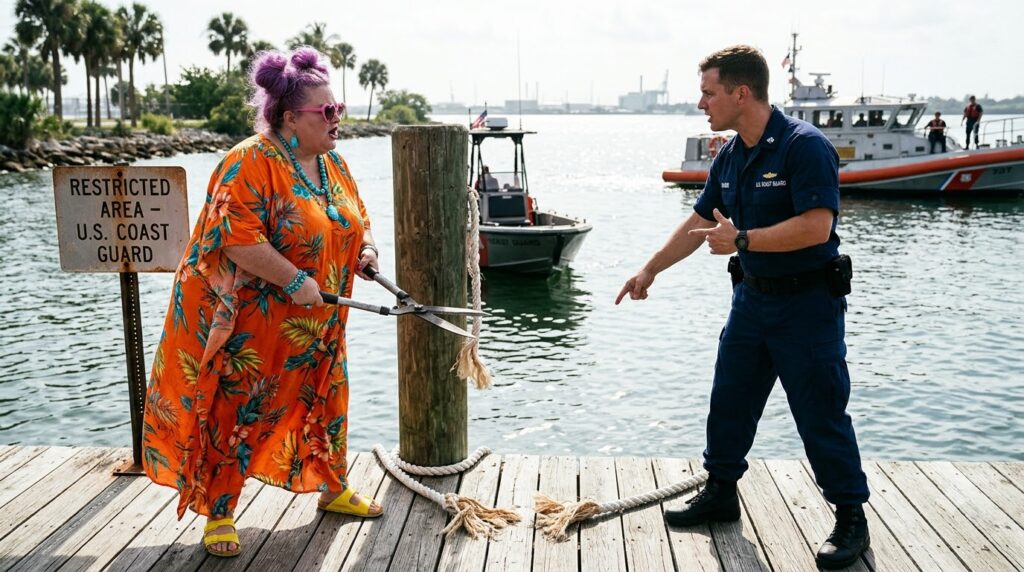
Chapter 7: The People She Never Noticed
The vessel in trouble was not Queen of Paradise.
It belonged to a retired schoolteacher named Harold Simmons.
Harold was seventy-eight and lived alone after losing his wife four years earlier.
He had owned his small fishing boat for nearly three decades.
It was not expensive.
It was not impressive.
But it carried memories of weekend trips with his wife, afternoons teaching his grandchildren to fish, and quiet mornings when the world seemed less complicated.
As the storm intensified, one of the boat’s securing lines failed.
The vessel shifted against its dock.
Water began entering through a damaged fitting.
Harold attempted to secure it himself.
That decision nearly cost him his life.
He slipped on the wet boards and fell into the water.
His neighbor heard him shouting.
The neighbor called emergency services.
Coast Guard personnel and local responders coordinated the rescue.
By the time help arrived, Harold was struggling to hold onto a dock ladder.
The current was stronger than he expected.
His hands were losing their grip.
Daniel was among the responders.
Working with the rescue team, he helped bring Harold to safety.
The older man was cold, exhausted, and shaken.
But he was alive.
Later, wrapped in a blanket while paramedics examined him, Harold repeatedly thanked the crew.
Daniel told him that helping people was the job.
Harold shook his head.
He had spent thirty-five years teaching elementary school.
He knew the difference between doing a job and caring about the people who depended on you.
The rescue became a quiet story around Pelican Point.
There was no dramatic television interview.
No one demanded recognition.
Neighbors brought Harold food, helped inspect his damaged dock, and arranged temporary repairs.
Eleanor visited him the following morning.
She brought homemade chicken soup and stayed long enough to make sure he had someone checking on him.
Harold asked about the Coast Guard boat incident.
He had heard pieces of the story.
Eleanor explained what she knew.
Harold looked toward the water.
He had seen enough storms to understand how quickly a routine afternoon could become an emergency.
“People don’t appreciate a lifeboat until they’re the ones in the water,” he said.
Eleanor remembered those words.
Meanwhile, Patricia’s own boat had suffered substantial damage.
The decorative canopy was destroyed.
A railing had bent.
Water had entered part of the cabin.
She called her insurance company and demanded immediate assistance.
The representative explained that an adjuster would inspect the damage when conditions allowed.
Patricia threatened to file a complaint.
The representative remained polite.
Then came a question she had not anticipated.
Had the boat been secured in accordance with the policy’s requirements?
Patricia insisted that it had.
But the maintenance worker had documented the condition of the vessel before leaving.
His photographs showed unsecured decorative equipment and the damaged canopy support.
The insurance company would need to review the circumstances.
Patricia ended the call furious.
For the first time, she began to understand that her demands could not automatically change the facts.
That afternoon, she drove past the Coast Guard station.
The restricted entrance was closed.
A sign warned against unauthorized access.
She slowed her car.
Through the fence, she saw personnel cleaning equipment and preparing for another patrol.
She recognized Daniel Mercer.
He was helping a younger crew member carry supplies.
He looked tired.
There was no triumph in his face.
No satisfaction at her embarrassment.
He was simply working.
Patricia felt an unfamiliar discomfort.
She had spent days describing him as an arrogant government employee.
But the man she had insulted had been out rescuing people while she argued about her damaged party boat.
She drove away before anyone noticed her.
That evening, an investigator contacted her attorney.
The inquiry into the dock incident was advancing.
Investigators had obtained the security footage, the witness video, the consulting documents, and the HOA financial records.
They also wanted to discuss her communications with Victor Lang.
Patricia had believed the matter was about one rope.
It was becoming clear that the rope had exposed much more.