
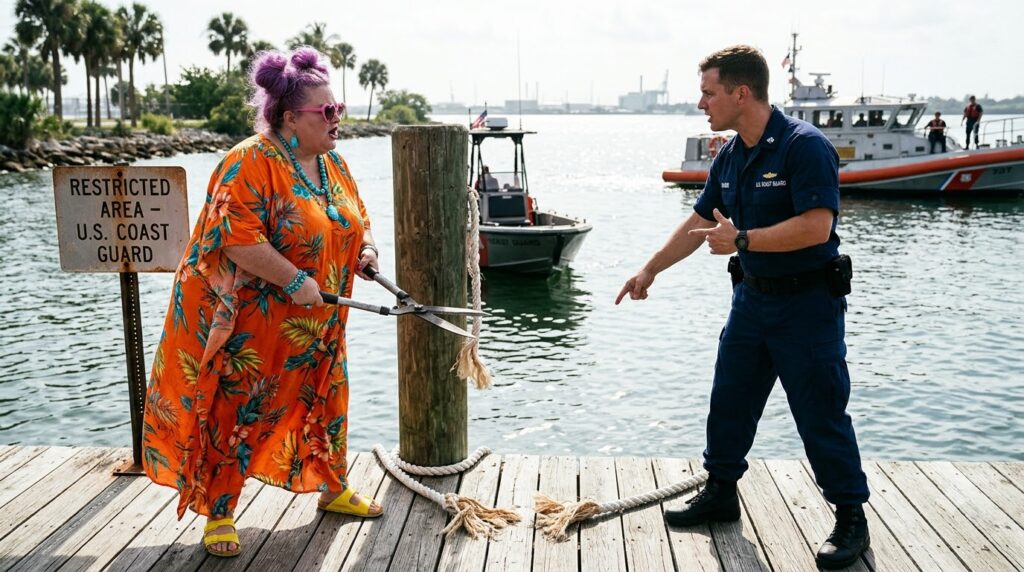
Chapter 10: The Dock Belongs to Duty
Six months later, the Coast Guard station looked much as it had before the incident.
The weathered dock had been repaired.
The damaged utility boat was back in service.
Fresh mooring lines secured the vessels to their berths.
The restricted-area signs remained clearly visible.
The water moved gently against the pilings.
On a bright Saturday morning, the station hosted a community safety event at a designated public access area.
Families attended demonstrations about life jackets, boating safety, emergency communications, and the importance of preparing for sudden weather changes.
Retired boat owners shared stories with younger families.
Children examined rescue equipment under the supervision of crew members.
Daniel Mercer helped demonstrate how quickly conditions could change on the water.
He spoke about preparation, responsibility, and the importance of following safety instructions.
He did not mention Patricia.
He did not need to.
The lessons were larger than one person’s misconduct.
Eleanor Brooks attended with several neighbors.
Harold Simmons was there too.
He had recovered from his fall during the storm and was walking with a cane while his dock underwent repairs.
He approached Daniel and shook his hand.
His grandson had made a small thank-you card for the rescue crew.
Daniel accepted it with a smile.
The card showed a bright orange rescue boat beneath a blue sky.
Across the top, in uneven handwriting, were the words:
THANK YOU FOR HELPING MY GRANDPA.
Daniel looked at the drawing for a long moment.
He had received commendations during his career.
He had worn medals on formal occasions.
But simple gestures like this meant something different.
They reminded him that the work was personal.
Behind every emergency call was someone’s father, mother, husband, wife, child, or friend.
That was why the boats mattered.
That was why the docks mattered.
And that was why no one had the right to endanger them for personal convenience.
Across town, Patricia was beginning her court-ordered community service.
Her assignment involved assisting a nonprofit organization that supported older residents with household needs.
At first, she resented the work.
She disliked being given instructions.
She disliked performing tasks without recognition.
She especially disliked that nobody cared she had once been president of a homeowners association.
But the work gradually exposed her to people she had spent years overlooking.
She met widows who struggled to maintain their homes.
She met retired veterans living on fixed incomes.
She met elderly couples who needed help carrying groceries or arranging transportation to medical appointments.
Most did not know her history.
They treated her as another volunteer.
Some thanked her warmly.
Others were too tired or distracted to say much.
She learned to continue working anyway.
One afternoon, she helped deliver groceries to an eighty-year-old woman who lived alone.
The woman’s house was modest.
Her porch needed painting.
A small American flag hung beside the front door.
Patricia noticed that the flag was larger than the size she once permitted under her HOA’s preferred guidelines.
For a brief moment, an old complaint formed in her mind.
Then she remembered Eleanor Brooks.
She remembered the widow who had fought to keep her flag.
Patricia carried the groceries inside without saying anything.
The woman thanked her and offered a glass of iced tea.
Patricia accepted.
They sat together for fifteen minutes, talking about Florida summers, grandchildren, and the difficulties of growing older.
Nobody argued.
Nobody issued a warning.
Nobody demanded authority.
It was one of the most peaceful conversations Patricia had experienced in years.
Her transformation was not sudden.
She still became impatient.
She still struggled with criticism.
And she still occasionally caught herself wanting to control situations that were none of her business.
But she was learning that respect could not be demanded through intimidation.
It had to be earned through conduct.
Back in Pelican Point, the HOA held its annual meeting.
The agenda was ordinary.
Residents discussed landscaping expenses, storm preparation, dock maintenance, and the neighborhood’s reserve fund.
Martin Keller presented the financial report.
Eleanor asked several questions.
The board answered them.
A few disagreements arose, but the meeting remained civil.
At the end, Martin announced that the association had completed its financial reforms and resolved the remaining consulting dispute.
There was no applause at first.
Then a few residents began clapping.
Others joined.
It was not a celebration of Patricia’s downfall.
It was relief.
The neighborhood finally belonged to the people who lived there.
Not to the loudest person in the room.
Not to whoever held a title.
And not to anyone who believed that ownership or money gave them the right to disregard others.
That evening, Eleanor sat on her porch overlooking the water.
The sun was setting behind the palms.
A Coast Guard vessel passed in the distance, its running lights beginning to glow.
Eleanor thought about her late husband.
He had often said that freedom and responsibility were inseparable.
People had the right to enjoy their homes, their property, and their communities.
But those rights came with obligations to neighbors and strangers alike.
She watched the vessel continue toward open water.
Somewhere beyond the horizon, someone might need help before morning.
And if that call came, the Coast Guard crew would answer.
They would not ask whether the person in danger was wealthy.
They would not ask whether that person was important.
They would not ask whether the person had been polite.
They would simply go.
Months earlier, Patricia Whitmore had stood on a government dock with enormous steel shears, convinced that her personal wishes mattered more than everyone else’s safety.
She had cut a rope because she wanted a parking space.
She had believed that power meant getting her way.
Instead, she had discovered something she could not buy, threaten, or command.
Real authority is measured not by how many people you can control, but by how faithfully you serve the people who depend on you.
And sometimes, the smallest act of selfishness can reveal the greatest difference between those who demand respect and those who have truly earned it.
THE END








