CHAPTER 8: THE SILENT GEOMETRY
The emergency lockout signal from the water authority didn’t arrive as a loud siren; it was a sudden, violent drop in the subterranean line pressure that made the entire ditch shutter. The roaring hiss of the burst pipe died down to a low, hollow gurgle. In the abrupt stillness, the heavy mid-afternoon heat flattened out across the shared lot line, thick with the chemical stench of old mud, wet iron oxide, and the bitter dust of pulverized concrete.
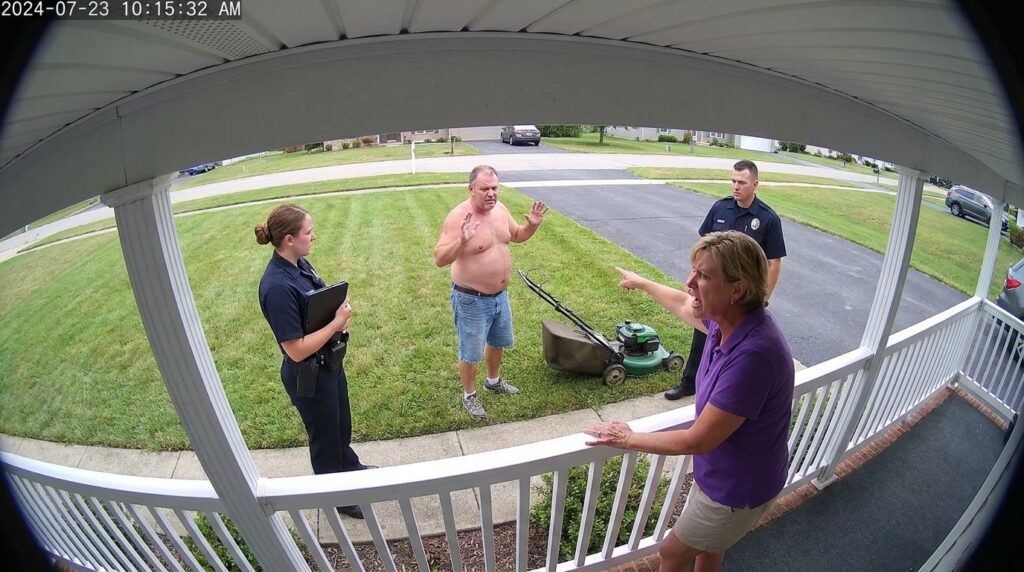
I stood completely still on the solid tarmac of my driveway. The three-inch margin of grass I had spent five years cutting was gone, replaced by a raw, jagged gap of wet gray limestone clay that marked the absolute edge of my deeded property. My old green lawn mower sat secure on its narrow island of remaining turf, its steel deck covered in a pale frost of limestone grit, completely untouched by the slide. In my palms, the residual itch of the engine’s long labor had finally faded, leaving my fingers feeling cold, detached, and remarkably steady.
Across the broken trench, the white vinyl fence line was entirely ruined. Three complete panels lay flat in the mud, their plastic rails shattered into sharp, hollow spikes that pointed toward the upper slope. Behind them, the massive stone segments of her private retaining wall had shifted forward another six inches, the entire structural terracing locked in a frozen, jagged tilt where the internal steel tie-backs had snapped. The lawn she had weaponized to enforce her arbitrary neighborhood rule had turned inside out, exposing the cheap, unpermitted shortcuts her family had used for decades to overreach the common easement.
The woman didn’t move from the second step of her porch walk. Her hands were lowered now, her fingers lightly tapping against the seams of her khaki shorts as if she were trying to locate the lost rhythm of her yellow plastic folder. Her face was entirely bare without her sunglasses, her eyes tracking the slow, steady drip of milky lime runoff as it leaked from the cracked base of her stone wall and pooled in the bottom of the public trench. She looked up at the black dome of her security camera, but the red indicator light was dead—the automated code enforcement lockout had severed the remote feed, leaving the unblinking glass lens completely dark under the heavy roof eave.
The mediating officer adjusted her grip on her field tablet, the screen flaring with a short, bright sequence of green checkmarks as the municipal system finalized the emergency incident report. She didn’t offer a glance toward the porch; her movements remained strictly transactional, the execution of institutional logic that recognized no personal status or neighborhood standing.
“The digital log is closed,” the mediating officer said, her flat midwestern voice cutting through the humid air with the precision of a ledger entry. “The engineering unit has already dispatched a vacuum excavator to stabilize the lower boundary vault. Mr. Vance, your utility access is cleared on the county plat.”
“I’ll have the deck cleaned off by five,” I said. My voice sounded thin against the massive silence of the street, but it was solid. I didn’t step toward her side of the line. I didn’t need to.
The woman didn’t answer. Her posture seemed to shrink back into the narrow shadow of her porch pillar, her white sneakers caked with the same sulfurous black mud that had exposed her husband’s illegal bypass line. The performance of her authority had completely dissolved, stripped away by the objective documentation of a ruggedized field screen and an unblinking overhead lens. She didn’t look at the officers as they walked back to their plain navy cruisers, their heavy leather utility belts creaking in unison against the quiet of the suburban cul-de-sac.
The second officer stopped near the rear bumper of his vehicle, his tall form casting a long, dark line across the loose driveway stone. He looked back once at the tilted concrete blocks of her upper terrace, his mouth set in a neutral line before he slid into the driver’s seat and clicked the door shut. The low, heavy rumble of the plain engines filled the corridor between our houses one last time, kicking up a final cloud of fine gray dust that settled slowly over the ruined vinyl rails and the deep, permanent geometry of the true property line.
I reached out and took hold of the black steel handlebar of the mower, my fingers locking around the worn rubber grip with an unyielding, deliberate pressure. The boundary was marked. The edge was sovereign.