CHAPTER 7: THE GRINDING ARCHITECTURE
The underground thump didn’t arrive as a sound; it came as a physical blow against the bottom of my boots. A long, jagged crack tore cleanly through the dry limestone of the driveway, racing up from the lip of the widening sinkhole and splitting the turf parallel to her fence line. The white vinyl posts didn’t just tilt; the third and fourth panels buckled outward with a dry, explosive pop as the top caps sheared off their internal brackets and flew into the brush.
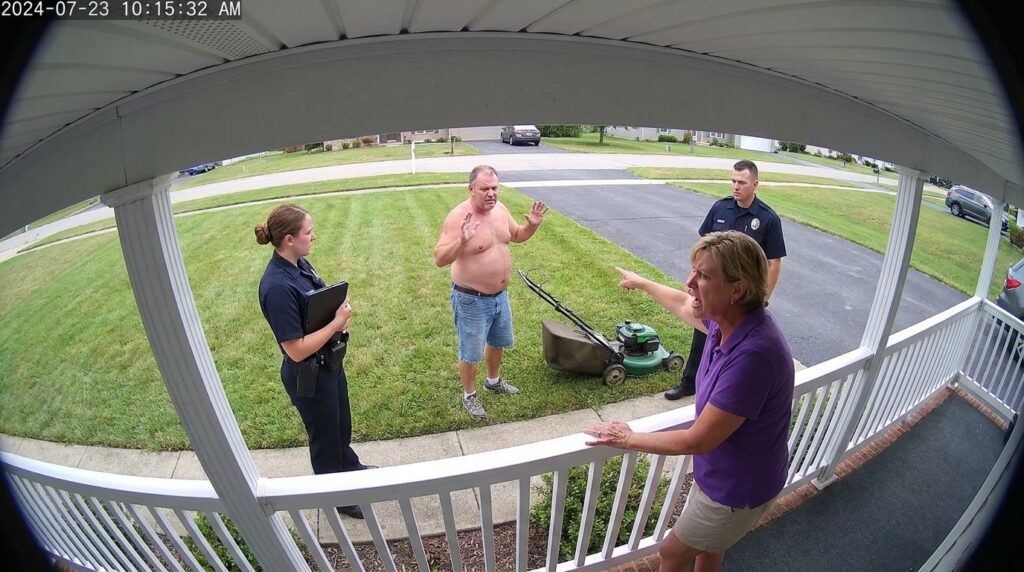
“Get back to the cruisers,” the second officer shouted, his arm sweeping low as he forcefully guided the mediating officer away from the destabilizing edge. His boots slipped on the crumbling stone, grinding the loose gravel into fine white powder. “Ma’am, vacate that porch now. The upper tier is failing.”
She didn’t move toward her door. She stood frozen on the lower step, her hand clamped around the iron handrail tightly enough to rattle the anchor bolts. Her sunglasses had slipped completely off her face, hanging from her left ear and revealing wide, bloodshot eyes that stared blankly at the expanding muddy torrent below. The yellow folder was gone, swallowed entirely by the black silt vortex in the ditch, but the real failure was happening fifty feet behind her house.
The massive concrete blocks of the upper terrace let out a sharp, metallic screech—the sound of steel reinforcement tie-backs snapping under thousands of pounds of saturated lateral weight. A visible wave of dark mud and shifting topsoil broke through the boxwood hedge, carrying her manicured stone paths down toward the lower perimeter. It wasn’t my mower that had triggered this; it was forty years of a hidden, unpermitted bypass line slowly eroding the limestone bedrock until the entire slope lost its foundation.
The mediating officer didn’t lower her field tablet. Even as she retreated toward the rear fender of the squad car, her fingers remained locked to the reinforced casing, her stylus maintaining a frantic cadence against the glass interface. The amber emergency line on her display was flashing rapidly now, synchronized with a remote warning from the county water authority.
“The district main pressure is dropping across the entire sector,” the officer said, her voice dropping into a tight, strained register that lacked any administrative ease. “Mr. Vance, your meter vault is completely submerged. The back-flow preventer is the only thing holding the neighborhood line from siphoning into that trench.”
“The vault won’t hold if her retaining wall hits the culvert,” I said. I retreated three steps, my eyes tracking the wide fissure as it crawled within six inches of my green mower’s wheel deck. The machine sat idle on the narrowing island of solid turf, its metallic shell covered in a fine layer of gray limestone dust. My fingers still ached with the residual rhythm of the engine’s labor, but the space between us was widening too fast to reach for the handlebar.
She looked up from the churning ditch, her gaze sweeping past the officers to lock onto my face. The performance of authority was completely gone, her features tight and hollow under the harsh glare of the summer sun. “You knew about the nineteen eighty-four drainage variance,” she whispered, her voice barely carrying over the grinding sound of the shifting concrete blocks behind her. “You’ve been waiting for the line to split.”
“I didn’t know about the variance,” I said, my voice flat against the humidity. “I just knew how the water smelled when I cut the edges. I knew the line didn’t match the city plats.”
The second officer moved between us, his tall silhouette blocking her view as the earth beneath the fourth vinyl post gave way entirely. The post vanished into the sinkhole with a heavy splash, exposing the raw, unpainted concrete footing that had been poured directly onto the public easement line without a gravel base or drainage wrap—a cheap, illegal shortcut that had remained buried until the water main forced the truth to the surface.
The mediating officer lifted her head from the screen, her eyes fixed on the crumbling border. The blue light from her tablet flared one last time before an automated municipal lockout banner froze the parcel record, transferring the entire file from a civil dispute into a criminal environmental code violation.
“Ma’am,” the officer called out over the steady hiss of the escaping water, her tone carrying the final, unyielding weight of the state system. “The city engineering unit has just issued an emergency condemnation order for the lower terrace at forty-two-twelve. Step away from that structure before the foundation shifts any further.”
The woman’s hand finally dropped from the iron handrail. She didn’t look back at her porch or her blinking security camera; she just stared at the wet, gray clay oozing across her white sneakers as the heavy, rhythmic grinding of the failing hillside continued to pull her entire property line down into the dark, rusted infrastructure below.