CHAPTER 3: THE ESCALATION OF THE FLUID
The wet earth under my heel gave way with a structural sigh. A small fissure opened in the slope, the dark, grease-thick water bubbling to the surface and coating the side of my left sneaker in sulfurous black silt. The metallic groan from beneath the sod vibrated straight through the soles of my shoes—a low, iron-on-iron rasp that sounded like an old pipe flexing under immense internal pressure.
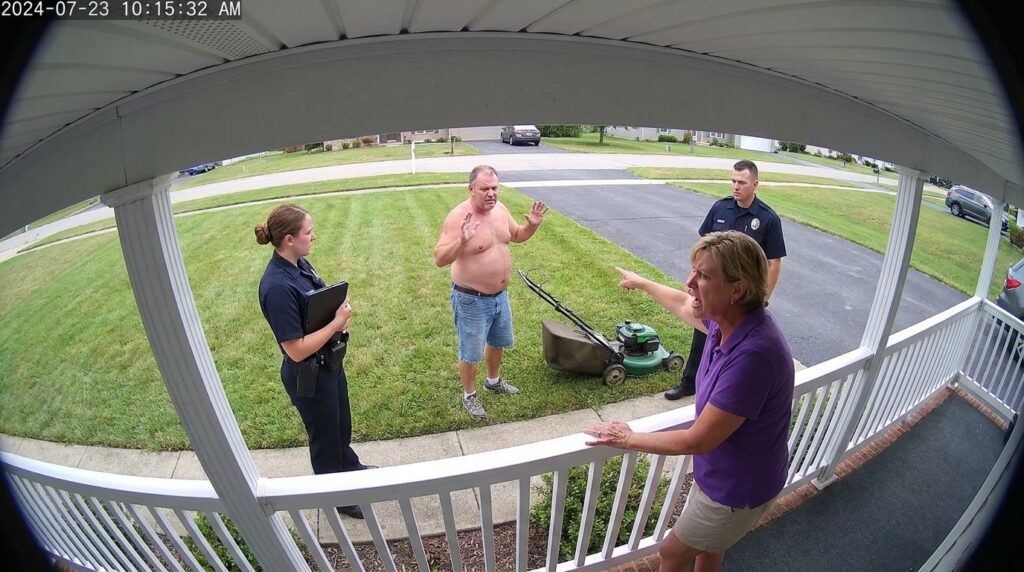
The mediating officer’s hand froze above her ruggedized tablet. Her head snapped toward the ditch, her eyes instantly cataloging the spreading patch of dark moisture. The stylus remained poised like an iron needle over the glass interface. Beside her, the second officer adjusted his stance, his boot heels grinding into the loose driveway limestone as he looked down into the narrow drainage line.
“There’s an unmapped variance here,” the mediating officer murmured. She adjusted the contrast toggle on the edge of her screen, forcing the blue glare to flare brighter across her high collar. “Mr. Vance, how long has that subsurface culvert been leaching?”
“It shouldn’t be leaching at all,” I said. My fingers curled automatically, missing the cold iron steel of the mower’s handlebar. “That’s a dead corrugated line. The municipal outflow was rerouted back in ninety-eight when they put the concrete curbs in down the block.”
“He’s tampering with the lines,” she shouted from behind the vinyl fence line. Her fingers dug into the top white rail, her short blonde hair catching the sharp glare of the midday sun as she leaned forward until her polo shirt strained at the shoulders. “He’s been digging out there at night, Officer. I’ve heard the shovel hitting the rocks. He’s trying to bypass the secondary meter to drain his runoff into my gravel bed.”
The yellow folder in her hand trembled against the vinyl, the thick plastic edges clicking like teeth. She held the water-meter key by its rusted handle, her thumb smudging the fresh mud on the shaft. She wasn’t just defensive; she was frantic, her gaze flicking between the officer’s digital display and the wet, black silt widening around my feet.
The mediating officer didn’t offer a glance toward the fence. She stepped onto the soft slope, her heavy black uniform boots leaving deep, distinct prints in the soggy turf. She squatted down at the margin where my cut grass ended, her gloved fingers reaching down to touch the rim of the exposed metal plate beneath the grass line. Her glove came away stained with a slick, iridescent film of iron oxide and rancid grease.
“This isn’t municipal runoff,” the officer said, her voice dropping into a hard, professional register that indicated a logic shift. She tapped her screen twice, bringing up a complex grid of red and yellow gridlines that overlay the aerial view of our lots. “The county GIS system shows a secondary easement right here. Recorded in nineteen eighty-four. But according to the active grid, this entire drainage culvert is listed as common infrastructure maintained by forty-two-twelve.”
“That’s a legacy filing,” she snapped from the porch line, her voice dropping into a defensive husk. “My late husband cleared that clearance with the board thirty years ago. It’s a closed utility buffer. It has nothing to do with his illegal mowing.”
I watched the way the water pooled. It wasn’t coming from my side of the slope; it was backing up from the dark, overgrown brush behind her fence line, flowing backward against the natural grade of the street. The heavy smell of old iron and wet lime was rising fast now, thick enough to taste in the dry mid-afternoon heat.
“The grade is wrong,” I muttered, pointing down at the small trench the water was carving through the fresh clippings. “Look at the direction of the flow. It’s pushing out from under the concrete footings of her fence.”
The second officer moved closer, his tall shadow falling across the wet grass, blocking out the glare of the sun. He looked down at the fence line where the white vinyl posts met the earth. The soil there was dry on top, but the ground was bulging slightly, the base of the third post tilted three degrees toward my property as if a massive, invisible weight were shoving it from behind from her side of the border.
The mediating officer stood up, her uniform trousers smeared with the gray limestone dust. She held the tablet between her palms, the screen flashing as she refreshed the municipal utility log. Her face remained locked in that flat, institutional neutrality, but her eyes narrowed as she compared the physical curve of the fence with the digital plot on the glass.
“Ma’am,” the officer said, her gaze fixing on the yellow folder still clutched against the woman’s ribs. “I need to see the variance certificate you’re holding in that folder. Right now.”
The woman didn’t move. Her fingers stayed locked around the plastic edges, her knuckles turning a sharp, bloodless white against the yellow surface. Behind her, the quiet suburban street remained empty, but the front door of forty-two-fourteen clicked open an inch, another neighbor’s face appearing behind the dark mesh of a screen door, watching the property line collapse in silence.