CHAPTER 5: THE SEVERED BREADTH
The ground beneath my left heel dropped four inches with a distinct, wet thud. It wasn’t a slow erosion; it was a clean structural failure. A circular plug of sod and limestone gravel slid directly down into the culvert mouth, swallowed by a hollow subterranean throat. The dark, sulfurous slurry that had been pooling around my shoes vanished into the breach, replaced by a sudden, rhythmic suction that gurgled deep beneath the property line.
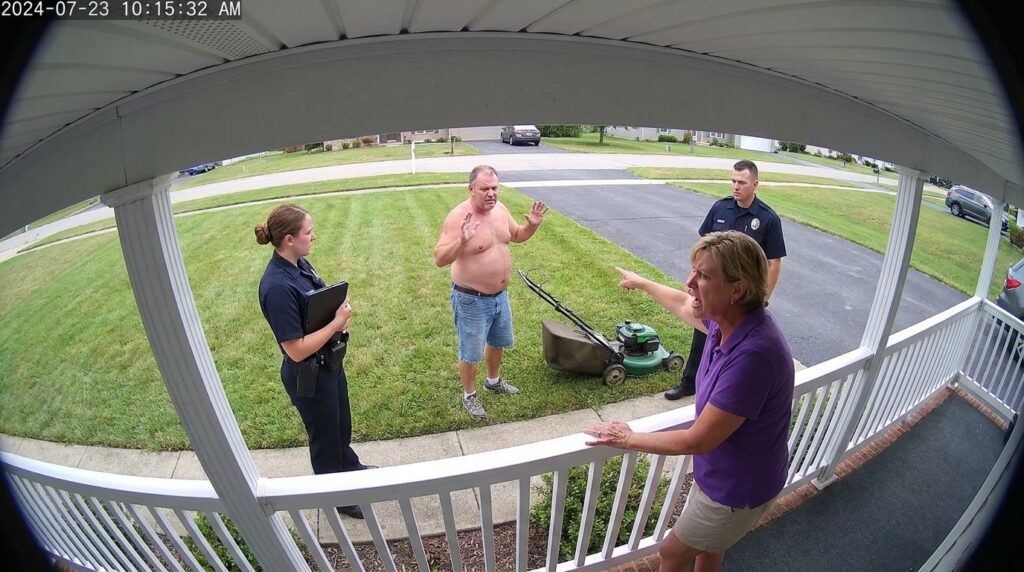
The mediating officer lunged backward, her heavy service boots skittering across the slick grass to find purchase on the solid concrete edge of my driveway. Her ruggedized field tablet clattered hard against her chest rig, the screen flashing an amber warning line as the internal accelerometer logged the sudden shift of the terrain. The second officer went rigid, his boots widening into a defensive platform stance, one gloved hand instinctively dropping to hover an inch over the hard plastic grip of his utility belt.
“Vance, don’t move,” the second officer commanded, his eyes tracking the fresh fissures spiderwebbing out from the sinkhole towards the green deck of my lawn mower.
I stayed frozen, my weight balanced entirely on my right leg, the rubber grips of the mower’s handle just out of reach of my outstretched fingers. Through the newly opened breach in the turf, the rusted crown of an ancient iron pipe stood exposed to the open air. Embedded directly into its corroded rim was a thick, rectangular surveyor’s pin—a solid block of brass oxidized to an aggressive dull green, stamped with the deep, clean tooling numbers: 1984-SYS-B / EASE-4212.
The woman behind the fence let out a short, high-pitched gasp that cut through the low idle of the squad car down by the curb. The yellow plastic folder slipped from her fingers, its stiff spine rattling against the white vinyl rails before dropping face-down into the dry ornamental stones on her side of the border. The water-meter key she had been holding stayed pinned in her palm, her arm extended over the boundary line like a dead branch.
“The line is structurally stable,” she said, though her voice lacked its previous administrative bite, sounding thin and brittle under the heavy glare of the sun. “That’s just a surface washout from his improper grading. My husband had the main pipe lined with reinforced polymer back in ninety-two. It’s on the master plat.”
The mediating officer didn’t offer a word. She knelt at the extreme edge of the solid pavement, her stylus scratching violently against the tablet screen to force an override of the local geological layer. The blue illumination from the display caught the sharp crease of her forehead as a series of county archival maps began to slide across the glass interface in rapid succession.
“The polymer lining isn’t registered on the municipal trunk line, ma’am,” the officer said, her eyes fixed on the shifting data grids. “And that green brass pin down there isn’t a city marker. That’s a private development monument from eighty-four. It marks the inner benchmark of a subterranean drainage vault.”
“It’s a common culvert,” the woman insisted, her body pressing tight against the vinyl rail, her sunglasses sliding down the bridge of her nose as she peered into the hole. “The neighborhood association has the drainage maintenance covenant on file. He’s required to keep his surface cleared so the intake doesn’t back up into my terracing.”
I looked down through the dark gap in the limestone base. The brass pin wasn’t level. It was tilted significantly toward her lot, the thick concrete collar surrounding the pipe cracked into three unequal fragments that were being slowly ground together by a massive, unseen lateral force. The wet gray clay beneath her fence wasn’t just soft; it was actively oozing out from under the vinyl posts, carrying small bits of crushed river stone from her private landscaping into the shared public ditch.
“The whole pipe is shifting,” I said, pointing the toe of my shoe toward the cracked collar. “Look at the alignment of the brass pin. It’s pointing directly at the center of her backyard.”
The second officer stepped closer, his shadow stretching long and dark across the broken earth. He leaned over the fence rail, his gaze following the line of the tilting post up to the higher slope of her property. Fifty feet back, behind the neat rows of her boxwood hedges, the massive concrete blocks of her private tiered retaining wall stood under the high sun, the heavy stone segments showing long, jagged horizontal seams where the mortar had turned to white dust under an immense, structural strain.
The mediating officer stood up slowly, her face locked in an iron expression that signaled the end of a routine dispute. She turned the tablet toward the fence, showing the woman a jagged red line that had just appeared across the GIS coordinate overlay—a line that didn’t match any of the standard property boundaries or neighborhood agreements on file.
“Ma’am,” the officer said, her voice dropping into a flat, legal warning. “Your nineteen eighty-four variance didn’t grant permission to use the common ditch. It allowed your husband to bury a private bypass line under it. And according to this live sensor log from the water district main, that line has just split wide open.”
The woman’s hand finally dropped from the vinyl rail. The water-meter key slid from her fingers, landing with a dull, heavy clink against the dry stones below, its square teeth buried in the dirt as the first low vibration of an underground water main failure began to rumble deep beneath our feet.