CHAPTER 2: THE GRAVEL LINE
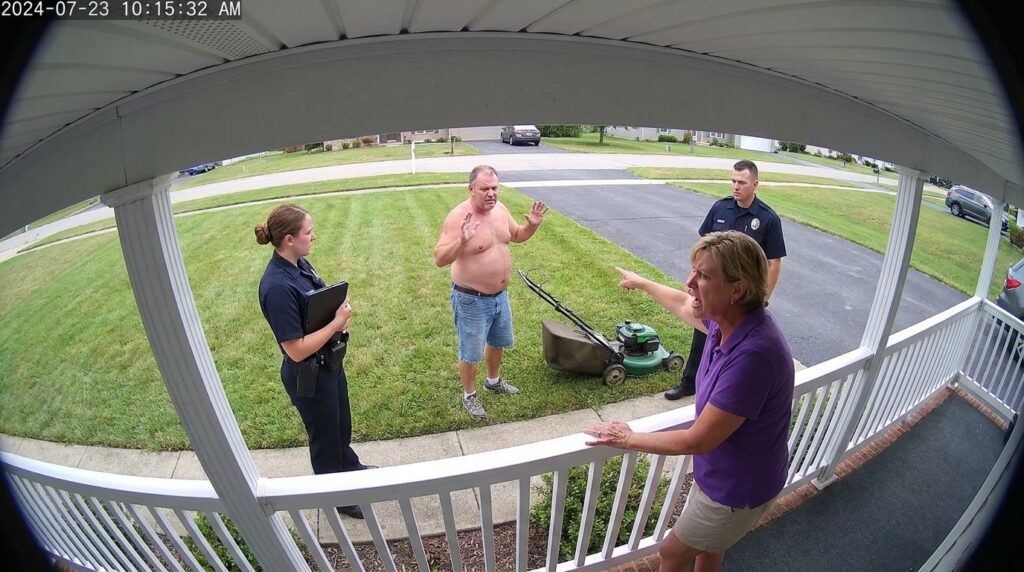
“Shut it down, sir,” the first officer said. The voice was a flat, unyielding midwestern monotone that sliced cleanly through the two-stroke whine of the engine.
My thumb pressed hard against the rubber kill switch. The mower sputtered, coughed a single plume of blue, oil-heavy exhaust, and died. In the sudden quiet, the heat seemed to settle twice as fast, thick and silent, broken only by the rhythmic tick-tick-tick of the cooling manifold. My fingers stayed locked around the black steel handlebar, still vibrating from the phantom pulse of the motor.
The two navy-blue cruisers sat angled across the gravel lane, their tires having kicked up a fine layer of gray limestone dust that now drifted across the rye grass. The driver’s side door of the lead vehicle remained clicked open, a steady chattering from the dispatch radio spilling into the afternoon air. The mediating officer—a woman with her dark brown hair pinned into a severe, flight-line bun—stepped onto the gravel, her boots crunching with a heavy, deliberate cadence. At her hip, the heavy leather of her utility belt creaked against her uniform trousers. Behind her, the second officer moved toward the rear fender of my mower, his posture tall and stationary, hands resting casually but securely near his belt buckle. He didn’t speak. His eyes just tracked the space between my boots and the vinyl fence.
“He’s running it right over the drainage easement, Officer,” she said, her voice rising an octave as she leaned farther over the white rail. The yellow plastic folder rattled against her ribs. She used her free hand to gesture frantically toward the ditch behind my shoulder. “He’s tracking the debris onto my side, destroying the grading, and frankly, it’s a public nuisance. I have the municipal code cited right here.”
She tapped the yellow folder with the mud-caked water-meter key. The metallic tink was sharp, but my eyes stayed on the dark crust of loam clinging to the key’s square iron teeth. It wasn’t the sandy clay of our surface lawns; it was the black, sulfurous muck that only sat six feet down, near the city main line.
The mediating officer didn’t look at the folder. She didn’t look at me, either. She stopped exactly at the intersection where the concrete driveway split into the grass, pulled a ruggedized field tablet from her chest rig, and tapped the screen with a black plastic stylus. The display cast a pale blue glow against her throat despite the harsh glare of the sun.
“Ma’am,” the officer said, her eyes never leaving the screen. “Hold your statement until I log the call parameters. Who is the deed holder for forty-two-twelve?”
“I am,” she said, her chest expanding. “And my family has maintained the integrity of this perimeter for—”
“Ma’am, stay here while I write this down,” the officer interrupted. The tone wasn’t angry; it was worse. It was entirely transactional, the mechanical sorting of facts by a state system that didn’t care about neighborhood status. The stylus clicked twice more against the reinforced glass. “Mr. Vance, is that your machine?”
“It is,” I said. My throat felt dry, lined with the dust from the cruisers’ arrival. I didn’t take my hands off the bar. “I’m clearing the three-inch margin from the fence post. Same line I’ve cut every Tuesday for five years.”
“He’s lying,” she hissed, her body tensing behind the vinyl boundary. “The survey clearly shows the common area begins at the third post. He’s deliberately encroaching to aggravate my tenant.”
The second officer shifted his weight behind me. The gravel shifted under his boot heel, a warning friction that signaled the perimeter was locked. He was watching her now, his eyes fixed on the pointing finger, tracking the erratic arc of her hand.
I looked down at the mud on the water key again. A single droplet of dark water was beginning to form at the tip of the iron prongs, dripping slowly onto her pristine white sneaker. It didn’t make sense for her to have that tool out here, not unless she had been down in the culvert box before the cruisers turned the corner. The city main sat directly under the disputed line, inside the concrete pipe that ran beneath our shared ditch.
The mediating officer finally lifted her gaze from the tablet. Her eyes were small, dark, and completely neutral as they measured the distance between the green deck of my mower and the first vinyl post. She turned her torso slightly, the stylus pointing toward my chest.
“Sir, step back from the mower,” she said.
It wasn’t a request. The weight of the authority in the yard shifted instantly, pinning me to the dirt. I let go of the rubber grips. My hands felt light, detached, the skin still tingling from the engine’s labor. I took two slow steps backward, my sneakers sinking slightly into the soft, over-watered turf near the culvert edge. As my heel pressed into the slope, the ground gave way with a wet, hollow squelch—far softer than a standard dry easement should have been under a July sun. Beneath the grass, something rusted and metallic groaned against the limestone base.