CHAPTER 4: THE CERTIFICATE OF THE LINE
“I’m waiting, ma’am,” the mediating officer said. Her voice lacked any rhythm, flat as a ledger page.
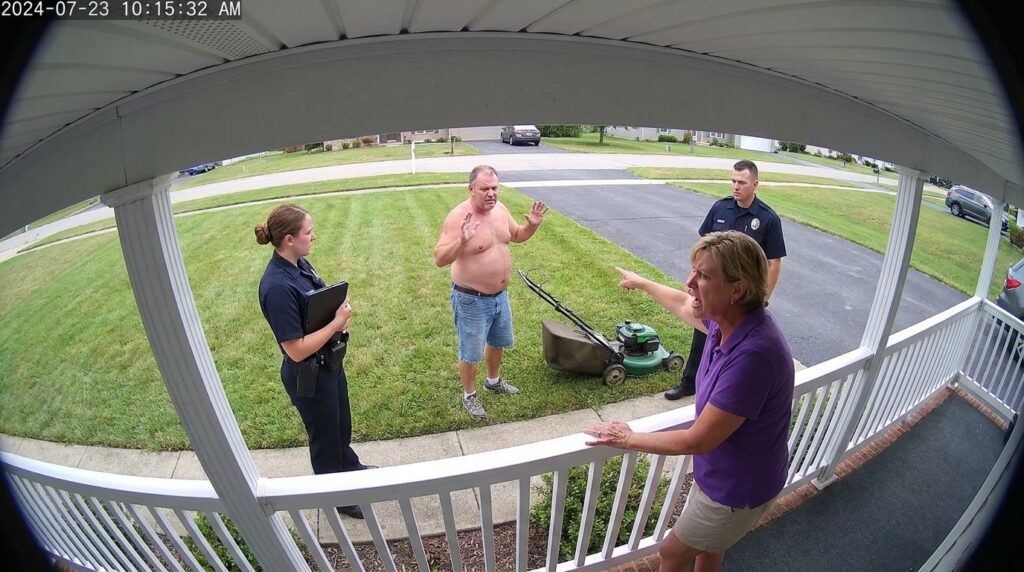
The woman behind the white vinyl fence didn’t unseal her grip on the yellow folder. Through the translucent plastic, the heavy embossed shadow of a municipal notary seal caught the high glare of the sun, distinct and round against the cheaper paper backing. Her knuckles stayed bloodless, locked over the top margin like she was anchoring herself to the rail. The second cruiser’s engine continued its hollow, metallic rattle down by the curb, blowing a thin heat shimmer across the front yard.
“This is completely outside the scope of my call,” she said, her chest expanding into a tight, hard block under her purple polo shirt. She looked toward the street, her sunglasses catching the reflection of the second officer’s tall, unmoving form. “I logged an active civil disturbance and code violation. You should be running his identification, not audit logging forty years of neighborhood infrastructure.”
The mediating officer tilted the field tablet forty-five degrees, her stylus tapping the edge of the reinforced casing. “Every call inside a disputed easement automatically pulls the plat records, ma’am. If your folder contains the certified nineteen eighty-four variance for the drainage line, I can cross-reference the index number right now and clear the unit from your property.”
I shifted my weight, my right shoe pressing deeper into the sod. The wet earth didn’t snap back; it stayed compressed, a dead grey clay consistency that oozed through the grass blades. The grease-stained deck of my green mower sat between us, its fuel cap venting a small, chemical hiss under the pressure of the midday heat. The machine felt cold now, the heavy steel blade beneath the deck completely silent, but the itch in my fingers remained.
“The certificate is private estate record,” she said. Her voice had dropped into a tight, fast rasp, the rhythm of her speech catching on the syllables. “It’s not for public review on a sidewalk. My lawyer has the filed counterpart at his office downtown.”
“Then I’ll log it as unverified,” the mediating officer replied. Her fingers danced across the digital grid, entering a series of red alphanumeric codes into the active report interface. “Which means the city engineering unit will be dispatched with a mechanical excavator to clear the outflow obstruction at forty-two-twelve by five o’clock tomorrow morning.”
The woman’s jaw clamped shut, a small muscle twitching near her left temple where her short blonde hair was pulled back behind her ear. Her thumb slipped off the top of the folder, revealing the edge of the document inside—a document that wasn’t typed on standard modern bond paper, but old, heavy legal cap, the blue ink of a surveyor’s stamp bleeding slightly through the fiber.
I looked from her frozen hands down to the base of the fence line again. The third vinyl post was distinctly out of true now, the gravel beneath its concrete footer shifting as the water under the slope continued its slow, silent backup. A small flake of white paint cracked off the rail where her palm had slammed down earlier, drifting into the black, sulfurous muck at my feet.
“The excavator will destroy the grading of my lower terracing,” she muttered, her eyes dropping to the blue screen of the tablet. Her hand finally lowered the yellow folder, but she didn’t open it. She held it by the spine like a broken tool. “The work was completed to code. My husband paid the city surveyor out of his own pocket to lock the coordinates.”
“If he paid out of pocket, then the record is proprietary to the owner,” the mediating officer said, her eyes narrowing as she looked up from the glass interface. She adjusted her grip on the stylus, her stance changing from a passive data log to a sharp, tactical focus. “But a city surveyor doesn’t take private funds for an easement adjustment, ma’am. Not without a public hearing.”
The second officer took a slow step forward, his boots crunching on the stone bed. His hand didn’t move toward his hip, but his shoulders squared, cutting off the clear line of sight between her porch and the driveway. The entire street seemed to have gone still, the dry summer wind dropping to nothing, leaving only the smell of hot vinyl, old fuel, and the stagnant iron sludge rising from the ditch.
“Let me see the surveyor’s stamp on that document,” I said, my voice cutting through her silence.
She snapped her head toward me, the lenses of her glasses completely dark. “You don’t have the standing to read my deed, Vance. You’re a tenant on an unmetered lot.”
“The lot is metered,” the mediating officer corrected without looking up. “And according to the nineteen eighty-four log, his meter box sits precisely twelve inches inside the culvert mouth. If your fence line is leaning over that vault, you’re the one obstructing the utility access.”
She didn’t answer. Her body seemed to shrink into the shadow of her own porch roof, her heels clicking back one inch onto her own concrete walk as the tablet began to hum with an incoming data transmission from the county archives.