
CHAPTER 3: THE COLD LIAISON
“You shouldn’t have come here,” the lieutenant colonel said. He dropped the canvas-bound ledger onto the desk. The heavy thump puffed a small cloud of dry, yellow dust into the light of the desk lamp, a desaturated haze that smelled of old mildew and decayed glue. “The Unit 77 roster was purged from the federal registers before I was commissioned. Carrying this onto a modern installation isn’t just an infraction. It’s an invitation for a quiet disappearance.”
I leaned my weight back onto my heels, my hands still thrust into the pockets of the dark wool coat. Through the lining, my fingers grazed the loose brass locking screw I had slipped from the knife casing on the desk while his back was turned. It was cold, its threads caked with a fine, green residue of oxidized copper.
“I didn’t bring it to read it to the clerks,” I replied. My voice maintained its slow, gravelly rasp, scraping against the clean, sterile hum of the air conditioning. “I brought it because the logistical depot at the ridge isn’t cold. The automated transport lines are pulling power from the grid. Two hundred thousand kilowatt-hours a month don’t disappear into an empty warehouse, Vance.”
The use of his first name—the name I had given him before the service swallowed him whole—made his jaw lock. The lieutenant colonel walked around the mahogany desk, his boots striking the floor with a calculated, rhythmic precision that attempted to reassert the authority of his rank. He stopped a mere foot away, his breath cold, his eyes drilling into mine with that same stubborn, unyielding density we both carried in our bones.
“The ridge is under my operational control now,” Vance whispered, his hand coming down flat on the desk blotter, right next to the worn silver pocket watch. “Whatever happens out there is sanctioned by the Department of the Army. Your old unit’s coordinates are dead. The field journal is a decoy, an antique artifact from a border skirmish that never existed on paper. If security finds you with it outside this room, I can’t protect you.”
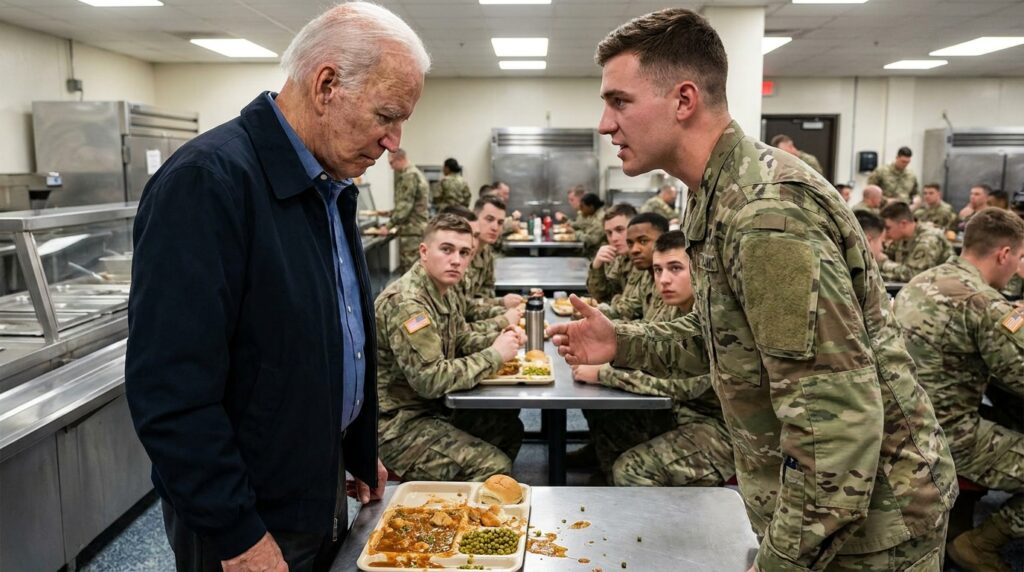
“I didn’t ask for protection,” I said, leaning in just enough to let him smell the rain and old wool on my coat. “I asked why the transfer orders for that boy in the mess hall are marked with the same red cross as my retirement manifest from seventy-six. You’re preparing his squad for a clearance run at the old border sector. The same run that left sixteen of my people in an unmarked ditch near the salt flats.”
Vance didn’t flinch. His face remained a mask of hardened military discipline, desaturated and pale under the fluorescent glare. He turned slightly, picking up the canvas book and flipping it open to the back cover. His finger tapped an iron-rimmed grommet hidden inside the spine—a structural anchor point meant for a carrying strap, but inside the hollow cylinder, a thin strip of silver micro-film gleamed like a snake’s scale.
“The red cross isn’t a manifest marker,” Vance said, his voice dropping into a flat, transactional drone that sent a sudden, icy needle of awareness down my spine. “It’s a biological quarantine flag. The boy in the cafeteria wasn’t soft because he lacked training. He was suffering from early-stage peripheral degradation. The same degradation that started in your fingers forty years ago.”
The room seemed to shrink, the dry smell of paper and gun oil suddenly turning thick and metallic, like blood drying on a hot radiator. I looked at the silver micro-film, then down at my own hand inside the wool pocket, my fingers tightening around the cold brass screw until the metal bit into my palm.
“You’re using them as filters,” I muttered, the realization hitting me not as a shock, but as a heavy, exhausting weight. “You’re sending his unit down into the old storage vaults to see if the modern seals hold against the rot.”
“I am executing orders,” Vance said, his face entirely devoid of color now, a statue of absolute compliance. “The same way you did when you crossed the flats. The only difference is, this time, I know exactly who is going into the hole.”
Before I could speak, a sharp, electronic buzzer tore through the silence of the office. The small red light above the oak door began to blink in a rapid, frantic rhythm, and the heavy tumblers of the mechanical lock began to slide back with a series of frantic, wet clicks.








