
CHAPTER 2: THE COMMAND ISOLATION
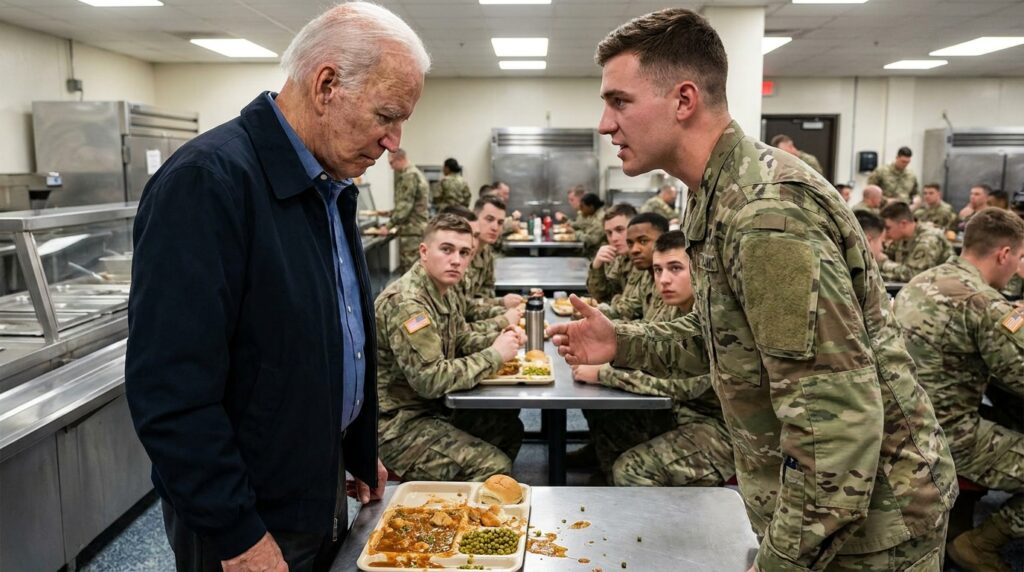
The green paint on the concrete wall was flaking in long, jagged scabs, revealing the damp, rusted iron rebar beneath it. The holding room smelled of floor wax, dry earth, and old starch—the specific, stagnant odor of an institutional cage that hadn’t changed since the Berlin Wall was standing. My hands were finally steady, but the knuckle of my left index finger throbbed where it had caught the coarse fabric of the private’s collar.
The heavy steel door didn’t click when it opened; it groaned on dry hinges, a harsh metal-on-metal scrape that vibrated right through the small of my back.
Two base security MP escorts stood in the threshold, their desaturated digital camouflage pristine, their faces perfectly blank under the fluorescent light. They didn’t look at my face; they looked at my hands. Between them stood a sergeant first class with a clipboard, his thumb pinning down my leather-bound wallet and the blue visitor’s pass.
“Stand up, sir,” the sergeant said. The command wasn’t loud, but it had the transactional coldness of a man who spent his days processing human cargo through a logistical pipeline. “Leave the coat on the chair.”
I didn’t move immediately. I let the silence stretch until the sergeant’s eyes flicked from the clipboard up to my lined face, his jaw tight with the sudden friction of an old man who didn’t follow the rhythm of the base. I stood up slowly, my knees popping with a sound like dry twigs, but I kept my spine straight. I didn’t leave the coat. I wore it, pulling the dark wool tight across my chest as I stepped into the gray-lit corridor.
The air in the administrative wing was colder, filled with the hum of server racks and the distant, rhythmic thud of boot heels on linoleum. They marched me past rows of frosted glass offices where young clerks sat before glowing monitors, their eyes tracking data fields, completely insulated from the physical reality of the mud and iron outside. We stopped before a solid oak door marked Commanding Officer – Authorized Personnel Only.
The sergeant didn’t knock. He punched a five-digit code into the mechanical lock, the tumblers falling with a heavy, metallic sequence that sounded exactly like the action of an M14 rifle locking into battery.
The office inside was larger, but the air was just as dry, smelling of old paper and gun oil. A desk made of dark, military-issue mahogany occupied the center of the room, its surface desaturated under a single desk lamp. On the green blotter lay my personal leather kit bag, its brass zipper forced open, its contents arranged in a neat, clinical line: three graphite pencils, a pocketknife with a three-inch carbon steel blade, a worn silver pocket watch with a cracked glass face, and a thick, canvas-bound ledger with a faded serial number stamped on the spine.
A man in a field uniform stood by the narrow window, his back to me, his hands clasped behind him. The silver oak leaves of a lieutenant colonel gleamed on his collar, catching the desaturated light from the courtyard outside.
“That’ll be all, Sergeant,” the officer said. His voice was lighter than mine, but it carried the same flat, unyielding rhythm—the specific cadence of a man who spent his life inside the structure.
The door clicked shut behind me, the lock engaging with that same heavy, mechanical finality.
The lieutenant colonel didn’t turn around immediately. He stayed by the glass, his eyes tracking a squad of recruits marching across the desaturated asphalt below, their boots striking the pavement in a ragged, exhausted cadence. When he finally pivoted, his face was in shadow, but the sharp edges of his jaw and the slight asymmetry of his nose were identical to the reflection I saw in the mirror every morning when I shaved.
He didn’t call me by name. He didn’t offer a hand. He walked to the desk, his fingers brushing the canvas-bound ledger with a slow, calculated curiosity.
“The gate manifest logs you as a civilian contractor checking the inventory at the old logistics depot,” he said, his voice dropping into a transactional register that didn’t match the hard line of his mouth. “But the depot has been cold since ninety-two. And this ledger didn’t come from any civilian office.”
He picked up the canvas book, turning it over so the faded stenciling faced me. The letters UNIT 77 – OP-ECHO were barely legible against the frayed olive cloth, but beneath them, a hand-drawn red cross had been inked into the fabric with a fine-tipped pen—the exact same mark that was currently drying on my visitor’s pass in the sergeant’s pocket.
“The private you broke in the mess hall is currently in the infirmary with a hairline fracture in his radius,” the officer continued, his eyes locking onto mine with an equal, probing intellect that searched for weakness. “He thinks he ran into a stubborn old civilian. But the computer doesn’t find any record of your civilian employment after seventy-six. It just finds a blank space where a service record used to be.”
I looked at the canvas book in his hand, then at the silver oak leaves on his collar. The mechanical watch on the desk gave a stiff, grinding tick that seemed to fill the silence between us.
“The private was soft,” I said, my voice a low, desaturated rasp against the clean walls of the office. “He was leaning too far forward. If you’re going to deploy them to the ridge next month, you should teach them how to balance their weight.”
The lieutenant colonel froze. His fingers tightened against the canvas ledger until the knuckles turned white, his eyes narrowing as he realized I knew the exact destination of the unit’s upcoming, classified transfer orders—a logistical detail that hadn’t been printed on any manifest in this office.








