
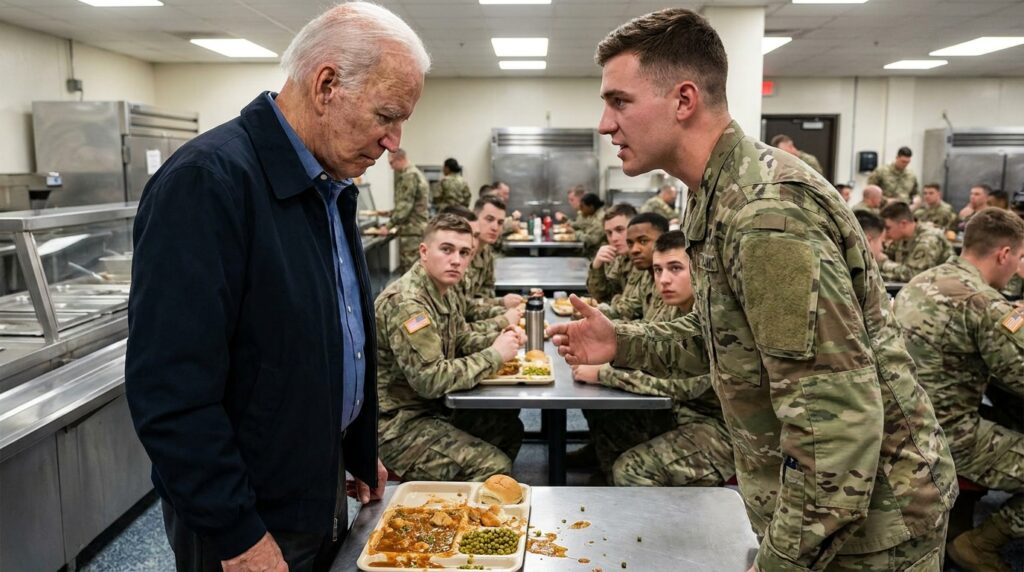
CHAPTER 1: THE FRICTION OF THE LINE
“Move along, old man, you’re holding up the whole line.”
The words weren’t just spoken; they were spat, dropped like hot brass into the dull roar of the Fort Meade mess hall. Then came the palm—flat, sweaty, and heavy with the thoughtless momentum of a twenty-two-year-old who had spent six months learning how to break things. The impact hit the dark wool of my jacket, a dull thud that rattled the cheap plastic tray against the stainless-steel serving rail.
The tray buckled. A bowl of lukewarm hominy tipped over the edge, spilling a gray, starchy slick across the metal counter.
Around us, the room didn’t go completely quiet—a base cafeteria never does—but the texture of the noise changed. The scraping of heavy plastic chairs slowed. The rhythmic, transactional clink of forks against tin partitions died out in a widening perimeter. Two dozen recruits in desaturated digital camouflage uniform stayed frozen, their mouths closed, eyes tracking the grease on the counter, waiting for the old civilian to shrink.
I didn’t shrink. My joints didn’t allow for fast retreating movements anymore; they were stiff, filled with the grinding ache of seventy-eight winters and the dry grit of places this kid hadn’t even read about in his tactical manuals. I looked down at the spilled hominy first. The steam rising from it smelled faintly of tin and cheap lye.
“Look at me when I’m talking to you,” the soldier muttered. His breath smelled of sour coffee and tobacco. He was leaning in, his clean-shaven jaw twitching with the specific, fragile arrogance of a private who thought the uniform made him six inches taller than the man wearing the old wool coat.
My right hand was still gripping the cold edge of the tray. My thumb felt the small, jagged notch in the plastic—a tiny physical imperfection. I didn’t think about the physics of it. I didn’t calculate the leverage. The movement was just old iron sliding into a groove it had worn fifty years ago.
I dropped my left shoulder, letting his forward lean carry his center of gravity over the slick of the counter. My right hand left the tray, fingers locking onto the stiff, coarse fabric of his uniform collar right where the seam met the throat. I didn’t pull him. I simply pivoted my heel into the concrete floor, letting the weight of my own age—the heavy, unyielding mass of an old man who refused to tip—become an anchor.
The private’s boots lost purchase on the greasy red tile. His eyes went wide, a sudden, animal panic short-circuiting his face as his own forward momentum turned against him. There was a sharp, brief scuffle of rubber soles, the hard clack of his elbow catching the edge of the line, and then he was down.
He hit the floor hard, flat on his back in the center aisle, the wind whistling out of his teeth in a short, wet gasp.
The mess hall went absolutely still. Nobody moved to help him. The silence was heavy, smelling of scorched grease and the desaturated musk of a hundred tired bodies.
I stood over him, my hands returning to my sides. My right forearm was trembling slightly from the sudden exertion, a cold vibration running through the bone, but I kept my fingers flat against the wool of my trousers. I looked down at his short, prickly hair, the neat camouflage pattern of his chest rising and falling as he tried to find his breath.
“You picked the wrong man to disrespect today,” I said. My voice was lower than the room tone, a gravelly rasp that felt dry in my throat, completely stripped of heat.
The young soldier stayed there, his back pressed against the cold red tile, his fingers twitching against the floor. The arrogance had drained out of his eyes, replaced by the deep, flushing heat of public humiliation. He looked at the boots of his peers at the surrounding tables, then up at my lined face. His jaw moved once, twice, before the discipline of the pipeline finally overrode his pride.
“Sir,” he whispered, his chest tightening as he forced the words past his teeth. “I went too far.”
I didn’t answer. I reached down, took my wallet out of the dark wool jacket, and looked at the blue visitor’s pass tucked behind the plastic screen. Underneath the laminated edge, a small, hand-drawn red cross was marked on the corner of the card—a detail that hadn’t been there when the front gate clerks logged me in an hour ago.








