
CHAPTER 5: THE SETTLING SILENCE
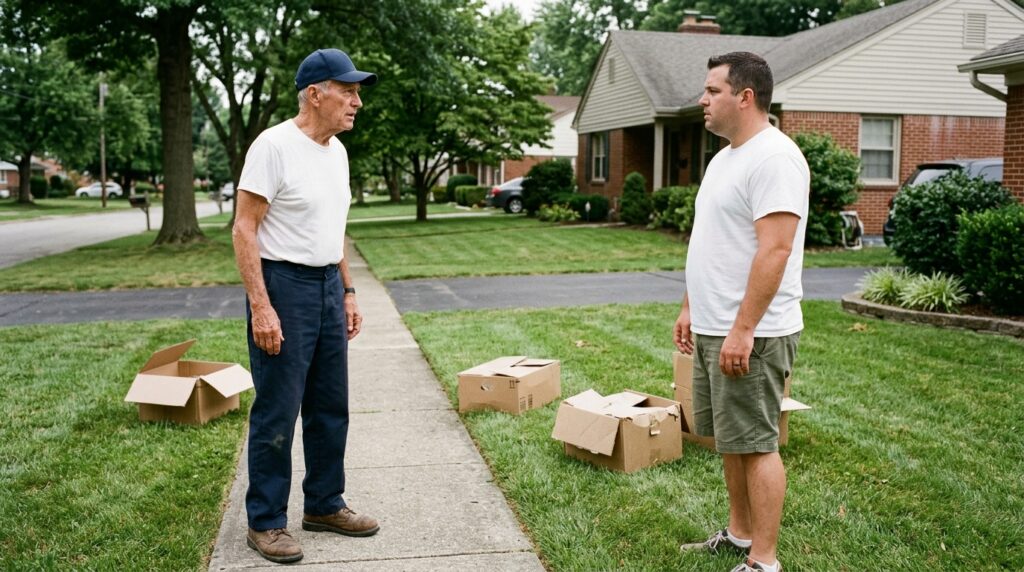
“Alright,” Mark muttered, his throat clicking as he forced the word out. He remained on one knee in the sharp gravel, his fingers bunching the wet, torn edge of the white legal packet. “Alright, I’m done.”
Arthur didn’t lower his gaze to match the younger man’s posture. He kept his head flat, his chin parallel to the concrete path, watching the light tremble over the hot hood of Mark’s pickup truck across the lane. The vehicle’s exhaust pipe let out a final, ticking pop as the steel began to cool under the heavy afternoon glare.
“The paper goes back into the dry carton, Mark,” Arthur said. The statement was dry, sparse, devoid of any small spike of victory. He reached up with his left thumb, checking the alignment of his navy service cap where the torn linen of his collar pressed against his neck. The skin was hot but dry.
Mark didn’t argue. He shoved the white packet deeper into the crushed paper core of the third box, his clumsy, thick fingers tearing a fresh three-inch split across the side panel. He didn’t look at Arthur’s face while he worked; his movements were small, hurried, and short, the frantic packing of an operator who had lost his pressure and knew the watch was watching. He dragged the heavy box back across the sod line, his sneakers leaving two dark, bruised channels through the dry rye grass.
“The trailer comes at seven,” Mark said over his shoulder, his voice thin, stripped of its weight. He didn’t lift his chest until he reached the concrete skirt of his own driveway. “I can’t stop the delivery, Art. The yard already charged the card.”
“The driver can drop the skids on the gravel by your garage,” Arthur replied, his voice an even, unyielding drone. “If he drops them six inches past the fence posts, I’ll have the county truck out here before he unhooks his safety chains. Your dad knew the width of the turn, Mark. He never brought anything larger than a flatbed six-wheeler down this lane.”
Mark didn’t answer. He turned his back, his heavy shoulders dropping as he hauled the broken box into the shade of his open garage bay. The heavy wooden door didn’t slam; it dropped down onto the greasy slab with a dull, hollow rumble that sounded like empty oil drums rolling in a cargo hold.
Arthur stayed on the second step until the echo cleared the lane. The silence that came back was thicker than the heat, full of the dry, hot smell of old creosote from the utility poles and the bitter tang of flaking zinc from the wire fence.
He stepped down onto the walkway then. His boots felt heavy, the thick rubber soles crunching into the loose grit that Mark’s struggle had scattered across the stone path. He didn’t go inside. He walked slow, his thumbs returning to his waist, his eyes tracking the jagged frost heave until he reached the corner where the plastic dry-cleaning bag was caught in the briars.
The bag was ruined, the thin film shredded into gray ribbons by the thorny stems of the blackberry bushes. Arthur reached into the thicket, his skin unbothered by the dry barbs as his fingers searched the base of the sod. Four inches down, beneath a tight knot of dried crabgrass roots, his knuckles struck something flat and cold.
It wasn’t the surveyor’s stake. It was a secondary marker—a three-inch disc of corroded iron plate, pinned to the limestone ledge by a heavy, square-headed railroad spike. Arthur cleared the dry soil with his thumb until the stamped numbers on the iron face became visible under the white glare of the sun.
The plate didn’t have the standard county registry stamp from seventy-two. The markings were older, deeper, hand-chiseled into the iron with a cold punch: 1954 – SEC 12 – VAR 04.
Arthur knelt in the grass, his knee pressing down onto a sharp piece of crushed aggregate until the bone ached. He knew the numbers. He had seen them once before, on an old navy blue blueprint blueprint that his own father had left in a cedar chest behind the water heater in sixty-seven. That blueprint hadn’t been drawn by a city clerk; it had been signed by an engineer from the regional railway authority before the state highway had cut the old farm lot into four narrow suburban strips.
He looked across the boundary line toward Mark’s living room window. The glass was dark, reflecting only the gray, shimmering line of the asphalt and the unpainted lower trim of the garage door. The iron disc beneath his hand wasn’t six inches from Mark’s driveway. It was eight feet inside it. If the chiseled marker from fifty-four was the true bronze pin, the legal line didn’t just trim the edge of the boxes—it ran straight through the center of Mark’s foundation, cutting the younger man’s kitchen and front porch completely off the municipal map.
Arthur’s fingers stayed on the rusted iron plate, feeling the cold, deep mass of the limestone ledge beneath the dirt. A bluebottle fly landed on the flaking brim of the iron disc, its wings twitching once before the heat drove it back into the shadow of the briars.
From behind the screen door of his own dark hallway, the telephone began to ring—a sharp, mechanical brass double-chime that had been wired into the wall box when the house was built. It rang four times before Arthur stood up, his joints popping like dry pine twigs in the stillness of the yard.








