
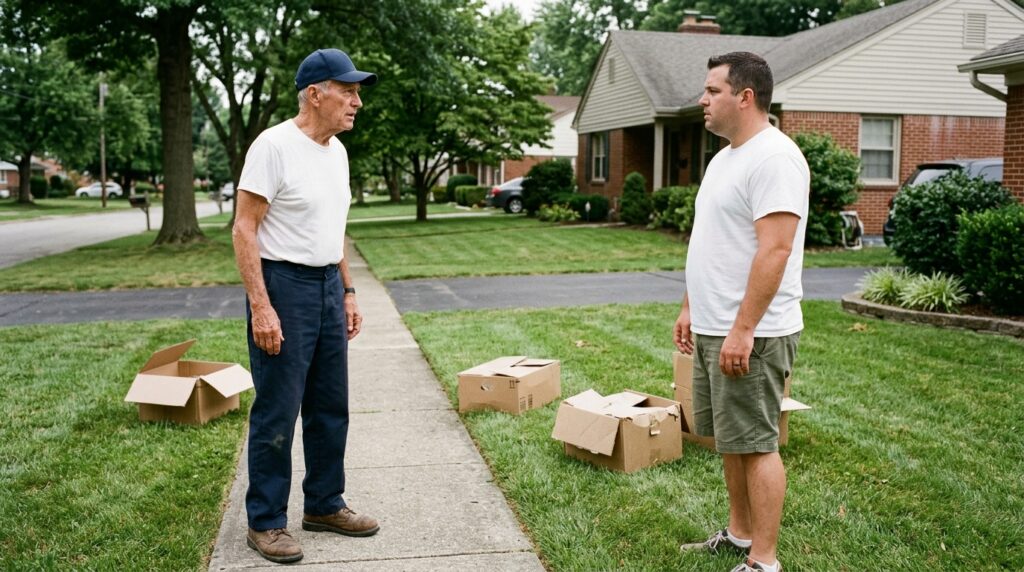
CHAPTER 3: THE APPROACHING RADIUS
Mark’s hand didn’t strike like a weapon; it pushed through the heavy air with the dead, blind momentum of an unlatched cargo door in a heavy sea. The grease beneath his fingernails was dark, almost black against the pale underbelly of his forearm. Arthur didn’t watch the hand itself. He watched the subtle tightening of Mark’s left shoulder, the way the younger man’s weight pooled into his forward knee, forcing his center of gravity past the point of recovery.
The world contracted down to the small, predictable physics of a narrow concrete walkway. A grasshopper kicked off from a split blade of fescue near the gravel line, its wings clicking once before it vanished into the shadow of the dropped cardboard carton. To a man who had spent three years in the vibrating steel belly of a fleet destroyer, listening to the microscopic groan of high-pressure steam lines through a stethoscope, the mechanical signals of an angry neighbor were loud enough to shake the floorboards.
“You’re leaning,” Arthur murmured. The words were small, dry grains dropped into the furnace of the afternoon heat.
Mark didn’t stop. His fingers caught the coarse, faded linen of Arthur’s work shirt just below the collar line. The fabric groaned, the old threads tightening against Arthur’s chest with a sharp, dry rasp. Mark’s breath came out in a hot, sour cloud that smelled of iron-heavy well water and burnt onions. “I’m standing where I belong, old man,” he snarled, his knuckles bunching as he twisted the cloth, trying to find leverage to drag Arthur off the pine step. “You’ve been looking down your nose at my family since the day we poured our driveway. You think that hat makes you special? You think anyone on this street gives a damn about a box of old papers in your attic?”
The pull was heavy, but it was linear. Mark was relying on forty pounds of excess grease and bone to do the work that discipline should have handled. He didn’t understand that concrete didn’t give under a boot, and he didn’t understand that an old man whose legs had been trained by thirty-two thousand miles of gray water didn’t have any lean left in him.
Arthur kept his feet flat. His boots were old black leather, the soles hard-vulcanized rubber that had outlasted three different county road commissioners. He felt the cold pressure of the brass coupling still gripped tightly in his right palm—a small, solid cylinder of dead weight that gave his forearm an anchor. He didn’t lift the metal. He didn’t swing it. He simply kept his right elbow tucked close to his ribs, his humerus acting as a short, unyielding strut against the pull.
“Your dad had a five-pound sledge,” Arthur said, his eyes perfectly level with the small, sweating notch above Mark’s collar. “He knew how to drive a line straight because he’d spent four years in the Seabees clearing coral off Tinian. When he hit that limestone ledge under the crabgrass, he didn’t quit. He took an iron bar and he worked it until the hole was four feet deep. He didn’t guess, Mark. He followed the bronze pin the state surveyor set in forty-eight.”
Mark’s left arm went rigid, his shoulder twisting as he poured more weight into the linen. “Shut up about my father. He’s six feet under the sod at St. Jude’s, and he’s not paying the taxes on this lot. I am. The lumber delivery is coming from the yard at seven tomorrow morning. Two skids of green pressure-treated four-by-fours. It’s sitting right on this walkway if I say so, and you’re going to step over it until the roof is on.”
The sun hit the metal siding of Mark’s garage across the lane, casting a hot, blinding sheet of silver light across the grass. The glare caught the edges of the scattered cardboard cartons between them, revealing the dark, oily smudge of old industrial sealer weeping through the bottom corners of the paper. There was a label on the third box down—a faded, blue-ink stamp from the county zoning office that had been crossed out twice with a heavy grease pencil.
Arthur’s gaze dropped to the stamp for a single millisecond. The ink was old, but the paper underneath wasn’t waterlogged like the rest; it had the crisp, flat edges of something pulled from a filing cabinet within the last forty-eight hours.
“You’ve been to the courthouse, Mark,” Arthur said. The tone wasn’t an accusation; it was the simple statement of a chief checking a oil-level sight glass before a shift change.
Mark’s hand jerked on the shirt. The linen tore at the seam near the second button, a tiny, clean sound like dry grass snapping under a heel. His face didn’t just turn red; it went a dark, dull purple around the jawline, the skin tight and shiny under the layer of grease. “I said shut your mouth, Art. You don’t know anything about my business.”
He didn’t just pull then; he shoved. He threw his left shoulder forward, using his entire upper body as a ram to force Arthur back through the screen door behind him. It was the moment of complete commitment—the point where weight becomes momentum and momentum can’t be turned back by an ungreased brake shoe.
Arthur’s left foot slid back exactly two inches, his heel finding the firm, unyielding vertical lip of the second porch riser. His knees bent by three degrees, his thighs locking into the pine structure until his body was part of the house foundation. He felt the heat vibration from the concrete path rise through his boots, a steady, dry hum that met the downward pressure of Mark’s arm halfway.
The neighbor’s storm door across the lane didn’t rattle this time, but the shadow of Mrs. Gable’s sun hat appeared in the narrow gap between her hydrangeas, her small, pale hand resting against the white paint of her porch rail. She didn’t call out. No one called out on this lane. The air was too heavy for noise, too thick with the iron smell of things that had been buried too long under the sod.
Arthur let his breath out in a slow, even stream through his teeth, his jaw relaxing as he watched Mark’s second foot leave the safety of the dry grass and settle onto the cracked concrete of the primary lane.








