
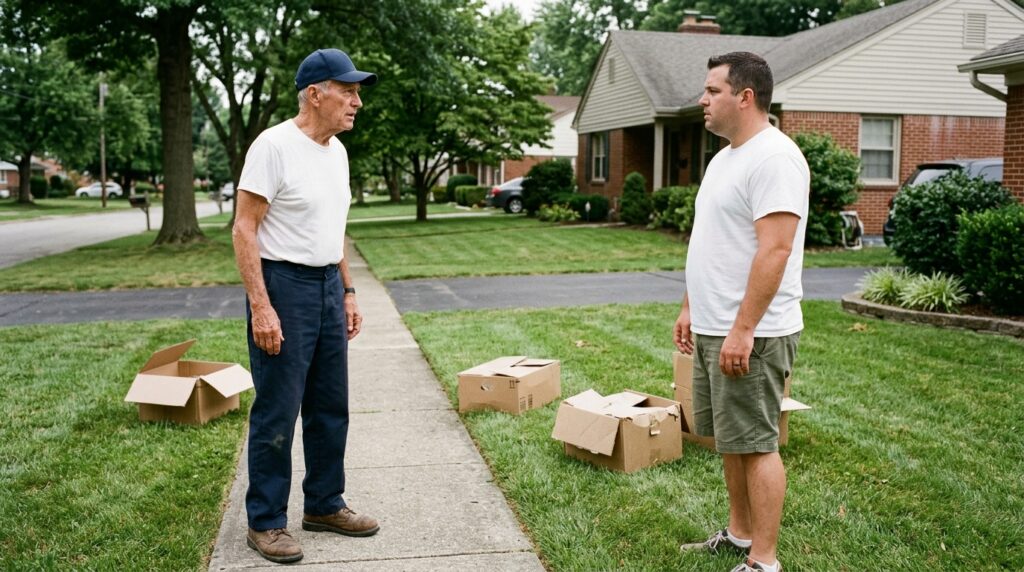
CHAPTER 2: THE CRUSHED GRASS
“You left your gate unlatched, Mark,” Arthur said. He didn’t turn his head toward Mrs. Gable’s porch, but his ears tracked the rhythmic, metallic slap of her aluminum storm door settling back into its frame. In the heat, every sound carried a sharp, dry edge, like dry kindling snapping under a boot.
Mark didn’t look back at the street. His shoulders remained hunched, his heavy frame blocking the light as he leaned into Arthur’s space. A drop of sweat cut a clean, pale line through the grey grit on his neck. “My gate isn’t your business, old man. This driveway is. My boxes are. You’ve been dragging your feet on this corner since my old man sold the lot, and I’m done asking nicely. The lumber for the new shed comes tomorrow. It goes right here.” He tapped the toe of his sneaker against the cracked concrete of Arthur’s walkway, a dull, rubbery thud that sent a tiny puff of grey dust into the air.
Arthur looked down at the shoe. The rubber rand was peeling away from the canvas, held together by a smear of dried yellow wood glue. A working man’s shoe, but lazy. The kind of fix that lasted three days before the grit worked its way back into the seam. Arthur knew that grit; it was the same fine, alkaline powder that blew off the dry flats behind the naval yards, the stuff that chewed through bearings and pitted steel if you didn’t grease the fittings every twelve hours on the watch.
“The stakes from seventy-two are still down there,” Arthur said, his voice flat, level, locked into the same low register he used when the generators failed in forty-knot seas. He pointed a single, calloused finger toward the base of the overgrown fescue where the plastic dry-cleaning bag was still shivering against the wire fence. “Six inches into that patch of crabgrass. If you drop the skids for that lumber on this side of the rusted post, the city inspector won’t even let you unhook the trailer.”
Mark let out a short, wet laugh that smelled of stale tobacco and warm soda. He took a half-step sideways, his heavy hip bumping against one of the stacked cardboard cartons. The box shifted, its taped seam groaning under the pressure of whatever density was packed inside. Through the split paper, Arthur caught the glint of oxidized iron—not plumbing fittings, but heavy, flat-headed tie-rods used for securing industrial concrete forms.
“The city inspector doesn’t come down this lane unless someone calls him,” Mark muttered. He lowered his voice, the pitch dropping into a granular, throat-deep gravel that carried the specific weight of a threat meant for an old man who lived alone. “And if someone calls him, Art, I’m going to know exactly which house the call came from. My family’s been on this block forty years. We don’t need papers to tell us where the dirt belongs.”
Arthur didn’t blink. He kept his gaze fixed on the small V-shaped notch where Mark’s collarbone met his throat. A man’s center of gravity was always lower than he thought, especially when he carried thirty pounds of soft lard around his middle. If Mark leaned forward another two inches, his heels would lift off the concrete. It was simple physics—the same balance math Arthur had used when he had to brace himself against the bulkhead of a destroyer while the deck rolled thirty degrees into the trough of a black Atlantic swell. You didn’t fight the roll; you let the steel find your bone.
“Your father knew where the iron was,” Arthur said softly. He reached down, his fingers closing around the cold, brass sleeve of the plumbing coupling that had rolled near his boot. The metal was pitted, the threads clogged with dried white pipe dope that had turned to chalk twenty years ago. “He helped me drive the pipe into the corner when we put the cedar posts in. He used a five-pound sledge, and we hit a limestone ledge four feet down. That pipe isn’t going anywhere, Mark. Even if you pile ten tons of pine on top of it.”
Mark’s face tightened, the skin around his eyes twitching as he looked down at the brass in Arthur’s hand. For a second, the heat seemed to stop moving between them. The air was thick with the smell of sun-baked tar from the roof shingles behind them and the sweet, rotting odor of grass clippings turning sour in the black plastic bin by the garage.
“He’s dead, Art,” Mark said, his voice losing its gravel, turning thin and sharp like a sheet of ungreased tin. “And his name isn’t on the tax roll anymore. Mine is.”
He reached out then, his heavy hand coming up fast, his fingers curling into a thick hook aimed directly at the loose fabric of Arthur’s work shirt. It wasn’t a punch; it was the clumsy, heavy-handed grab of a man used to clearing brush or hauling crates, an assertion of weight meant to rattle an old man’s teeth and make him look at the ground.
Arthur didn’t pull back. His boots stayed flat against the concrete, his heels locked into the frost heave. He watched the hand come, noting the yellow smear of wood glue on the thumb, the ragged edge of the fingernail, the raw, red skin around the knuckles where the grease had been scrubbed away with kerosene. The hand was slow. To Arthur, whose mind still measured time in the clean, mechanical clicks of a engine-room telegraph, Mark’s arm looked like it was moving through old grease.
The space between them closed, the heat of Mark’s body arriving a fraction of a second before his fingers touched the cloth. Arthur didn’t raise his hands to defend his face. He simply dropped his left shoulder three inches, his frame settling into the pine step behind him until his spine was as straight and rigid as a stanchion on a main deck.








