
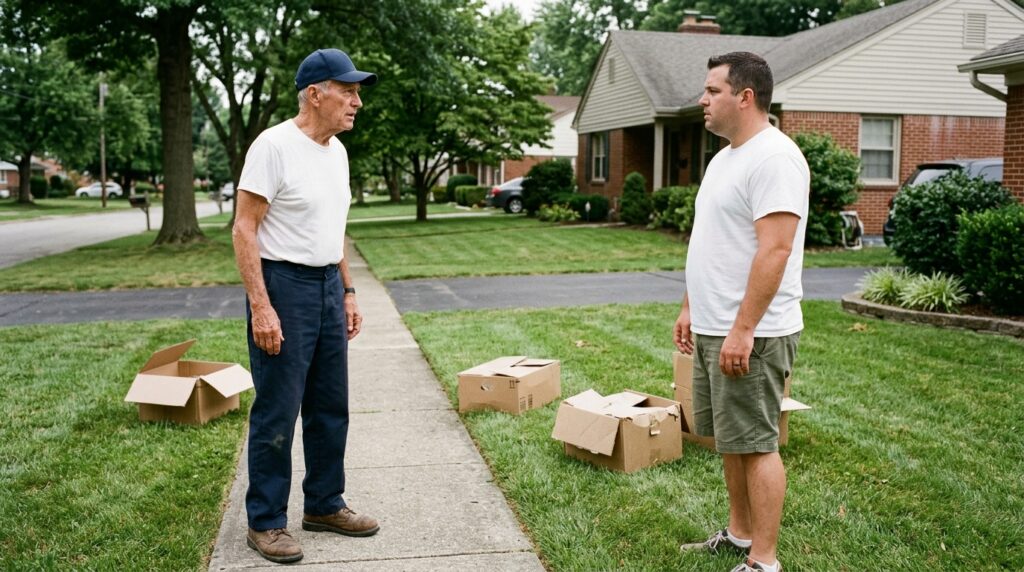
CHAPTER 4: THE LEVERAGE OF IRON
The full weight of Mark’s thirty-eight years came forward in a single, unguided rush. The split seam of Arthur’s shirt gave way entirely with a dry hiss of cotton threads, but the skin beneath stayed stone-still. Arthur felt the kinetic line traveler up Mark’s arm—clumsy, top-heavy, leaning thin on a base of soft gravel. To Arthur, a man who had calibrated the hydraulic governors on twin-propeller shafts while thirty-foot walls of winter seawater pounded the bulkheads, weight was just an equation waiting for a fulcrum.
He didn’t swing his arm. He didn’t reach for Mark’s face. Arthur simply dropped his right hip two inches, sinking his center into the pine step until his bones stacked neat and dead like iron pillars. His left hand came up under the mass of Mark’s extended wrist, his thumb finding the small, shallow depression between the younger man’s radius and ulna. It wasn’t a strike; it was a simple, short torque—the exact mechanical rotation a mechanic used to break the corrosion on a frozen valve stem.
The friction was brief and dry. When Mark’s weight hit the fixed strut of Arthur’s frame, the momentum had nowhere to go but down. Arthur’s right thumb pressed into the tendon, twisting the wrist outward by forty-five degrees. The physical frame that Mark had built his intimidation on suddenly buckled at the hinge. His sneakers lost their bite on the smooth concrete of the walkway, the yellow glue at the seam tearing open as his heel drifted off the line and caught the soft, rotting lip of the turf.
Mark stumbled. His heavy arms flailed once, cutting a wide, ragged circle through the hot air before his hip struck the stack of cardboard cartons behind him. The top box gave way with a wet, heavy crunch, the dry-cleaned plastic bag caught in the wire fence snapping violently as Mark’s shoulder dragged it down into the dirt. A dozen long, rusted iron concrete tie-rods spilled across the gravel, clinking together like dead bells.
Arthur stood exactly where he had been three seconds ago. His feet hadn’t cleared the concrete heave. The faded navy cap sat square on his head, the brim casting a sharp, gray wedge of shadow across his eyes. His breathing remained long and steady, a rhythmic draw of dry air that tasted of road tar and parched earth.
“Don’t underestimate me,” Arthur said. His voice didn’t carry the raw throat-scrape of an old man’s anger. It was low, dense, and flat, the sound of a cold diesel block settling into its mounts after a twelve-hour run. “Back off now.”
Mark lay sprawled across the broken cardboard, his palms flat against the gravel lane. The red color had left his face, replaced by a greasy, pale sweat that made the dirt on his forehead look like wet ash. He looked down at his left wrist, where the red mark of Arthur’s thumb was already turning a deep, iron-bruise purple under the sun. His breath came in ragged, shallow gasps, his chest heaving under his sweat-ringed shirt like a landed carp.
“You broke my arm,” Mark whispered, his voice thin and high, stripped of its gravel. He looked around the yard, his eyes darting toward Mrs. Gable’s driveway as if searching for a line of retreat that didn’t involve the old man standing on the porch step.
“It’s not broken,” Arthur said, his hand lowering until his fingers rested against the cold seam of his dark work pants. “The joint is stiff because you don’t grease the hinges. Get your things off my stone, Mark.”
Through the split side of the carton Mark had crushed, a thick, white packet of legal-sized documents had slid out onto the dry grass. The top page was stamped with a heavy, blue-ink seal from the county recorder’s office, dated three days prior. The heading wasn’t a standard property deed; it was a formal notice of systemic variance, marked with three separate red ink lines that ran straight through the schematic of Lot 4—Mark’s lot.
Arthur’s gaze locked onto the document. Even from five feet away, his eyes, trained by thousands of hours of reading micrometer markings under dim bulkhead lamps, caught the thin, dashed line that indicated the official county survey boundary. It didn’t stop at the fence lane. It didn’t stop at the gravel. The line cut directly through the graphic layout of Mark’s home, splitting the foundation of his garage and his living room into two unequal halves of disputed dirt.
Mark saw Arthur looking. With a frantic, jerky scramble, he pulled his knees under his chest and grabbed the paper, cramming the waterlogged corners back into the torn cardboard with his good hand. His knuckles were shaking, the raw skin bleeding slightly where he had scraped them against the iron tie-rods.
Across the lane, the shadow behind Mrs. Gable’s hydrangeas moved back three inches into the porch recess. Her pale hand didn’t leave the rail, but her head bowed down, her eyes fixed on her own neat concrete path as if the heat had suddenly become too bright to look at directly.
Arthur didn’t step down from the pine riser. He watched Mark gather the loose brass couplings, his fingers tracking the way the younger man’s heavy frame had shrunk under the sudden weight of the silence.








