
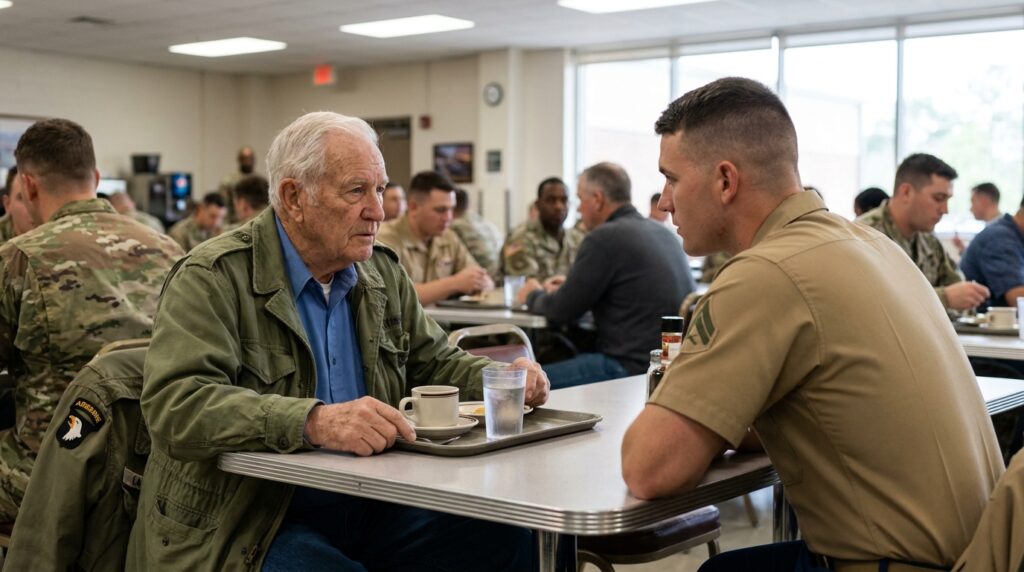
CHAPTER 5: THE COLD REALIGNMENT
The steady, deliberate click of the leather heels did not stop until it reached the edge of the puddle of spilled water.
Calvin Vance did not adjust his posture. He remained centered over the fallen specialist, his eyes tracing the clean, unpolished lines of the senior officer’s trousers that had entered his narrow field of vision. The starch in the newcomer’s khaki was uniform, lacking the hurried creases of the cafeteria workers or the sweat-stained margins of the junior enlisted pool. This was administrative authority carved out of climate-controlled headquarters, carrying the faint, cold scent of high-grade paper and floor wax.
“Stand down, Specialist Miller,” the voice said. It was thin, precise, and entirely devoid of theatrical volume. It was the tone of a man who assumed every molecule in the room would obey his physical presence without validation.
On the floor, Miller scrambled for purchase, his combat boots slipping once against the wet linoleum before he hauled his athletic frame into a rigid, trembling stance. His face was entirely pale now, the chemical flush replaced by the stark, hollow terror of a soldier who had just committed an actionable transgression under the eyes of the division command. He didn’t look at Calvin. He kept his eyes locked three inches above the silver eagle insignia pinning the collar of the colonel who stood between them.
“Sir,” Miller rasped, his right hand snapping into a salute that vibrated with static tension. “The civilian was… he was interfering with division-level documents, sir.”
Colonel Arthur Vance—no relation, though they shared the same gray, lean facial architecture characteristic of the regional recruitment boards—did not return the salute. He held a slim, black leather briefcase in his left hand, the thumb of his right resting against a bright silver latch marked with a three-digit security rotation wheel. His eyes didn’t waste movement on the shattered glass or the spilled tray; they scanned the red-striped folder lying near Miller’s boot, then shifted smoothly to Calvin’s face.
“Get your personnel out of this hall, Specialist,” Colonel Vance said. He didn’t look back at the three soldiers still frozen at the table. “Report to the transit guard at Bay Three. Your unit file has been re-routed.”
Miller hesitated for a single micro-second, his eyes darting toward the red-striped folder on the floor as if weighing the risk of reaching for it. The colonel’s gaze didn’t waver. It was a cold, impenetrable wall that offered zero room for negotiation. Recognizing the absolute finality of the command, Miller dropped his arm, spun on his heel, and marched toward the western exit with his three silent companions tracking behind him like ghosts.
The mess hall began to breathe again, but the volume remained low, an anxious murmur that stayed twenty feet away from the two men standing in the center of the wet tile.
Calvin reached down and picked up his leather folder from the dry edge of the table. His fingers were steady, the unpolished brass zipper of his jacket catching slightly as he pulled the canvas straight. He knew the colonel hadn’t arrived by accident; the timing was too precise, the interception too synchronized with the moment the red security strip had been unmasked.
“You’re outside your assigned grid, Calvin,” the colonel said. He spoke in a muted undercurrent that didn’t travel past the immediate table lane. He stepped closer, his polished leather shoes leaving a faint tracking line through the moisture on the floor. “The audit was scheduled for the logistics compound, not the general detachment mess.”
“The logistics compound is a shell, Arthur,” Calvin replied, his gravelly voice dropping into the same transactional frequency. He didn’t offer a salute; his relationship with this command structure had been severed from the official rosters forty years ago, replaced by a gray, unwritten protocol. “The administrative clerk at the counter is running an archaic directory system to bottle up old files. And your specialist on the floor wasn’t hiding a drug stash. He was carrying an asset diversion log stamped by the procurement sub-directorate.”
The colonel’s thumb didn’t move from the briefcase latch, but the muscles around his knuckles tightened until the skin grew translucent. The equal intellect rule dictated that an officer of this grade would have a counter-move already mapped, but the discovery of the procurement log in a public cafeteria was an unexpected variable that threatened the structural isolation of the post.
“The log is part of an ongoing internal inquiry,” Colonel Vance said, his voice clipped and dry. “It’s classified under a division hold. You weren’t cleared to access the serial prefixes.”
“I don’t need clearance to read a label that falls at my feet,” Calvin said. He tucked his leather folder back under his arm, his fingers logging the cold weight of the brass key-tag through the leather. “The Pentagon didn’t send me down here to verify your inventory sheets, Arthur. They sent me because your division is bleeding transport assets into the civilian sector, and the signatures on the gate receipts match the routing keys in your office.”
The colonel’s gaze narrowed into a sharp, defensive edge. The shadow of the administrative building seemed to lengthen through the cafeteria windows, cutting across the polished Formica tables. The decoy secret—the idea that this was a simple case of low-level theft or localized misconduct—had shattered on the floor along with the glass tumbler. The ultimate reality was far heavier: the corruption wasn’t an infection from the bottom up; it was an operational design directed from the very command desks tasked with the audit.
“You’re an old man with an expired ID card, Calvin,” Colonel Vance said, his voice dropping into a razor-thin whisper that carried the cold finality of an institutional threat. “The gate guards can strip that field jacket off your back before you reach the perimeter. You have no rank here. You have no status.”
Calvin looked through the plate-glass window toward the sun-baked quadrangle outside, where a formation of fresh recruits was marching in perfect, mechanical synchronization.
“The rank isn’t on the jacket, Arthur,” Calvin said softly. He didn’t back away. He let his right hand settle into his pocket, his thumb catching the serrated tooth of the key-tag. “And the signature block that opened the gate for me this morning didn’t come from your base commander. It came from the chairman.”
The colonel did not reply. He turned his head slightly toward the main doors as the sound of a second set of vehicles idling in the courtyard rattled the structural glass of the facility. The situation was expanding beyond the margins of the roadmap, and the next physical step would carry them both directly into the command room where the final accounts were kept.








