
CHAPTER 2: THE GEOMETRY OF THE CAGE
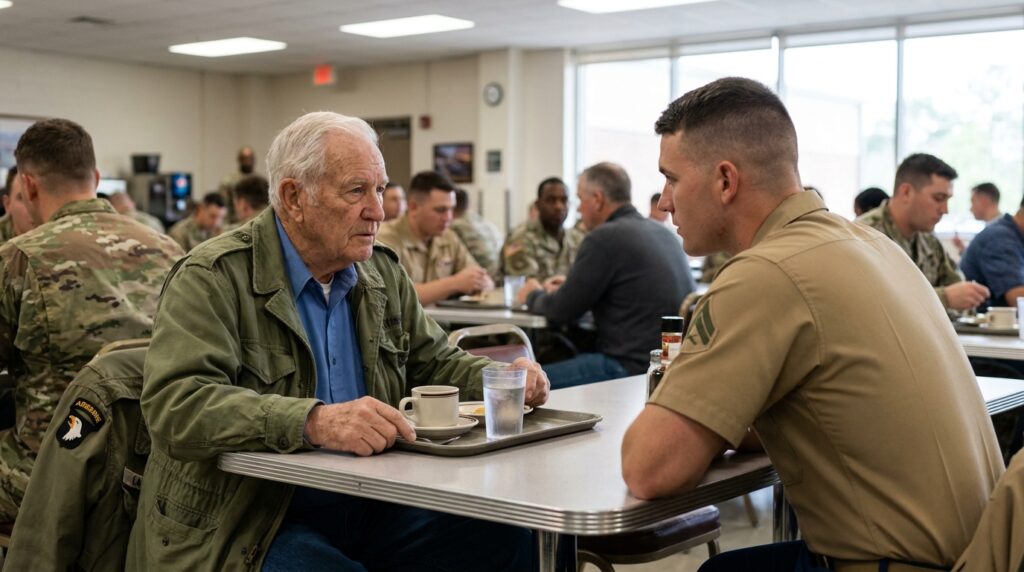
The threshold of the mess hall smelled of scorched lard and the sharp, chemical tang of floor sealant. It was a massive, low-ceilinged cavern of acoustic tile and fluorescent tubes that vibrated with a steady, low-frequency hum. Calvin Vance tracked the room from south to north, his eyes decoding the landscape before his boots took their second step on the polished terrazzo. To an ordinary civilian, it was a midday rush—four hundred hungry bodies in tan and olive drab pushing toward the steam tables. To Calvin, it was a grid of interlocking fields of fire, blind spots, and transit lanes currently occupied by personnel whose collective situational awareness had been dulled by routine.
He kept his brown leather folder tucked under his left bicep, his thumb resting lightly against the notched brass key-tag that lay hidden beneath his paper ration voucher. The metal was cold. It had a small, deliberate file mark across the third tooth—a detail not found on standard issue base keys. It was a minor anomaly, a micro-discrepancy that had stayed in his pocket since he crossed the guard gate three hours ago.
Calvin moved toward the tray line with a measured, rhythmic stride. The tray he lifted from the stainless steel stack was standard brown Formica, its edges nicked and scarred by thousands of industrial dishwasher cycles. He selected a single small plate of generic meatloaf, a mound of gray-white potatoes, and a heavy glass tumbler of water. Every movement was calculated to draw zero attention; he was an old man seeking a quiet corner to digest bad news from a database. Yet, as he turned away from the cashier counter, he noted the subtle shifting of bodies forty feet ahead.
A group of four active-duty soldiers occupied the long table flanking the eastern exit lane. Their starched tan utility uniforms were pristine, the creases sharp enough to draw blood, but their posture was sloppy with the loose, unearned confidence of men who believed their immediate environment was entirely under their control. The youngest of the group—a specialist with an athletic, heavy-shouldered build and a high-and-tight haircut that revealed a thick, reddening neck—was leaning back on two legs of his metal frame chair. His boots were extended into the middle of the walking lane, a passive-aggressive blockade for anyone trying to navigate the row.
Calvin didn’t alter his vector. He walked toward an empty seat at the far end of their table, his boots making no sound against the floor.
As Calvin neared the extended boots, the heavy-shouldered specialist didn’t move them. Instead, he let the front legs of his chair drop onto the floor with a loud, deliberate slap that caused the water in Calvin’s glass to ripple in precise concentric circles. The other three soldiers at the table stopped talking. Their silence was sudden, sharp, and coordinated.
“You’re tracking dirt onto a clean floor, old-timer,” the specialist said. His voice wasn’t loud, but it possessed a flat, testing quality—the kind of tone used by a junior non-commissioned officer trying to see exactly how much weight a civilian would carry before they bent. He didn’t look up at Calvin’s face; he stared directly at the faded green fabric of Calvin’s sleeve, where the silhouette of an old, unstitched airborne patch left a darker, unweathered shadow in the canvas.
Calvin set his tray down on the laminate surface. The sound was a dull, heavy thud. He didn’t sit. He remained standing, his feet spaced twelve inches apart, his long, lined fingers resting lightly on the cold aluminum trim of the tray. He could see the specialist’s eyes—there was a slight, unnatural dilation in the pupils, a glassy sheen that didn’t match the standard fatigue of a morning detail. Underneath the starched collar of the tan uniform, a muscle in the young man’s jaw was twitching in a rapid, irregular rhythm. It was a physiological tell. The boy wasn’t just arrogant; he was vibrating on a current of internal panic, using physical aggression as a hard outer shell to keep something from spilling out.
“The table is public, Specialist,” Calvin said. His voice was low, gravelly, and entirely flat, devoid of the defensive spike the young soldier was clearly angling for.
“Public for base personnel,” the soldier replied, his hands planting firmly on the tabletop as he leaned forward, his torso invading the twelve-inch perimeter of Calvin’s workspace. The scent of him shifted—underneath the laundry soap, there was the sour odor of cold sweat and something synthetic, like burnt copper. “Not for administrative tourists who can’t find the exit gate. You’re in the wrong lane. Move your tray before someone moves it for you.”
The three soldiers beside him didn’t laugh. They watched with a rigid, uncomfortable intensity, their eyes darting toward the main aisle as if checking the distance to the nearest supervisor. They weren’t participating, but they weren’t stopping it either; they were locked into the specialist’s orbit, bound by a collective compliance that felt more like shared fear than camaraderie.
Calvin looked down at the specialist’s hands. The knuckles were white where they pressed against the laminate. Beside the young man’s thumb lay a small, official-looking document folder with a red security strip—a standard unit disciplinary file. Calvin’s eyes registered the serial prefix on the tab before the specialist subtly slid his forearm over the paper to obscure it. The prefix didn’t belong to a standard base company; it was a division-level holding action code.
The jigsaw pieces inside Calvin’s head began to align, the sharp edges of the scenario clicking into place with a cold, mathematical certainty. The specialist wasn’t defending his table; he was hiding a fire that had already been lit behind the scenes, and an old man with an obsolete uniform was the easiest target to burn for distraction.
Calvin reached for his glass of water, his fingers steady, his gaze remaining locked onto the specialist’s twitching jaw. He didn’t move the tray. He simply cleared his throat, the sound like gravel turning over in a cement mixer.








