
CHAPTER 1: THE BRASS THRESHOLD
“The system doesn’t back-date civilian claims from the mid-seventies, sir,” the clerk said. Her fingers didn’t stop tapping against the plastic edge of her keyboard. She wasn’t looking at him; she was looking at the small digital clock at the bottom right of her dual-monitor display. “If you didn’t update the signature block before the fiscal rollover, you’re essentially a ghost in the database.”
Calvin Vance did not shift his weight. He kept his feet spaced exactly twelve inches apart, his heels parallel to the tape line on the gray linoleum floor. It was a stance his lower spine remembered better than the names of his grandchildren.
“The signature is valid,” Calvin said. His voice was a dry, gravelly hum, scraped clean of any pleading cadence. “The authorization came out of Fort Bragg when the command structure was still analog. Look under the secondary ledger.”
The clerk let out a short, rhythmic breath through her nose—the universal currency of low-level base bureaucrats dealing with the left-over personnel of forgotten deployments. She clicked a mouse three times, the sound sharp and metallic in the air-conditioned sterile chill of the personnel detachment office.
“Nothing,” she lied. She didn’t want to dig into the archival directories. To her, the old man in the faded green field jacket was just an afternoon bottleneck, a collection of deep wrinkles, unpolished brass zippers, and a stubborn refusal to clear the window. “You’ll have to request a physical file pull from St. Louis. Come back in six to eight weeks.”
Calvin looked at the reflective tint of the glass barrier separating them. He could see his own reflection—the stark white hair clipped close at the temples, the skin around his jaw tight but sagging slightly at the throat. He also saw the shadow of three active-duty soldiers waiting in line behind him, their starched tan utility uniforms smelling of fresh laundry detergent and gun oil. They were leaning against the security rope, their fingers hooked into their belt loops, their eyes fixed on the back of his head with an undisguised, restless impatience.
“Six weeks,” Calvin murmured. He didn’t argue. In his line of work, arguing was an admission of a weak position. If the database was blind, he would find an alternate entry point. He reached down, his fingers locking onto the worn edge of his brown leather folder, and pulled it back toward his chest with a smooth, unhurried economy of motion.
“Next,” the clerk called out, her voice already rising an octave to welcome the youthful, valid identification card of the specialist standing behind Calvin.
The young soldier didn’t wait for Calvin to turn. He executed a sharp, deliberate side-step, his shoulder brushing against the rough canvas of Calvin’s sleeve as he passed. It wasn’t an accident; it was a calibrated assertion of space, the subtle crowding out of a civilian element that no longer contributed to the active readiness of the post.
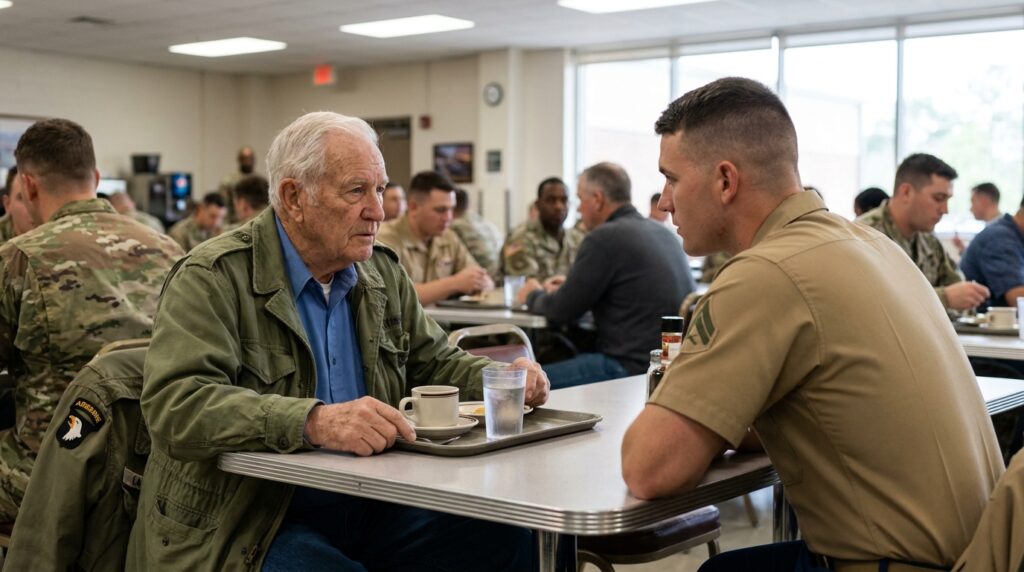
Calvin let the friction happen. He absorbed the impact through his shoulder without breaking his balance, his eyes narrowing slightly as he logged the specialist’s unit patch—the crossed rifles of the infantry, pristine and perfectly centered. He turned toward the double doors leading to the central quadrangle, the heavy smell of institutional grease and burnt coffee drifting from the mess hall across the alleyway. His stomach gave a small, hollow pull. He needed a place to sit, a flat surface to re-examine his documents, and a tactical assessment of who was running the administrative office from behind the curtain. He pushed through the heavy brass-plated doors, entering the midday glare of the base cafeteria.








