
CHAPTER 3: THE ANATOMY OF THREAT
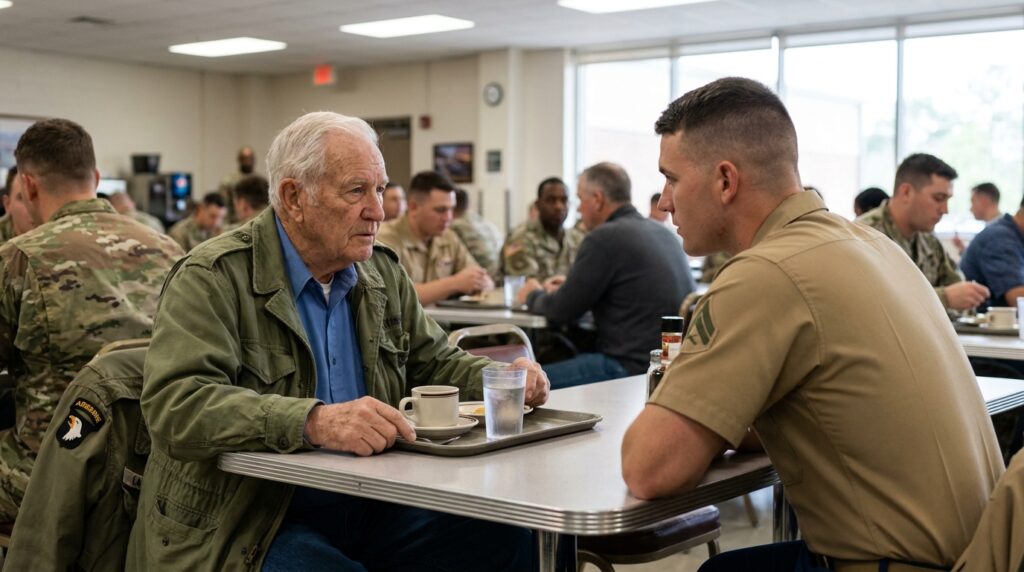
“Drink the water if you’re thirsty, old man, but do it somewhere else,” the specialist said. His left hand flat-lined against the Formica, his fingers spreading like out-of-spec industrial clamps. The twitch in his jaw had stabilized into a rigid, hard-set lock, the muscles over his cheekbones white and bloodless under the glare of the fluorescent tubes.
Calvin Vance let the cool glass slide an eighth of an inch between his calloused fingertips. He did not lift it to his lips. To break eye contact now would be to cede the physical corridor he had established with his own posture. His green field jacket felt heavy across his shoulders, the coarse wool lining retaining the chill of the personnel building while the humid air of the mess hall grease traps clawed at his neck.
“The space is adequate for two,” Calvin said. His gravelly pitch remained unmodulated, dropping beneath the high-volume chatter of the adjacent tables where a dozen junior personnel were arguing over a training rotation. “And the folder you’re covering with your sleeve indicates your unit has an open administrative hold. Red stripe. Serial block zero-nine.”
The specialist’s torso stiffened, his shoulders squaring until the starched canvas of his tan uniform bunched behind his neck. The three soldiers flanking him stopped tracking the room entirely. One of them, a lean private with grease under his fingernails from the motor pool, cleared his throat and made a subtle, five-inch retreat with his stool. The perimeter was widening, not out of respect, but out of the primitive survival metric that governs small units when an undetected mine is clicked underfoot.
“You don’t read the labels on my desk,” the specialist whispered. The low velocity of his voice carried the distinct scent of stale adrenaline and the synthetic, bitter residue of chemical stimulants. “You don’t look at my uniform. You don’t exist on this post anymore, pop. You’re a ghost with a tray. Now pick it up and walk before I lose my patience.”
Calvin logged the distance between them: twenty-two inches. The table edge was precisely waist-high on the specialist, who was now standing on the balls of his feet, his weight shifting forward into a dynamic incline. It was a textbook tactical posture for an unannounced physical check—an intimidation wedge designed to force a civilian backward into the transit lane where they would lose their balance against the incoming flow of personnel.
“The division code on that folder is a holding action for an Article 32,” Calvin continued, his internal monologue cold, rapid, and wholly transactional. He wasn’t guessing; he was reading the structural anatomy of the young man’s desperation. The drug dilation in the pupils, the unanchored aggression, the red-striped file hidden like contraband—it wasn’t a show of force. It was a structural cover-up. “An administrative isolation for unauthorized substance distribution within the motor pool. You aren’t defending a table, son. You’re trying to keep that jacket from being stripped down to the threads before the general’s clerk signs the morning log.”
The specialist’s face lost its remaining color, replaced by an ugly, dark flush that started at the starched seam of his collar and rushed into his cheeks. The accusation was accurate enough to strike the bone. The equal intellect rule dictated that an adversary with their back against a structural wall would not retreat; they would double the leverage of their error to suppress the threat.
“Shut up,” the young soldier hissed. His right hand left the table, his fingers hooking into a rigid, curved claw as his arm pulled back six inches—the universal mechanical chambering for a collar grab or a heavy, close-quarters shove. “You don’t say another word about my file. You don’t even breathe toward this table.”
The two remaining soldiers at the table stood up, their movements clumsy with panic. They didn’t draw closer to support the specialist; they stood as human barriers, their eyes tracking the high-definition security bubbles hanging from the acoustic tiles fifty feet away. They were calculating the structural cost of being associated with a public assault in a base facility.
“Miller, don’t,” the lean private from the motor pool muttered, his voice a thin, dry warning that went entirely unheeded. “Sit down. The duty sergeant is at the western kiosk.”
The specialist, Miller, didn’t look back. His focus had narrowed into the high-risk, low-visibility blindness of a cornered animal. He stepped around the corner of the Formica table, his heavy combat boots squeaking against the polished terrazzo as he entered Calvin’s primary interaction lane. His chest was now six inches from the veteran’s shoulder, his larger, athletic frame completely eclipsing the light from the eastern window line.
Calvin didn’t alter his stance. His heels remained locked on the parallel axis. He felt the cold iron of his hidden brass key against his ribs, a reminder of why he had entered the gate. He wasn’t here to survive a minor bureaucrat or a broken soldier; he was here because the Pentagon’s readiness committee had noted a systemic rot in the lower-tier commands. This boy wasn’t the rot—he was just the fruit.
“Step back, Specialist,” Calvin said, his gravelly voice dropping an octave until it resonated inside his own chest cavity. It wasn’t an order from a superior rank; it was the final mechanical detent before a heavy spring is released.
Miller’s right hand shot forward, his fingers targeting the green canvas of Calvin’s lapel. The movement was fast, driven by a surge of unmetered chemical energy, but the trajectory was linear, predictable, and devoid of the disciplined weight that comes from real operational exposure.








