
CHAPTER 6: THE BROKEN RECOGNITION
The heavy steel security doors at the far end of the mezzanine didn’t just swing open; they rattled against their frames, throwing a sharp, metallic echo across the subterranean concrete. The heavy boots of the late-shift supervisors struck the stairs in a fast, rhythmic cadence, but Frank didn’t turn his head toward the sound. His boots remained anchored. His gaze stayed fixed on the three-times-folded paper resting in the dirt between his leather toes, and on the small, scarred identification tag that lay inches from Marcus Fletcher’s trembling knee.
“Vance!” The voice of the shift captain came down the platform, flattened by the low acoustic ceiling of the station. “Hold him there. Don’t let him move.”
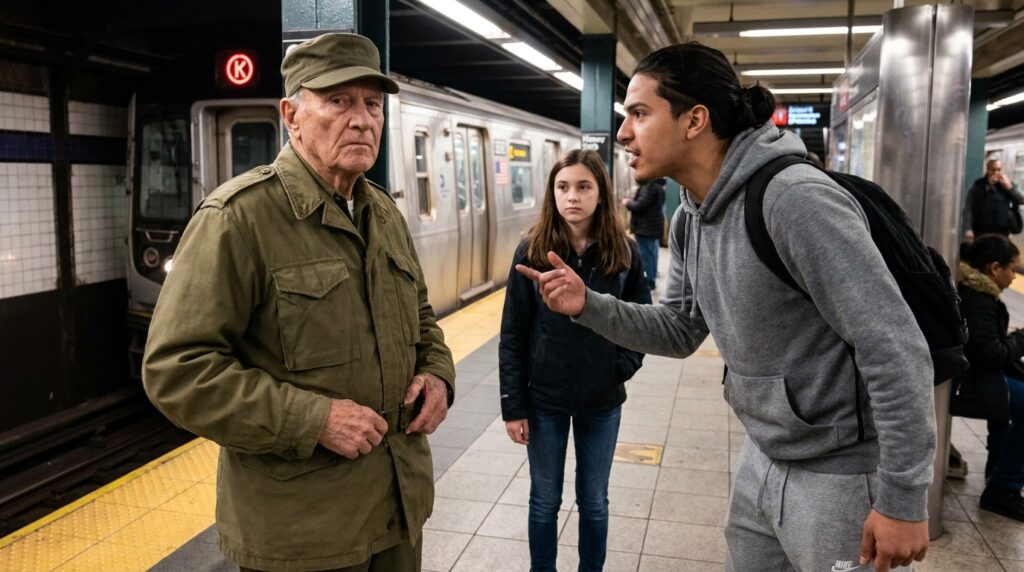
Marcus didn’t try to move. The young man stayed on the floor, his long dark hair hanging like a split veil over his face, a single drop of sweat slipping from his chin to darken a tiny circle of the gray terrazzo. His fingers were completely still now, resting near the edge of the frayed document he had defended with such desperate, unweighted bravado only minutes before.
Frank slowly knelt. The movement was a deliberate, mechanical protest of his joints, the coarse wool of his trousers tightening against his knees as he lowered his tall frame onto the cold platform floor. He didn’t use the sudden authority of the oncoming guards to press his advantage. Instead, his thick thumb, rough with the deep grease-scars of an old logistics yard, reached out and turned the stamped aluminum identification tag over.
The metal was cold, thin as a shaved coin, its edges rimmed with a dull white oxidation that only came from months of contact with human salt and sweat. Frank’s eyes didn’t track the bold blue letters of the Veterans Administration header anymore; they tracked the secondary serial string stamped along the lower lip of the aluminum tag. It was a sequence he had written into three dozen shipping manifests during the winter of ninety-four—a company registry that belonged to his own detachment, the final logistics unit to pull out of the lower valley before the base was deactivated.
And beneath the registry number, hidden under three deep, deliberate scratches that looked like they had been carved with the tip of a service blade, was a name.
David J. Vance.
The watch inside Frank’s breast pocket gave a loud, uneven thud against his ribs—a heavy, isolated striking of gears that seemed to suspend the entire subterranean basin in a strange, slow-motion freeze. The roar of the idling subway cars seemed to drop an octave, turning into a low, oceanic murmur that hummed inside the bones of his head. He didn’t look at Marcus’s face; he looked at the boy’s wrists, noticing for the first time the slight, curved indentation of the bone where the radius met the joint—the exact genetic architecture of his own hands, passed down through an estranged son who had walked into the gray light of the state clinic three years ago and never returned.
“Grandpa?” Chloe’s voice was a tiny, fragile thread that barely reached him from the space above his shoulder. She had knelt beside him, her small hand coming down to touch the coarse olive cloth of his sleeve, her brown eyes widening as she tracked the path of his thumb across the salt-rimmed metal. “Grandpa, what is it?”
Frank didn’t answer her. He couldn’t clear the gravel from his throat. The entire moral landscape of the platform had dissolved, leaving behind only the faded, fraying textures of a family history that had been ground into the urban dust. The boy in the gray hoodie wasn’t an anonymous boundary-crosser looking for clout among the pillars; he was a runner tracking a ghost through the cold corners of the lower transit yard, systematically baiting every uniform on the line in a frantic, undisciplined effort to find the old man who shared his blood.
“You’ve been looking for the logistics file,” Frank said, his voice dropping into a whisper so low it was completely buried beneath the hum of the train’s compressor. “That’s why you had the discharge form. You didn’t steal it from a locker. He gave it to you.”
Marcus didn’t raise his head. His shoulders hitched once—a silent, jagged tremor that shook the heavy fleece of his hoodie. His hand closed around the document, his knuckles turning white as he pulled the creased paper against his chest, holding it like a shield against the heavy boots that were now clearing the yellow safety tile just twenty feet away.
“He told me there was someone down here who still remembered the company,” Marcus whispered, his voice cracking into the damp air, entirely devoid of street cadence. “He said if I found the uniform with the Fort Bragg patch, I’d find the line.”
The shift captain’s shadow fell over them—a wide, dark outline that blocked out the cool glare of the nearest fluorescent strip. Behind him, two transit officers stood with their hands resting on their utility belts, their faces set in the hard, institutional neutrality of the city.
“Vance, get up off the deck,” the captain commanded, his boots stepping onto the yellow tactile plating. “We’ve got the transport unit coming down the elevator. We’ll take the kid from here.”
Frank didn’t rise. He kept his large frame positioned between the officers and his grandson, his hand remaining gently resting on the concrete beside Marcus’s knee. The cracked crystal of the pocket watch against his chest ticked one final, heavy stroke, the vibration traveling through his uniform coat like an old promise that had finally run out of platform.
“The kid isn’t a transport case, Captain,” Frank said, his gravelly voice rising from the floor with an absolute, un-yielded command that made the officers halt mid-stride. He reached down, took the corner of the gray fleece hoodie, and pulled Marcus slowly toward his shoulder, the coarse wool of his old uniform absorbing the boy’s silent, shaking grief. “He’s with me.”








