
CHAPTER 2: THE ENCROACHING SHADOW
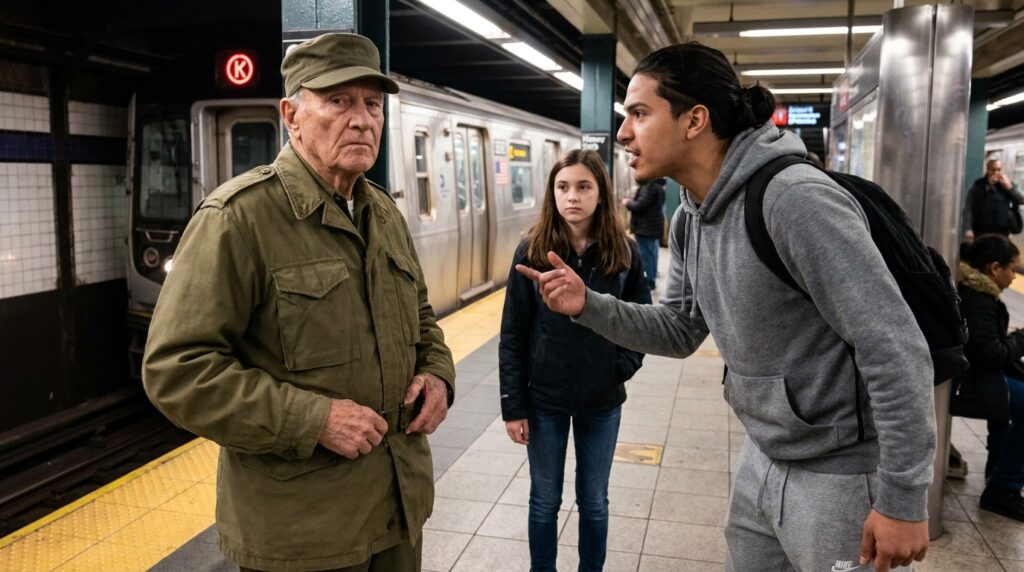
“You’re in the way, old man,” Marcus Fletcher repeated, his voice dropping into a register that was meant to slice through the ambient hiss of the 14th Street tunnels.
Frank didn’t shift his boots. The rubber soles of his security issue footwear remained firmly planted across the seam of two concrete slabs, right where the yellow tactile plating began its warning line. The station air was thick, tasting of old oil and the metallic dust scraped from thousands of daily braking pads. It was a faded texture he had known for forty years, long before the city transit authority had changed the color of their uniform patches from silver to this muted, uninspired olive.
“The platform is wide enough for a man with eyes, son,” Frank replied. He kept his hands low, the fingers relaxed but curled slightly inward, a heavy habits-of-the-service positioning that kept his center of gravity uncommitted. “The train doors open in thirty seconds. Step back into the lane.”
Marcus didn’t retreat. Instead, he leaned forward, using the loose, shifting mass of his gray fleece hoodie to mask the narrow frame beneath it. He smelled of cold asphalt and cheap tobacco, an aggressive, frantic heat radiating from his skin that spoke of hours spent drifting through the upper mezzanines. Behind Frank, Chloe’s fingers dug deeper into the canvas strap of her bag, her small knuckles turning the color of chalk. Frank could hear her breathing—shallow, rhythmic hitches that rattled against the damp roar of the oncoming train.
“I don’t see a lane,” Marcus said, his eyes scanning the faded brass button on Frank’s collar. His smile was small, thin, and entirely devoid of warmth, the calculated smirk of a boy who knew the crowd would rather record a tragedy on their small screens than step into the friction to stop one. “I just see a lot of old cloth that needs to get out of the light.”
The distant commuters had already begun to form the circle—the silent, non-participatory witness layer of the city. They didn’t move to help; they simply slowed their paces, their heels making a dull, scraping cadence against the terrazzo as they adjusted their paths to maintain visibility. A few hands slid toward pockets, the familiar, dark rectangles of smartphones peeking out from wool coats. They were waiting for the old man to break, for the fragile authority of the transit patch to dissolve under the weight of modern indifference.
Frank ignored them. His focus remained locked on the small space between Marcus’s chin and the frayed drawstrings of his hood. But his peripheral vision, trained in darker fields than these concrete tubes, caught the rhythmic swing of the key ring tucked inside Marcus’s fleece pocket. The scarred military identification tag bounced against the dark fabric, its stamped aluminum surface showing deep, jagged gouges that looked like they had been made by a survival knife or concrete friction. It wasn’t surplus. The serial number sequence was old—the prefix belonged to a logistics company out of Fort Bragg, the same unit Frank’s company had supported during the tail-end of his final deployment.
“You’ve got people watching you, kid,” Frank said, his gravelly voice dropping an octave, carrying the heavy weight of a command that didn’t need to shout to be felt. “They aren’t looking at you because they respect you. They’re looking because they want to see how hard you hit the floor when the momentum changes.”
Marcus’s jaw tightened, the smirk vanishing behind a sudden, sharp tensing of the throat muscles. To his left, one of the teenagers from the emergency gate called out—a short, high-pitched whistle meant to signal that the transit police hadn’t cleared the turnstiles yet. The platform was an island, and for the next twenty seconds, the rules belonged entirely to the two men standing on the yellow tile.
“You think you’re still something, don’t you?” Marcus whispered, stepping another three inches into Frank’s personal space, his shoulder checking the air just enough to brush against the stiff fabric of Frank’s sleeve. “You’re just a uniform the city forgot to throw away.”
Frank felt the watch in his breast pocket tick against his ribs—one loud, uneven thud that felt remarkably like a warning. The air coming out of the dark mouth of the tunnel was turning hot, pushing a wave of trash and dry paper before it. The train was coming. The yellow safety bumps beneath his boots began to vibrate, a low-frequency hum that traveled up his legs and settled into his lower back.
He didn’t look back at Chloe. He didn’t need to. He knew exactly where she was standing, her small frame shielded by his mass, her eyes wide with the terror of a child discovering that the world didn’t care about the silver oak leaves her grandfather kept in a velvet box at home.
“The uniform stays,” Frank said, his eyes never leaving Marcus’s pupils. “And you’re about to run out of platform.”
Marcus didn’t answer with words. His right hand came out of the fleece pouch, the fingers shifting into a rigid, clawed hook that targeted the center of Frank’s olive lapel—a kinetic invitation designed to pull the old man forward, to break his posture before the crowd could see what was coming next.








