
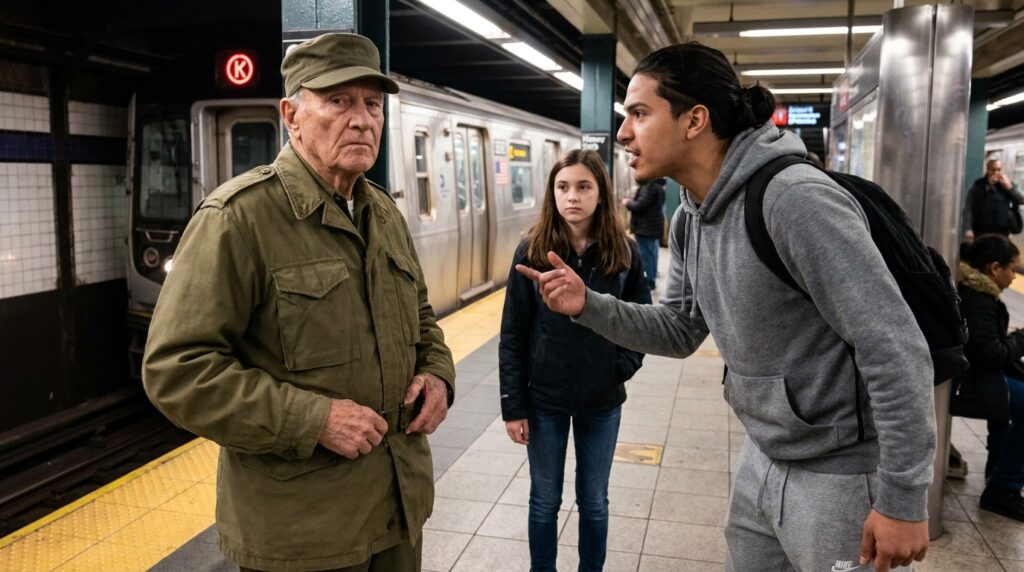
CHAPTER 5: THE WARNING ON THE FLOOR
Marcus’s scraping fingers missed the edge of the document by a fraction of an inch.
The three-times-folded paper lay flat against the transit dust, its creased corners curling upward into the humid, iron-scented draft of the platform. The blue ink of the official Veterans Administration header was raw, clear, and stark under the unshielded station lights. Frank didn’t move his boot to pin it down, nor did he reach down to claim it. He simply kept his tall, sturdy frame anchored between the boy on the concrete and the open doors of the idling subway car, his heavy gaze resting on the block letters that detailed a medical facility discharge from three weeks prior.
The name on the form was heavily redacted with thick, marker-drawn lines, but the secondary tracking sequence—the operational code for the regional veteran support registry—remained entirely legible.
“Don’t touch that,” Marcus whispered, his voice cracking into a ragged, high-pitched plea that completely stripped away the last remaining traces of his street posture. He didn’t look up into Frank’s eyes; his gaze remained desperately fixed on the paper, his thin shoulders trembling beneath the oversized gray fleece of his hoodie. “It’s not yours. It doesn’t belong to you.”
“The paper belongs to the state, kid,” Frank said, his gravelly voice dropping into that quiet, low-frequency register that carried the density of an old command log. “But the stamp at the top tells a story about someone who didn’t get their papers processed right. Someone who walked out of the clinic doors before the medication cycle was finished.”
Chloe stepped forward, her soft leather shoes making a tiny, distinct click against the gray terrazzo as she moved closer to Frank’s side. The terror that had frozen her chest during the boy’s initial approach had faded into a strange, watchful reverence, her long brown hair catching the flickering reflection of the train’s cabin lights. She looked at Marcus, then down at the paper, her brows knitting together as she noticed the small, tarnished military-issue identification tag dangling from the key ring that had spilled from Marcus’s pocket during the fall.
“Grandpa,” she murmured softly, her fingers lightly tapping the stiff olive cloth of his sleeve. “Look at the tag. The stamp sequence on the lower rim.”
Frank didn’t shift his head, but his peripheral vision locked onto the aluminum rectangle resting near Marcus’s knee. The jagged gouges across the metal face were deep, but they didn’t completely cover the stamped company markings—the specific registry numbers for a logistics company out of Fort Bragg that had disbanded the same winter Frank had returned to civilian life. The tag wasn’t a surplus imitation or a piece of street jewelry. It was an original, worn down by years of pocket friction until the edges were as thin as a copper coin.
Around them, the witness layer remained frozen in a dense, unnatural silence. The commuters inside the train cars stared through the glass windows, their faces pale and unmoving, like a gallery of painted portraits. On the platform, the hands holding the smartphones had dropped down to chest-level, the glowing screens dark or neglected as the crowd realized the confrontation had shifted entirely away from a dynamic public altercation into a private, devastatingly quiet reckoning between two generations.
“You’ve been spending your mornings in the lower yard,” Frank said, his boots remaining perfectly still across the concrete seam. “That’s why you’ve got maintenance grease on the hem of that fleece. You aren’t jumping turnstiles for the thrill of it, son. You’re looking for the people who sleep near the generator housing.”
Marcus didn’t answer with words. He slowly pulled his hand back, curling his fingers into his palm as if trying to preserve the warmth of a grip that had already broken. His head dropped forward, his long dark hair falling like a curtain across his lined, sweating face, his breathing coming in shallow, ragged stabs that rattled against the heavy, mechanical idling of the train.
“You don’t know anything about the yard,” Marcus whispered, the words muffled by his hair, his tone slipping into a subdued, bitter regret. “You just wear the jacket. You just walk the line.”
Frank felt the brass pocket watch tick against his ribs—one loud, uneven thrum that seemed to mark the exact point where the structure of the day’s duty collapsed into something far heavier. He knew the maintenance bays better than any supervisor on the payroll; he knew the cold corners where the steam pipes leaked, the hidden access tunnels where the city’s forgotten veterans crawled to escape the winter drafts, and the names of the three men who had vanished from the state registry without a trace.
“I walk the line because I know who’s crossing it,” Frank told him, his gravelly voice maintaining its unhurried, steady weight. “And I know that form wasn’t given to you by a clerk. You took it out of a locker, or you found it in a bag left behind in the dark.”
Marcus finally looked up, his dark eyes wide and glossy under the stark fluorescent glare, all the manufactured aggression entirely drained from his expressions. He subdues his tone, avoiding direct eye contact with Frank as his hand twitched one last time toward the paper.
“Okay,” Marcus whispered, the word barely audible over the low hum of the train’s compressor. “Okay, I get it. Just… don’t let them take the paper.”
Before Frank could reach down to answer the request, the iron-scented air of the station split once more as the heavy steel security doors at the far end of the mezzanine groaned open, signaling the arrival of the late-shift supervisors and the transit police.








