
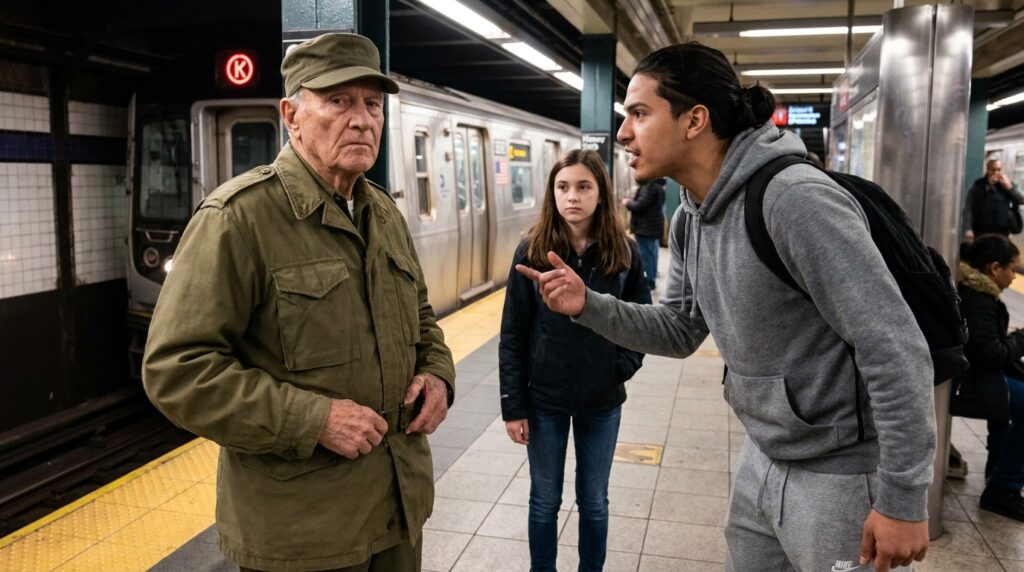
CHAPTER 3: THE THREAT AT THE BOUNDARY
Marcus’s fingers never found the coarse weave of the olive lapel.
The movement was loud in its intention but slow in its execution, a telegraph born of street bravado rather than the brutal, economic geometry of survival. To Frank, whose perception of conflict had been forged in environments where an unhedged inch cost a life, the reaching hand looked like an object drifting through stagnant water. He didn’t flinch. He didn’t step back onto the yellow warning bumps where the train’s massive steel body was already slicing through the hot subterranean air, screaming its arrival with a high, mechanical shriek.
Instead, Frank adjusted his weight by a fraction of an inch, sinking his hips into the cold, vibrating foundation of the platform. His left hand came up—not to strike, but to intercept. His palm, rough and leathered by decades of manual labor and service grip, met the inside of Marcus’s wrist. The contact was a dull thud against the roar of the incoming locomotive, a localized friction where two generations rubbed raw against one another.
“Step back from the line, son,” Frank said.
The words were spoken directly into the pocket of dead air between them, completely unhurried, even as Marcus’s shoulder twitched with the realization that his forward momentum had been met by a stone wall. The boy’s fingers curled into an empty claw just inches from Frank’s chest, the gray fleece bunching at the elbow.
Chloe let out a sharp, choked breath behind them. Her small hands found the back of Frank’s heavy coat, anchoring her trembling frame to the only stable object in the entire underground basin. Frank could feel her terror through the stiff wool—not just a fear of the aggressive boy in front of them, but the deep, foundational panic of a child watching the fragile order of her world threaten to split open on the edge of a concrete drop-off.
“Let go of me, you old bastard,” Marcus hissed. He tried to yank his arm back, his sneakers sliding a fraction of an inch into the thin layer of grime covering the terrazzo floor. But Frank’s grip wasn’t an act of anger; it was a mechanical lock, the unyielding application of center-of-gravity physics that treated Marcus’s wrist like a structural joist.
The witness layer had completely crystallized now. The distant commuters didn’t look like people anymore; they were a wall of dark winter coats and pale, upturned faces, illuminated by the rhythmic flashing of the train’s warning lights as it began to clear the tunnel mouth. The smartphones were held high, their lenses catching the cool fluorescent glare of the overhead strips. They were silent, a collective jury waiting to see the old man dragged into the dirt, expecting the fraying seams of his late-career uniform to give way under the kinetic energy of youth.
Frank didn’t look at the cameras. He looked at the scarred identification tag dangling from the key ring inside Marcus’s pouch pocket, which was bouncing erratically as the boy struggled against the hold. Up close, the faded textures of the gray fleece revealed details that the dim station lighting had previously hidden—small, grease-stained smudges along the hem that matched the industrial lubricants used in the maintenance bays of the lower yard, the same bays where Frank spent his morning inspections.
“You’re breathing too fast,” Frank told him, his gravelly voice maintaining its low, steady cadence despite the howling screech of the train’s iron brakes just fifty feet away. “Your weight is entirely on your heels. If I let go of this wrist right now, you’re going to fall into the side of the second car.”
“I said, get your hands off me!” Marcus lunged forward with his opposite shoulder, using his entire slim mass to drive his elbow toward Frank’s jaw. It was a desperate, undisciplined correction—the reaction of a boy who had never faced a force that didn’t negotiate with noise.
Frank’s eyes didn’t track the swinging arm. He felt the shift in the air pressure, the heavy iron-scented draft of the approaching engine hitting them full in the face, blowing the brim of his weathered veteran cap upward just enough to expose the deep, pale scar across his forehead. The pocket watch against his ribs gave another dull, uneven thud, a rhythmic baseline that seemed to measure the absolute expiration of the interaction lane.
He didn’t use force. He used Marcus’s own frantic acceleration, twisting his own torso by three degrees to let the boy’s weight carry him into the empty space where the old man’s shoulder had been a micro-second before.








