
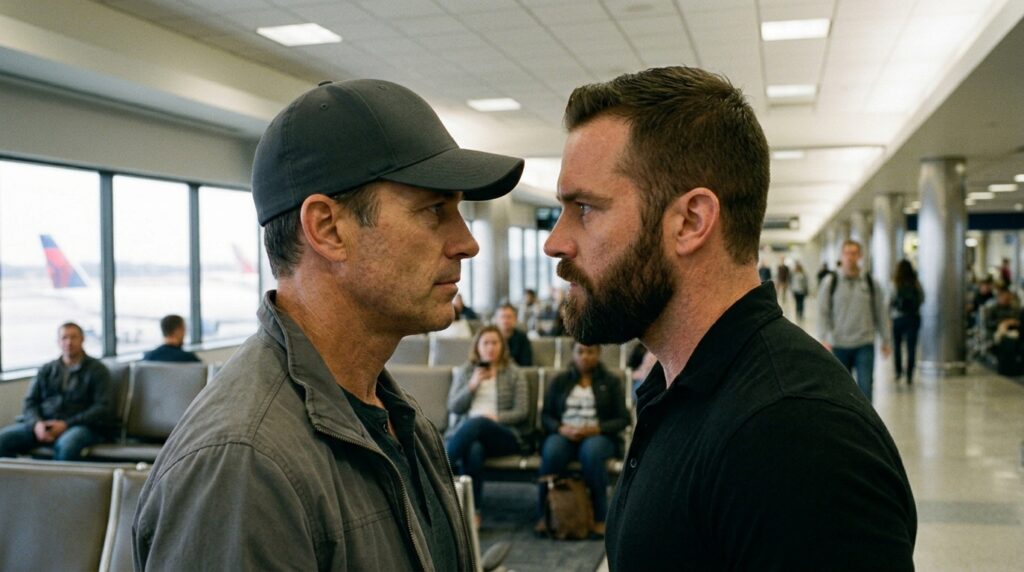
CHAPTER 6: THE RUSTED UNCOUPLING
The dust under the fire shutter tasted of zinc powder and decades of dead skin cells. Miller dragged his frame out from the six-inch crawlspace, his boots scraping dry across the pitted floor iron of a secondary baggage sorting platform. The air was entirely different here—colder, sharper, dominated by the heavy, sweet stench of industrial rubber vulcanization from the endless miles of intersecting luggage belts that twisted through the darkness like blind subterranean rivers.
He sat back against a massive steel junction frame, the rusted angle-irons biting straight through the tear in his gray jacket. His left shoulder was a solid knot of dull heat, but he forced the arm up, clamping his elbow against his chest to compress the joint. Under the desaturated amber hue of an isolated terminal maintenance light, he pulled the stolen manifest from his inner pocket. The paper was heavily creased now, damp with the oily residue of his palms.
He unrolled it using only his right hand, flattening the coarse sheet against the cold, rust-scaled side of a dead conveyor motor.
His eyes didn’t stop at the name AL_COOPER. He forced his focus downward, tracking the small, tightly packed alphanumeric strings printed along the bottom margin—the data rows the TSA officers had been waiting for their handheld scanners to clear. There was a secondary stamp across the base of the page, applied with an old ink-pad that had run dry during the impression. The purple ink was faded, oxidized into a dull brown, but the geometric shape was unmistakable.
It was an administrative discharge seal from the Department of Defense Logistics Agency, dated three months prior. But it wasn’t stamped over a list of active military assets. It was stamped over a corporate liquidation ledger.
Miller’s fingers tightened on the edge of the sheet, the paper tearing slightly at the margin. The bearded bully at the gate hadn’t been an active operative sent by an active command structure. The tracking manifest wasn’t a live surveillance log. It was an archived manifest of private security personnel who had been cut loose from the payroll after the Kabul liquidation—men whose contracts had been voided, whose clearance levels had been zeroed out, and whose tracking data had been dumped onto the private market.
The realization settled like cold lead in his throat. His retirement hadn’t been breached by a pristine, state-level network designed to bring a soldier back into the cold. It had been sold. The bearded man at the gate was a rogue contractor working for a scrap-tier data broker, using old operational logs to hunt down former field names for an entry-level payout. The elaborate setup—the confrontation, the crowding—wasn’t a strategic trap. It was the clumsy, desperate move of an unemployed mercenary trying to verify a face before his target slipped across state lines.
“You’re reading the old ledger, Miller.”
The sound came from the high catwalk above the primary conveyor belt. The voice was thin, dry, and punctuated by the mechanical, rhythmic click of a manual safety selector being switched off.
Miller didn’t look up immediately. He stayed in his lean against the motor casing, his eyes remaining on the faded brown stamp on the paper. The name of the firm listed below the liquidation mark was Vanguard Global Risk Management—the same parent entity that had leased the security detail to the airport authority.
“The uniform belongs to the gate,” Miller said, his voice dropping into the grinding resonance of the nearby sorting arms. “But the contract belongs to the scrap pile.”
A man stepped into the edge of the halogen beam on the platform ten feet up. It wasn’t the supervisor, and it wasn’t the bully. He wore the gray utilitarian coveralls of a terminal baggage handler, but his hands were steady on the receiver of a heavy, parkerized pump shotgun, the barrel pointed directly at the center of Miller’s chest. His face was identical to Miller’s in the ways that mattered—weathered around the eyes, skin dried out by high-altitude wind, and the posture of someone who had spent thirty years learning how to occupy a space without leaving a footprint.
“The company went under in April,” the man on the catwalk said. He didn’t drop the barrel an inch. “The digital keys were sold to three different recovery groups out of Boise. We aren’t here for the agency, Miller. We’re here because your old alias is the only thing attached to the unliquidated hardware accounts.”
“The accounts are empty,” Miller murmured.
“The bank accounts are,” the handler replied, his boots shifting slightly on the metal grating of the catwalk, the iron giving off a low, sharp ring. “But the cold-storage ledger isn’t. The broker wants the serial numbers from the deployment. He thinks they’re still moving through the domestic terminals.”
Miller’s thumb remained pressed against the knurled crown of his brass watch. The internal vibration hadn’t stopped; it had grown sharper, more intense, the microscopic pulse beating against his wrist like a buried wire trying to ground itself. The decoy secret—the idea that his old command had tracked him down to bring him back into the gray lane—was gone, shattered by the dry ink stamp on a piece of stolen corporate paper. He wasn’t being hunted by an empire. He was being scavenged by the survivors of a dead one.
But the final reality—the reason the watch on his wrist was still generating a rhythmic, physical pulse through its cracked crystal—remained hidden from the men on the catwalk. They thought they were hunting for bank records. They didn’t know what was actually sealed inside the casing.
A sudden, violent lurch shook the entire baggage platform. Fifty yards down the line, the main sorting carousel hummed back to life as the primary electrical sub-station auto-shunted its power to the secondary circuit. The massive rubber belts jerked forward with a high-pitched, screaming screech of friction that filled the room with the smell of burning tire code.
Miller didn’t look at the light. He used the instantaneous explosion of noise and movement to roll his mass to the right, his body disappearing beneath the heavy steel skirt of the primary sorting carousel just as the first blast of buckshot tore through the dead motor casing behind him, showering the iron floor with white-hot sparks and rusted metal flakes.








