
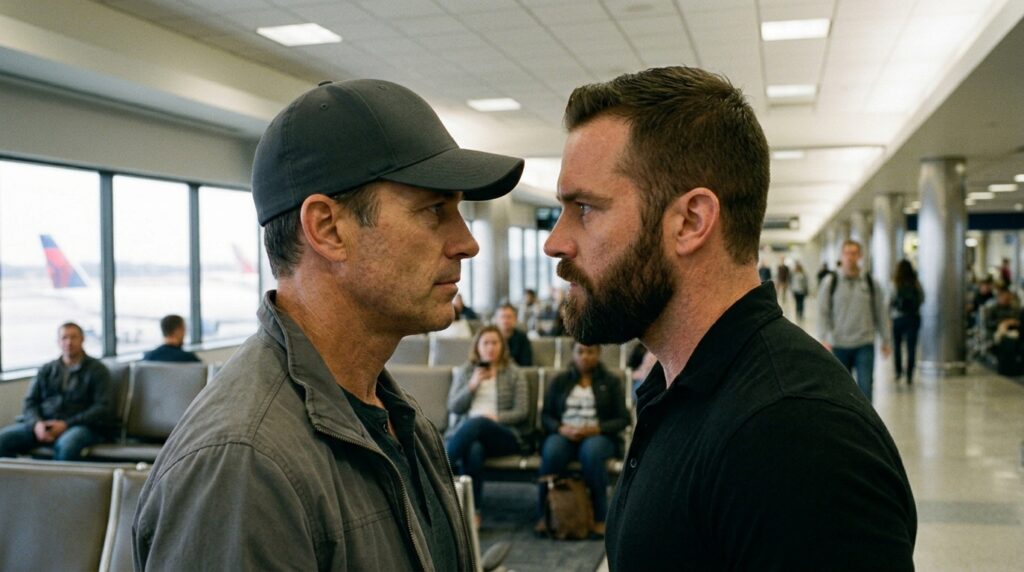
CHAPTER 2: THE WITNESS SHIELD
The silence didn’t break; it merely hardened, settling over Gate B12 like lime dust on a warehouse floor. The large, bearded man stayed down on the linoleum, his breath returning in short, rhythmic wheezes that sounded like a torn bellows. No one moved. The everyday travelers, frozen with their rolling carry-ons and half-empty coffee cups, formed an accidental ring around the seating row—a human wall built entirely out of modern hesitation.
Miller didn’t check his knuckles. He kept his hands low, fingers loose, his right shoulder slightly dropped to hide the split seam under his arm. He could feel the cold draft of the terminal air conditioning seeping through his gray jacket. His eyes remained fixed on the space two inches above the fallen man’s forehead, watching the rapid, involuntary twitch of the bully’s eyelids. That was the adrenaline peak. The realization of vulnerability.
“Hey! What the hell is going on over there?”
The voice came from fifty yards down the concourse—sharp, authorized, and accompanied by the heavy, rubber-soled squeak of airport security issue boots. Two TSA officers were cutting through the crowd near the duty-free shop, their blue shirts bright against the dull, desaturated background of the terminal.
The bully shifted, a low groan scraping past his teeth as he tried to roll onto his side. As he moved, his heavy leather carry-on bag—slung loosely over his shoulder during the initial approach—slid off his arm, the brass zipper bursting open against the corner of a fixed metallic seat. A cascade of personal items spilled across the floor: a travel shaving kit, a pack of wintergreen gum, and a thick, blue-bound paper folder with an industrial plastic spine.
Miller’s gaze dropped to the folder. Even from three feet away, under the yellowing fluorescent tubes, his eyes locked onto the header block printed on the top sheet. It wasn’t an airline itinerary. It was a standardized personnel manifest, its margins stamped with a three-letter defense contractor logo he hadn’t seen since the deployment in the Karakoram range six years ago.
Before he could process the print, the crowd closed the gap. The passengers weren’t looking at the bag; they were looking at the blue shirts rushing toward them.
“He targeted him,” a woman in a beige trench coat said, her voice rising to cut through the approaching authority. She stepped forward, physically placing herself between Miller and the first guard. “The big guy came straight out of the boarding queue. He was looking for a fight. The older gentleman didn’t even move until he was touched.”
“She’s right,” a man with a laptop case chimed in, nodding aggressively. “I saw the whole thing. The guy in the black shirt shoved him first. It was unprovoked.”
The witness layer was hardening into a protective shell, a collective defense mechanism that civilian crowds used when they recognized an absolute boundaries-crossing. They didn’t see Miller’s grip; they didn’t see the tactical pivot that used the big man’s weight against him. They only saw a quiet traveler in a plain baseball cap being crowded by an entitled bully.
The first security officer, a heavy-set man with a radio humming on his shoulder, slid to a halt between the two men. “Everyone stay back. Sir, don’t move,” he directed at the man on the floor, before turning his eyes to Miller. He took in the faded jacket, the unbranded cap, and the complete lack of sweat on Miller’s face. “You okay, pal?”
“I’m fine,” Miller said. He kept his tone small, cooperative, matching the profile of an exhausted technician who had simply defended his personal space. “He wanted the seat. I didn’t want any trouble.”
“He’s lying,” the man on the floor wheezed, his fingers clutching at the metal support beam of the seating row as he hauled his bulk upward. His face was a mottled, angry purple, the geometric beard smeared with a gray streak from the floor polish. “He… he broke my arm. Look at him. He knew exactly what he was doing.”
The officer looked at the bully’s arm, which was fully intact but trembling with a mixture of shock and exhaustion, then back at the crowd, which was already murmuring in collective disapproval of the bully’s claim. “Sit down, sir. We’ve got the police coming up from the main checkpoint. Just stay where you are.”
Miller used the distraction. He didn’t look like he was moving, but his left boot slid six inches to the side, his toe catching the edge of the blue-bound folder that had spilled from the leather bag. With a practiced, heavy drag, he drew the document back toward the shadow of his own seating row, out of the direct line of sight of the guards.
The texture of the paper was crisp, expensive—the kind of high-rag content stock used by logistics firms that didn’t exist on public registries. He knelt down, pretending to check his own canvas duffel bag, his hand sweeping low to gather the spilled papers before the security team could begin logging the scene.
His thumb hit the first page of the manifest. His eyes scanned the row items in the three seconds he had before the second officer turned around.
It wasn’t a standard corporate roster. It was a regional tracking log for active personnel transit through the Pacific Northwest corridor. And halfway down the page, highlighted in a faint yellow marker that looked green under the terminal lights, was a name he hadn’t used since the contract in Kabul went dark.
AL_COOPER / STATUS: IN TRANSIT / GATE B12.
Miller closed his hand over the paper, the dry stock crunching into his palm with a low, metallic rasp. His heart didn’t accelerate; his vision simply narrowed until the entire airport terminal felt like a painted backdrop. The bearded man wasn’t a frustrated traveler venting impatience. He was a marker. A spotter.
The second security guard turned back to Miller, his notepad out. “Sir, I need to see your ID and your boarding pass for the flight to Seattle.”
Miller reached into his jacket, his fingers moving past the folded document hidden in his inner pocket, his touch brushing against the cold, broken crystal of the brass watch on his wrist. The second hand was still dead, but the internal gears felt like they were spinning under his skin.








