
CHAPTER 11: THE SYSTEM CUT
The red light on the microwave terminal box didn’t blink; it grew solid, a dense, unyielding prick of crimson that seemed to drain the remaining amber warmth from the logging cabin’s damp corners. The air inside the small cedar room had grown thick, smelling intensely of old wire lacquer, overheated copper plates, and the wet, rotten pulp of the framing timbers. Miller felt the tiny green emitter inside his split watch casing vibrate one last time—a sharp, mechanical sting that traveled straight up his numb left forearm like an electric needle.
The download loop was closing. The countdown had reached zero.
“It’s finishing, Miller,” the supervisor muttered from the overturned crate. Her right hand remained clamped onto the steel crank of the dead generator, her fingers white-knuckled and trembling from the sudden drop in tension. “The keys are clearing the satellite buffer. Once that stream prints to the ring terminal, the shadow network is theirs. They’ll have the unflagged routes for the next ten years, and our names are the only markers left on the waste ledger.”
Miller didn’t move his boots. He kept his heels planted firm into the soft, rotting plywood floor, his low center of gravity absorbing the rhythmic shudder of the storm outside. His ruined gray canvas jacket hung loose off his left shoulder, the raw canvas stiff with grease and dried lime dust from the airport tunnels.
He didn’t look at her face. He looked at the gray coaxial cable connecting the junction box to the floorboards. It was the only line left that tied him to the entity that had manufactured his entire life.
“The contract was already voided,” Miller said. His voice was a flat, desaturated rasp that barely carried across the three feet of empty space between them. “They just wanted the signature.”
He didn’t draw a tool. He didn’t have the three minutes required to trace the circuit or pry the copper lugs from their terminal housing with his fingers. He shifted his mass three inches to the left, his right hand reaching down to grip the heavy iron handle of the manual line-separation switch mounted to the side of the junction box. The iron was heavily oxidized, flaking away in small, orange scales that crunched under his calloused palm like dried bone.
The switch was built for industrial logging equipment—a brutal, spring-loaded bar designed to sever a high-voltage circuit instantaneously in case of a cable snap.
A heavy boot heel hit the low cedar step of the cabin door behind them.
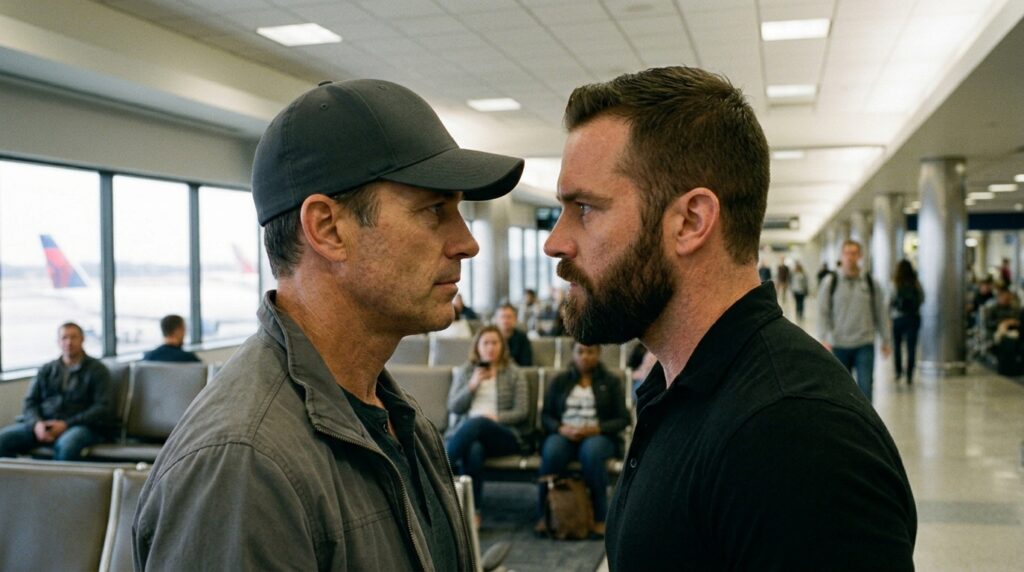
The frame didn’t give way, but the door panel groaned as a shoulder hit the latch from the outside. The rusted iron hinge pins squealed—a sharp, high-frequency scream that cut straight through the gray noise of the rain. The handler from the baggage pit stood in the opening, his gray coveralls soaked black, his face desaturated and hollow beneath the dripping brim of a dark cap. He didn’t have the shotgun anymore, but his right hand was buried inside his utility pocket, the heavy, blocky outline of a compact pistol tracking toward the center of Miller’s ribs.
“Step away from the line, Miller,” the handler said, his breath whistling through his teeth in short, cold plumes of gray vapor. “The terminal is locked. The download is verified. If you break the loop now, the encryption drops into a hard-cycle wipe. Nobody gets the routing keys.”
“That’s the idea,” Miller murmured.
He didn’t look back to check the alignment of the barrel. He didn’t try to execute a cinematic defensive pivot with his locked left shoulder. Time dilated, slowing down to the precise, heavy rhythm of the gear teeth inside his watch. He felt the cold iron of the switch handle against his palm, the texture of the rust scale biting into his skin, the sharp, oily scent of the generator grease rising from the floorboards.
He threw his full physical weight onto the lever.
The iron bar didn’t slide; it snapped down with a violent, concussive crack that released thirty pounds of stored spring tension inside the box. A blinding blue arc-flash erupted from the copper terminal block, filling the narrow shack with the sour, chemical smell of ozone and vaporized insulation. The red diode on the panel blinked once, turned a dull, smoky black, and dissolved into dead glass.
The compact pistol fired from the doorway—a sharp, metallic pop that sounded small against the roar of the machinery and the storm. The round tore through the cedar siding two inches above Miller’s right shoulder, showering his face with sharp splinters of dry wood and oxidized lacquer.
But the line was severed.
The green emitter beneath the split crystal of his watch went cold, its internal heartbeat stopping completely as the hardware drive sensed the absolute vacuum on the receiving terminal. Across the state line, inside the deep basement of the ring, the monitor screen would be showing a flat gray baseline—the encryption keys scrambled into an unreadable string of zero-value code that could never be reclaimed by the system.
The handler dropped his arm, the weapon lowering toward the floor as the small red light vanished from the junction box. His face was identical to Miller’s in the final twilight of the cabin—just as tired, just as gray, and completely empty of the corporate logic that had brought them to the same dead end.
“The tracking lane is closed,” Miller said, his voice dropping into the absolute silence that followed the electrical pop.
He didn’t wait for the handler to rack the slide or chamber another round. He gathered his canvas duffel bag with his right hand, his fingers checking the cracked brass watch face one last time. The crystal was broken, the steel casing split, but the skin beneath it was whole. He stepped past the supervisor, past the quiet shape in the doorway, and walked out into the cold, open-air friction of the logging road, his boots sinking into the wet mud as the gray horizon opened up before him, completely clean.








