
CHAPTER 3: THE FLICKER LANE
“The system is running slow today, Mr. Cooper,” the second TSA officer muttered, his thumb tapping the edge of Miller’s laminated driver’s license against his handheld terminal. The plastic casing of the scanner was chipped and scratched, its screen emitting a low, sickly green hue that matched the desaturated lighting of the gate.
“The grease gets into everything,” Miller said softly. He stood with his knees slightly bent under his denim jeans, a loose posture that hid the tension locking his lower back. His left hand remained buried deep inside his gray canvas jacket pocket, fingers resting against the heavy, fiber-textured stock of the stolen manifest sheet. “The heat from the runway doesn’t help.”
The officer didn’t answer. He turned the scanner toward the glass partition of Gate B12, looking for a clearer signal. Through the triple-paned acrylic window, the Boeing 737 sat motionless at the jet bridge, its metal skin looking like dull lead under the low, iron-gray clouds of the Pacific Northwest afternoon. Fuel trucks crawled across the concrete below like beetles in grease, their yellow strobe lights rhythmic and mechanical.
Then, the background hum died.
It wasn’t a sudden explosion; it was an extraction of weight. The heavy, omnidirectional thrum of the terminal’s main climate control fans clicked off, followed instantly by the high-frequency whine of the terminal display boards. The red arrival times blinked twice, shifted to a jagged string of nonsensical symbols, and then dissolved into dark gray glass.
A collective murmur passed through the seating rows—the familiar, heavy sigh of three hundred travelers being told without words that their delay had just become indefinite.
“Power drop,” the first guard said, his hand moving automatically to the radio on his shoulder. He clicked the toggle three times. The only response from the small speaker was a dry, high-pitched squelch that sounded like sand being thrown against a tin roof. “Comms are down. Davis, check the corridor link.”
The light didn’t vanish entirely. The emergency strips along the baseboards flickered to life, casting an amber, desaturated glow that caught the dust motes rising from the commercial carpet. The shift in illumination completely altered the geometry of the space—deepening the shadows between the fixed metal chairs, turning the glass corridors into long, reflective mirrors.
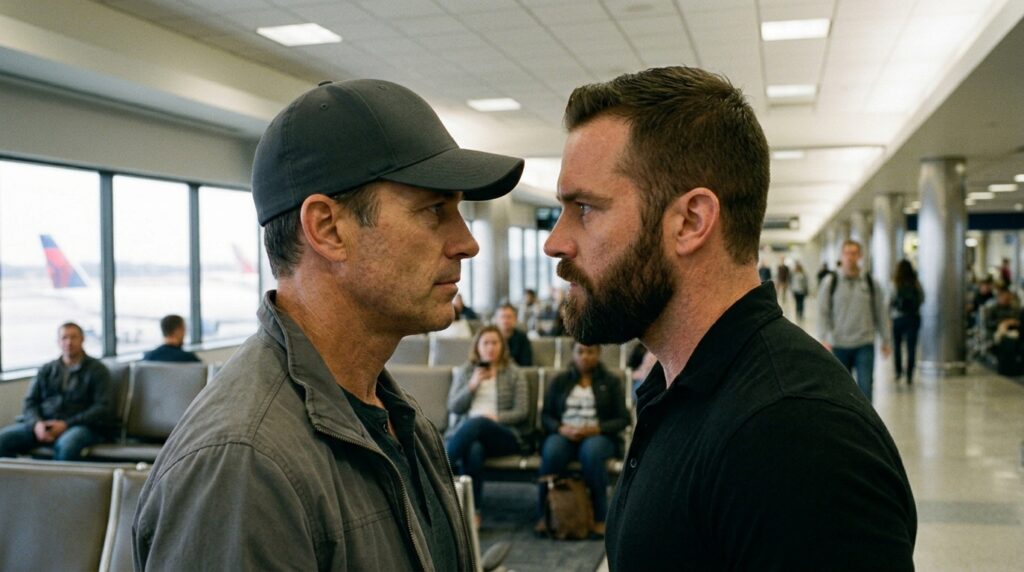
Miller didn’t move. He felt the cold iron of the seating rail behind his leg. His focus was three yards to his left, where the large, bearded bully had been sitting under guard. The man was gone. In the sudden twilight of the blackout, his seat was empty, the heavy leather carry-on bag missing from the linoleum. Only a stray strip of plastic binding spine remained, glinting in the low orange light.
“Hey, pal, stay right where you are,” Davis, the second officer, said, turning his face back toward Miller. His hand wasn’t on his sidearm, but his forearm was tense, his fingers hovering near his belt. The green screen of his handheld terminal was black now, a dead piece of glass.
“I’m right here,” Miller murmured.
He didn’t look at the officer’s face. He looked at the floor. In the desaturated amber light, a dark, rhythmic trail of oily wet prints was leading away from the gate counter—not toward the main exit checkpoint where the crowd was beginning to bottleneck, but toward the narrow, gray-painted utility door behind the boarding desk. The door was marked with a weathered brass plate: Maintenance Logistics – Authorized Personnel Only.
The lock on that door was a mechanical deadbolt, independent of the terminal’s electronic grid. And the latch was swinging loose.
“Davis, we’ve got a situation at the main line,” the heavy-set officer called out, his boots already scuffing toward the center of the concourse where twenty passengers were beginning to push against the security stanchions. “The automated gates locked down when the grid dropped. They’re trapping people in the corridor.”
Miller took one step back, letting his shoulder melt into the thick shadow of a structural concrete pillar. The gray canvas of his jacket was an exact match for the unpainted aggregate of the pillar. To the frantic guards, he was simply another shape dissolving into the background of a broken airport.
He pulled the stolen manifest sheet from his pocket, his fingers feeling the deep creases in the rag stock. The name AL_COOPER was a ghost—a marker meant to draw an asset out of isolation. The rolling blackout wasn’t a failure of the local grid. It was an environmental partition, designed to separate the target from the witness shield that had protected him five minutes ago.
He turned his body away from the main terminal flow, his eyes tracking the loose maintenance door. The hinge gave off a faint, metallic hiss as it swung an inch wider in the draft. Someone had just gone through, and they hadn’t used a key.
Miller gripped the strap of his canvas duffel bag, pulling it high against his ribcage to eliminate any swaying momentum. He didn’t run; he slid through the gap in the stanchions with the quiet, efficient labor of a man walking a fence line in the dark.
As his boot crossed the threshold into the unlit concrete maintenance corridor, the heavy steel door clicked shut behind him, the latch catching with a dry, mechanical thud that severed the low roar of the terminal crowd completely. The darkness inside smelled of old hydraulic oil, wet copper, and cold, damp stone.
Miller reached down, his fingers checking the brass watch on his left wrist. The metal was cold against his skin, but as his thumb pressed the knurled crown, he felt a sharp, microscopic vibration inside the casing—a tiny, rhythmic pulse that had nothing to do with the keeping of time.








