
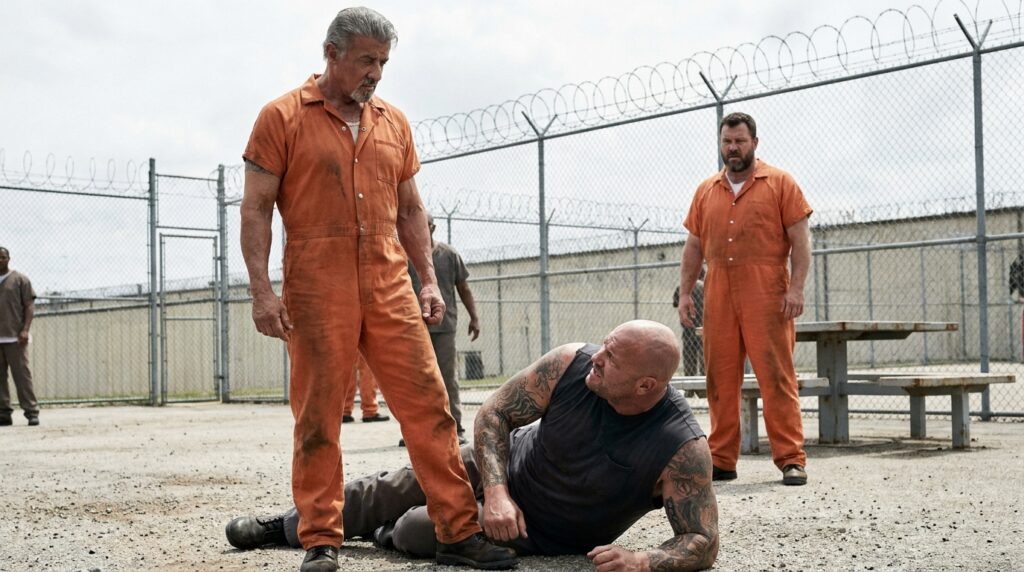
CHAPTER 6: THE TACTICAL TRUCE
The cold grease-stained muzzle of the mini-14 rifle hung perfectly still in the square gap of the gun tower window. John Vance didn’t raise his hands. His boots remained anchored over the concrete edge of the walkway, his left forearm muscle slightly twitching beneath the rough cotton of his sleeve where the gray bootlace stayed tight.
He didn’t look up at the glass box. He knew the precise angle of the trajectory—forty feet elevation, a thirty-degree downward sweep, the safety catch already toggled to the second notch based on the dry, dual click that had vibrated down the iron support pillars.
“Step away from the table, Vance,” Sergeant Harris’s voice mechanicalized through the wall-mounted paging horn. The sound was distorted by dust in the diaphragm, flat and tinny against the low rumble of the block’s main generator. “Keep your hands clear of the manifest.”
Vance didn’t pull away immediately. He let his fingers trail over the hand-written signature at the bottom of page three, feeling the slight indentation the blue ballpoint pen had left in the fiber of the paper. Asset remains offline. The notation wasn’t a warning to the prison guards; it was an order.
He stepped back exactly one pace, leaving the printed manifest weighted under the chipped red brick.
Beside the fence line, Brody Miller was breathing in short, rattling gasps, his heavy frame curled into the gravel. His eyes shifted from Vance’s boots to the locked iron crossbars of the tier gate. The gate was a solid block of zinc-plated steel, four inches thick, its locking pins driven into the reinforced lintel by a hydraulic piston that required an administrative key from the central office to reverse.
Brody’s three associates had dropped their triangular spacing. They were backed against the concrete wall of the bathhouse, their palms pressed flat against the flaking mortar, their faces pale under the desaturated glare of the afternoon sun. They knew the rules of a tower lock. If a rifle muzzle dropped below the horizontal plane, the next sound wasn’t a warning siren; it was a copper-jacketed round clearing the fence line.
“The gate isn’t opening, Sergeant,” Vance said toward the paging horn. He didn’t shout. He spoke into the open air, knowing the directional microphone on the catwalk railing was sensitive enough to catch the gravelly grit in his voice. “The count hasn’t been logged in the main ledger.”
The rifle barrel stayed steady for six seconds. Then, with a slow, heavy clack of the steel receiver mechanism, the long cylinder rose by three inches, the muzzle tilting away from Vance’s chest back toward the gravel perimeter lane outside the wire.
The window didn’t slide shut. The Guard Sergeant behind the glass simply leaned back into the shadow of the tin roof, his hand leaving the stock of the weapon. There was no whistle. No alarm. No tactical response team moving through the inner sally port with plastic restraints and batons.
Marcus stepped forward from the staging gate, his boots making a faint scraping sound in the sand. He stopped five feet behind Vance, his face dark with sweat. “They aren’t coming down, Commander. Harris isn’t calling the shift.”
“He can’t call the shift,” Vance murmured, his eyes tracking the thin oil slick dripping from the base of the tower pillar. “If he files an incident report for a yard fight, the manifest has to be attached to the logbook. The warden would have to send the file to the state circuit clerk.”
“The state doesn’t have this file,” Marcus whispered, his eyes widening as he looked down at the hand-written notation on the table. “I’ve run the digital balance sheets for every high-security transfer that cleared the Denver depot since ninety-eight. There’s no operational allocation for a deep-cover unit in this facility’s budget. Someone is carrying the cost of your cell on a completely separate ledger.”
Vance reached down, his movement slow enough for the tower watch to track, and took the brick off the paper. He didn’t fold the sheet; he rolled it into a tight, hard cylinder, his fingers tucking it into the interior waistband of his trousers, beneath the orange fabric where the guard searches rarely checked during a standard tier return.
Brody managed to pull his heavy bulk up against the iron post of the table. His sleeveless shirt was torn at the seam, the raw skin of his shoulder scraped red by the concrete edge. The arrogance had been completely ground out of his face, replaced by the primitive focus of a brawler who realized the ring he had been fighting in didn’t have any ropes.
“You knew,” Brody wheezed, his hand holding his ribs as he looked up at Vance. “You knew Harris wasn’t… going to drop the block.”
“Harris wanted an eruption, son,” Vance said, his voice flat as he turned toward the locked tier gate. “He needed you to create enough smoke in the yard to justify a total block isolation. If this tier goes into a permanent lockdown, no one enters the laundry lines. No one signs the manifests. The asset stays offline because the door stays shut.”
Vance walked toward the heavy steel crossbars of the gate, his boots regular and rhythmic against the hot stone. He didn’t wait for Harris to use the paging horn again. He stopped six inches from the iron mesh, his gaze fixing on the small, square inspection port at eye level.
Behind the glass, the corridor was entirely empty. The line guards had been withdrawn to the secondary barrier forty yards back, leaving the entire floor of Tier 3 isolated between the wash house and the wire—a silent, unwritten truce designed to see who would survive the pressure before the keys turned again.








