
CHAPTER 4: THE THRESHOLD OF PRESSURE
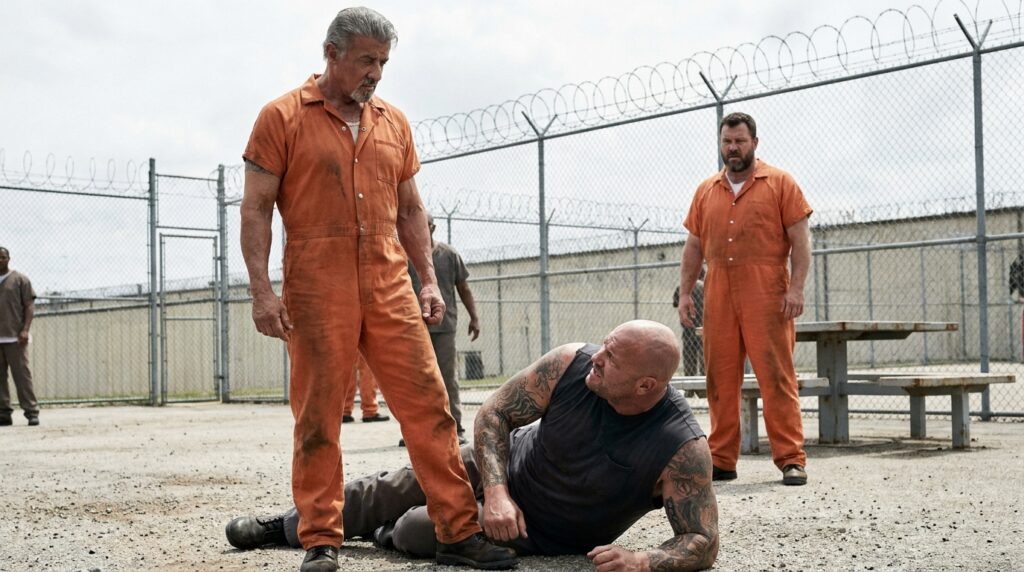
Sergeant Harris did not move from the center of the iron frame. The sun behind him burned the concrete walkway to a stark, blinding chalk-white, casting a long, skeletal shadow down the wash house corridor. The heat radiating off the gravel outer lanes felt like a physical barrier, thick with the smell of scorched earth and bleached dust.
John Vance stopped three paces from the doorway. His breathing remained locked in the steady four-second cycle he had maintained since his boots first cleared the processing floor five years ago. He didn’t drop his hands to his sides, nor did he hide them in the pockets of his orange jumpsuit. He stood with his fingers relaxed but anchored, his weight balanced evenly over the coarse grain of the floor.
“You’re out of your sector, Vance,” Harris said. The brim of his peaked patrol cap stayed low, cutting a dark, straight line across his eyes. Only the tight, sun-hardened line of his jaw showed through the shadow. He didn’t look back into the dark toward the lockers where Brody was dragging his heavy bulk into an upright posture. “The wash house rotation belongs to Tier 4 after the half-hour whistle. You’re supposed to be at the concrete benches near the wire.”
“Manifest had my name for the afternoon sheets, Sergeant,” Vance said. His voice was flat, carrying the dry, unyielding grit of the yard dirt. “The logbook on the thermostat wall shows the allotment. I don’t move unless the clerk marks the slot.”
Harris let out a brief, dry sound that might have been a laugh if there were any humor in this tier. He shifted his belt, his leather holster creaking against the heavy brass buckle of his utility strap. “The clerk doesn’t sign off on transfers anymore. I do. And right now, the yard is waiting for you to complete your tier obligation.”
Behind Vance, the scraping sound of a heavy rubber sole against a concrete drain grate signaled Brody’s recovery. The giant was on his feet now, his breath coming in shallow, shuddering gasps that rattled through his massive chest. He didn’t try to close the distance. He stayed hidden in the gray, steam-thick shadows near the iron lockers, his tattooed forearm pressed flat against his ribs to hold his cracked structure together. He was waiting to see if Harris would call the line guard with a whistle.
Vance didn’t look back. His mind was already parsing the spatial parameters of the outer walkway. The distance from the laundry threshold to the first concrete picnic table was precisely forty-two yards. The razor wire along the inner perimeter fence sat twelve feet high, the barbs overlapping in rusted spirals that caught the glare of the high afternoon sun. At this hour, the shadow of the gun tower fell short of the benches, leaving the entire center lane exposed to the high-angle observation windows above.
“The gate is open early today,” Vance noted, his eyes tracking a tiny flake of peeling paint on Harris’s shoulder strap. “The count usually takes another twenty minutes before the safety bolts drop.”
“We’re moving the timeline up,” Harris said. He stepped back by an inch, clearing the doorway just enough for a single man to pass through into the blinding white light of the lane. “The administration doesn’t like backlogs in the yard corridors. Go find your table, Vance. Brody’s boys are already settled near the south fence. They’re expecting an accounting.”
Vance moved past the guard without a shift in his alignment. As his shoulder cleared Harris’s utility belt, he caught a sharp, familiar odor beneath the stale sweat and leather conditioner—the distinct, chemical signature of lithium grease mixed with fine weapon oil. It was the exact preservative used for long-term storage of military-grade small arms, an oil that had no place in the correctional department’s standard-issue maintenance bins.
Vance didn’t turn his head. He stepped onto the sun-baked concrete of the yard walkway, his boots absorbing the blistering heat of the stone.
The yard was unnaturally quiet for an early air call. Usually, the first ten minutes after the safety bolts released were loud with the shouting of block factions organizing their spaces, the heavy thump of basketballs against chain-link, and the collective drone of five hundred men locked in a cage. Today, the circle around the picnic tables was already formed.
Thirty yards out, three of Brody’s closest associates stood in a loose, triangular formation near the center benches. They didn’t have weapons out—the tower guards would have picked that up from the glass box—but their postures were rigid, their shoulders squared to the walkway lane like infantry pickets holding a crossroad. Marcus followed Vance out, keeping a four-pace buffer between them, his boots dragging through the dry dust at the edge of the concrete.
“He’s setting it up, Vance,” Marcus whispered, his eyes fixed on the gun tower forty feet above their heads. The long barrel of the Guard Sergeant’s mini-14 rifle was visible through the reinforced pane, but it wasn’t pointed down at the tier lane. It was resting on the sandbag ledge, tilted up toward the sky. “Look at the high watch. They aren’t tracking the line. Harris told them to drop focus before he unlatched the laundry.”
Vance kept moving forward, his pace steady, unhurried, tracking the friction of the dust beneath his soles. His mind did not drift to the threat in front of him; it stayed anchored to the pristine brass pin that had been sliced from the jumpsuit collar inside. The crossed rifles of his old unit weren’t a random taunt from an inmate gang. Brody wouldn’t know the difference between an infantry crest and a correctional badge.
Someone had given Brody that tool to use as an anchor. Someone wanted Vance to use his hands in the open sun, where every lens in the high watch could record the exact mechanics of his training.
“Vance!” a voice called from the south benches. It was one of Brody’s enforcers, a lean, scarred man with a shaved head and an old quarry brand on his neck. He stepped into the center lane, his hands dropping to the waistband of his orange trousers. “Where’s the Ox? He was supposed to bring the iron down ten minutes ago.”
Vance stopped ten feet from the concrete table. He didn’t look at the man who spoke. His eyes went straight to the weathered wooden surface of the bench, where a clean, printed copy of the institutional transfer log lay weighted down by a chipped piece of red brick.
The manifest was open to page three. At the very top of the column, printed in the sharp, official ink of the federal logistics depot, was his own service serial number—a classified sequence that had been deleted from the public database before he was even processed into this block.








