
CHAPTER 5: THE GRAVITY OF RECOGNITION
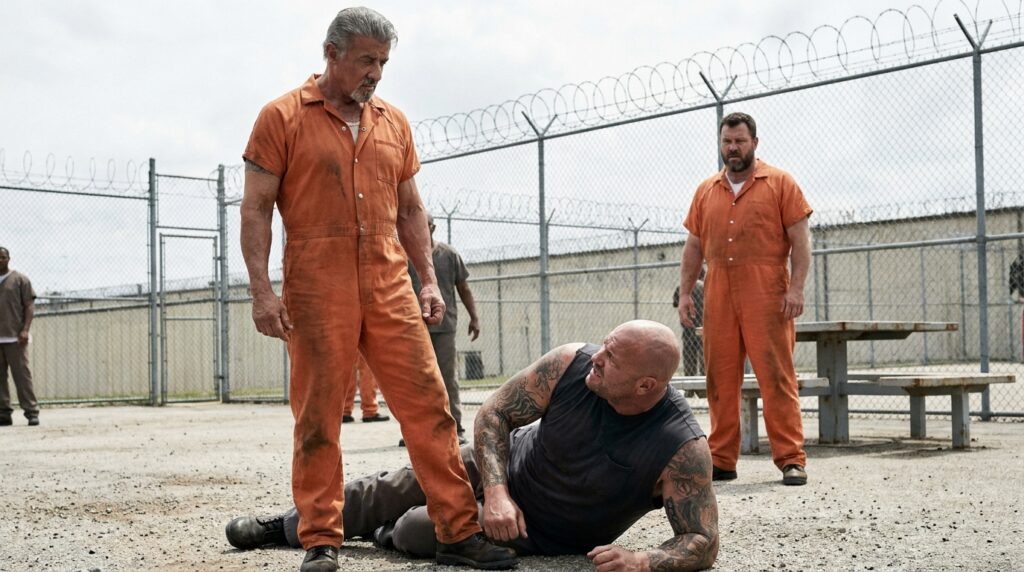
The heat-cracked timber of the concrete picnic table radiated a steady, blistering warmth that warped the air directly above the document. John Vance stood over it, his shadow falling across the printed numbers on page three.
The three digits—followed by the double-letter operational code he hadn’t seen since a cold tarmac exit in Germany—were clean. They weren’t a photocopy. The black toner had been stamped into the fibrous, recycled paper by a federal machine, the ink crisp and thick enough to catch the fine white dust drifting off the recreation lanes.
“You’re in my lane, old man,” Brody’s voice cut through the dry silence.
The heavy, uneven drag of his boots had caught up. Brody moved into the blinding glare by the fence line, his massive arms swinging awkwardly, his dark sleeveless top stained dark with wash house sweat. He didn’t have his crew at his back anymore; they were holding their triangular spacing ten yards back, their eyes darting nervously from Brody’s bruised jaw to the unmoving glass booth of the gun tower.
Vance did not look up from the manifest. His left thumb remained tucked under his cuff, his skin registering the coarse friction of the gray bootlace wrapped around his wrist. Every parameter of the yard was shifting. The rifle barrel in the upper watch window remained tilted toward the clouds, completely stationary. Sergeant Harris had gone silent, his long shadow retracted inside the dark corridor of the laundry building behind them.
“The lane belongs to whoever can keep it, Miller,” Vance said. His voice was a thin, dry scratch against the drone of the facility’s exhaust fans.
“It’s not just a lane anymore,” Brody growled, stopping three feet away. His breath was shallow, hitching against his damaged ribs, but his large knuckles were white where he gripped the chain-link mesh. “The Sergeant said you were a ghost. He said if someone pulled your file from the basket, the whole block would get restructured. New cell bosses. New distribution slots. He gave us the numbers, Vance. Your numbers.”
“Harris is an administrative clerk with a badge,” Vance murmured, his eyes finally moving from the page to Brody’s face. He noted the wide, frantic dilation of the younger man’s pupils. This wasn’t the calculation of a prison enforcer protecting a black-market route. This was the blind, kinetic momentum of a man who realized he had been loaded into a weapon and pointed at a target he couldn’t see. “He doesn’t have the clearance to pull these records from the cellar. He was handed that file.”
“I don’t care who handed it to him!” Brody stepped forward, his massive build throwing a dense shadow over the table, obscuring the paper. He reached out with a wide, desperate sweep of his left arm, attempting to grab Vance’s collar and drag him across the wood—a reckless crowd-out driven by the raw panic of his exposed position in the open sun. “Alright, I’m done playing the quiet rotation with you!”
Vance didn’t retreat into the chain-link behind him. To fall back was to lose the solid grounding of the concrete walkway. Instead, he dropped his center of gravity by two inches, allowing Brody’s heavy wrist to brush the top of his shoulder.
In one fluid, economic movement, Vance pivoted his right hip into the curve of Brody’s stride. He intercepted the sweeping arm at the elbow joint with a flat-handed check, leveraging the brawler’s forward momentum while his left foot stepped sharply behind Brody’s leading heel.
It was the exact defensive technique from the wash house, executed with the cold precision of a mechanical press. Brody’s weight carried him over the block. His boots skidded across the sun-baked dirt, his balance completely breaking as his shoulder sheared against the heavy iron edge of the picnic bench.
The impact was loud—a dull, fleshy thud followed by the high-pitched metallic ring of the iron frame warping under his mass. He went down hard into the gravel beside the fence line, his back pinned against the rusted barbs of the bottom wire, stripped of all leverage.
The yard frozen. Across the concrete lanes, the low hum of casual conversation and the rhythmic thump of basketballs stopped instantly. Marcus stood forty feet away, his stocky frame locked in mid-stride near the staging gate, his jaw tight as he watched the biggest brawler in the tier look up from the dirt.
Brody didn’t try to stand. He stayed grounded, his fingers clawing at the dust, his chest heaving as he stared up at the older man standing upright over the lane, his shoulders squared, his posture completely undisturbed. The massive tattoos on Brody’s arms looked pale under the gray layer of yard dust.
He looked at Vance’s eyes—steady, unblinking, and entirely clear of anger—and then he looked at his own crew, who remained frozen in their triangular lanes, refusing to step into the sun.
“Alright,” Brody croaked, his voice tight and compliant against the chain-link. “Alright, I’m done.”
Vance didn’t speak. He reached down and picked up the paper manifest from the wooden table, his fingers smoothing out the crease Brody’s shoulder had made. As he turned the page, a new line of text at the very bottom of the document caught his eye—a hand-written notation in blue ink, signed not by the prison warden, but by an active-duty colonel within the Department of Defense logistics command.
The notation read: Isolation Protocol Alpha verified. Subject containment sequence under continuous monitoring. Asset remains offline.
Before Vance could process the ink, a sharp, metallic click echoed from the wall behind him. The secondary safety bolts on the main tier gate didn’t open—they slammed shut, the heavy iron crossbars locking down with a deafening thud that cut off the recreation yard from the cell blocks. Above them, the gun tower window slid open with a screech of ungreased metal, and the long barrel of the mini-14 rifle finally dropped, pointing directly at John Vance’s chest.








