
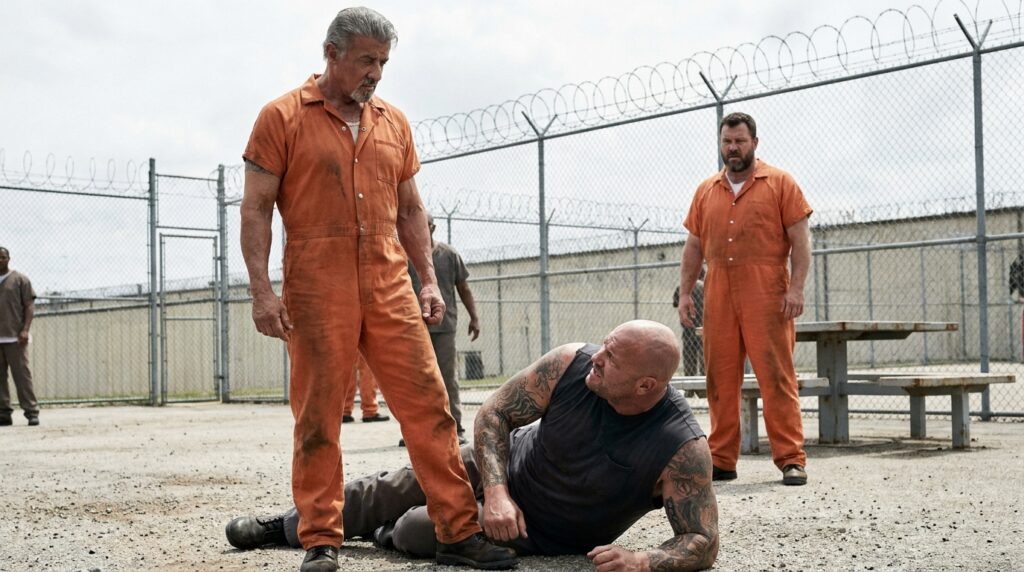
CHAPTER 1: THE FRICTION OF THE BLOCK
The industrial wash house smelled of stale bleach and the scorched, metallic heat of commercial ironers. It was a heavy, rusted scent that clung to the back of the throat like dried lime dust. John Vance did not look up from the folding table. His fingers, calloused and thick from thirty years of hard labor and older duties, smoothed the rough seam of a standard-issue orange jumpsuit. Every crease had to be precise. In the desaturated light filtering through the reinforced mesh windows, the fabric looked almost brown, stained by the iron-heavy well water that ran through the facility’s pipes.
To his left, the floorboards vibrated with the low, off-balance thudding of a heavy-duty extractor. It was a rhythm Vance calculated automatically—four beats of a mechanical skip followed by a long, scraping drag. He knew every loose bolt in the foundation. He knew exactly how much oil the main flywheel was losing by the distinct, burnt-sugar smell drifting from the motor housing. Survival in the tier did not belong to the loudest voice; it belonged to the man who measured the wear and tear of his surroundings before the metal finally snapped.
“He’s not hearing you, Ox,” a voice rasped from the dark corridor near the steam pipes. It was Marcus, his stocky frame silhouetted against the wet heat of the drying racks. He was leaning against a support pillar, his hands tucked deep into his pockets, eyes shifting toward the far end of the folding line where the air grew noticeably colder.
Brody Miller moved into the light of the single unshielded bulb. The skin of his bald head was slick with sweat, the massive ink-work on his forearms twisted into dark, illegible knots as he flexed his fingers. He didn’t walk; he crowded the lane, his heavy work boots dragging through the gray dust on the concrete. He stopped less than two feet from Vance’s table, his shadow blotting out the desaturated glare from the window.
“The old man hears fine,” Brody said. He slammed a heavy, rust-spotted iron flat down onto the neatly folded stack Vance had just finished. The impact sent a small cloud of dry lint into the air between them. “He just thinks if he keeps his eyes on the thread, the rest of the world goes away. I told you three days ago, Vance. Your crew doesn’t use the south tables anymore. You’re occupying space that belongs to people who actually have a purpose in this block.”
Vance stopped his hands. He did not pull away from the table, nor did he look into Brody’s eyes. Instead, his gaze remained fixed on the tattooed skin of Brody’s wrist—noting the slight tremor in the radial artery, the subtle tilt of the younger man’s weight toward his right heel. A classic brawler’s stance, overcompensated by raw mass. Underneath his own sleeve, the frayed remnant of the gray military bootlace pressed hard against Vance’s pulse point. He breathed in through his nose, holding the hot, chemical air for three seconds before letting it out.
“The tables belong to the state, Miller,” Vance said, his voice low and dry, like gravel turning over in a shallow stream. “And the state says everyone gets an hour of air. Go back to your tier.”
Brody leaned over the metal table, his chest nearly touching the iron. “The state isn’t down here on the concrete, old man. Your time out here is done.”
Vance reached out to pick up the next jumpsuit, his movement deliberate and slow. But as his fingers brushed the coarse cotton, his eye caught a small, bright glint tucked inside the collar of the garment Brody had just slammed down. It was a brass collar pin—not correctional issue, but a specific, dual-pronged military insignia from an active domestic infantry brigade. The metal was clean, completely devoid of the rust that coated everything else in the block.








