
CHAPTER 5: THE FILE IN THE VAULT
The iron frame of the file locker didn’t yield easily. It was frozen into its housing by twenty years of damp basement air and calcified rust that had formed along the structural weld points. Miller squeezed his fingers into the narrow gap between the drawer and the casing, his boots slipping against the grimy concrete floor as he leaned his full weight backward. The metal resisted with a low, vibrant hum, a sharp shudder passing through the sheet iron that vibrated up his forearms.
He couldn’t use a crowbar. The sound of shearing metal would bounce through the floorboards straight to the guard post at the end of the lower tunnel. Instead, he reached into his pocket and produced the heavy keyset he had pocketed from Captain Vance’s desk before the third watch split. The ring felt oily, smelling of cold graphite and old oxidation.
He didn’t use the standard key. His eyes tracked the small, etched cross pattern near the weld of the loop. He unhooked the small mechanical pin that held the extra shanks in place, sliding out a long, narrow iron pick with three jagged teeth that had been rounded down by years of intentional friction. It wasn’t standard issue. It was a tool designed to bypass the older tumbler boxes that the academy administration considered long obsolete.
Miller inserted the iron pin into the core of the heavy padlock securing the cabinet. He held his breath, his ear pressed against the cold, flaking paint of the frame.
Click. Scrape. Click.
The internal brass springs resisted, stiffened by salt dust and old grease, but he turned his wrist slowly, mimicking the unhurried geometry he had seen the Instructor use at the fuel gate. The heavy internal bar dropped with a dull, hollow clack that sounded like an iron latch falling into place inside a stone wall.
The drawer slid forward four inches, spilling the smell of old cellulose, damp mold, and dry iron dust into the dark room.
Miller worked fast under the narrow beam of his shielded penlight. His fingers flipped through the gray cardboard guides, their edges frayed into fibrous pulp by time. Most of the labels were stamped with standard logistical codes—quartermaster receipts, coal shipments from the late nineties, vehicle decommissioning logs with pitted staples rusting through the paper.
Then his hand hit a folder that was twice as heavy as the others.
The manila stock had turned the color of dry tobacco leaves. In the upper right corner, the same stamp he had seen in Clinic G was visible under the yellow light: an inverted triangle enclosing three small, hand-punched holes. But unlike the folder in the clinic, this file wasn’t empty.
Miller pulled it from the rack, the old paper cracking like dried mud along the spine.
Inside lay a single unredacted operational brief dated October 14, 2004. The heading across the top read: Project Linebrook: Post-Action Structural Evaluation. The text below was typed on an old mechanical machine, the letter ‘E’ consistently striking higher than the rest of the line.
“Operation collapsed at the secondary breach point due to uncoordinated detonation sequencing. Tactical detachment suffered seventy percent equipment loss and structural exposure. Senior Instructor Vance, acting as field coordinator, failed to verify the load-bearing integrity of the primary exit lane before initiating the extraction protocol.”
Miller’s thumb traced the typed words, his pulse thumping hard against the back of his throat. A black-ops failure. The text described a catastrophic collapse, an operation that had gone completely dark in some forgotten sub-basement across the border. According to the document, the old man wasn’t a living legend preserving an honorable tradition; he was an administrative exile, stripped of his field status and quarantined at this preparatory school to keep his failure from leaking into the modern tactical sectors.
Beside the file, resting in a small hollowed-out compartment within the thick back cover, was a heavy brass-rimmed mechanical chronometer. The crystal face was cracked across the center, a dark line bisecting the brass gears inside. Miller picked it up, noting its unusual weight. When he turned it over, he saw that the official military serial number had been systematically scratched out by a coarse metal file, leaving nothing but silver-gray gouges in the brass casing.
“You’re looking at things that don’t belong on your ledger, Recruit.”
The voice came from the dark gap of the doorway, flat and unhurried, like a stone dropping into a deep well.
Miller froze, his fingers locking around the heavy brass chronometer. He didn’t turn his head immediately; his eyes stayed on the shadow cast across the open drawer by the beam of his penlight. The shadow was immense, its shoulders squared into the iron alignment that only one man at the academy possessed.
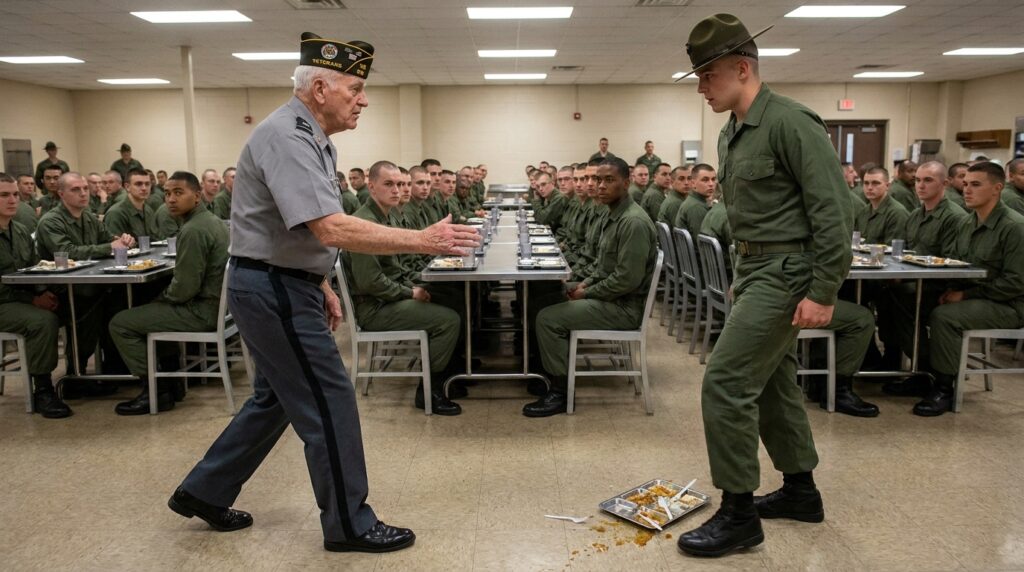
The Instructor stepped into the room, his gray wool coat unbuttoned at the top, his cap centered precisely between his ears. He didn’t look angry; his face was the same mask of weathered granite he had worn in the mess hall when he broke Miller’s balance with a single palm strike.
“Instructor,” Miller said, his voice catching slightly on the grit in the air. He held the unredacted folder against his chest, the rough cardboard scraping his fingertips. “This report… it says you broke the line twenty years ago. It says you got your unit trapped.”
The old veteran didn’t look at the file. He walked up to the iron cabinet, his thick-knuckled hand reaching out to touch the cold, rusted edge of the drawer he had spent two decades ignoring. His fingers brushed across the flaking green primer, leaving clean tracks in the gray masonry dust that covered the surface.
“The paper says what the administration needs it to say to keep the building standing, kid,” the old man said softly. He reached out and took the brass chronometer from Miller’s hand, his thumb tracking the file marks across the back of the casing with a slow, mechanical regularity. “A wall doesn’t care which stone takes the weight, as long as the roof doesn’t come down on the people inside.”
He slid the chronometer into his pocket, the brass clinking against the heavy keyset already hidden there. Then he looked down at Miller, his pale gray eyes empty of malice but full of something much heavier—the absolute, pragmatic reality of a man who had traded his identity for a secret that was still bleeding through the floorboards.
“Put the folder back in the track, Miller,” the Instructor directed, his voice dropping into that low, gravelly rumble. “The morning watch starts in twenty minutes, and the clay out on the training ground doesn’t care about history. It only cares about who’s standing when the whistle blows.”








