
CHAPTER 10: THE MEASURED LINE
The iron support frame of the secondary gate did not buckle inward; it tore downward into the earth with a long, vibrating scream of shearing metal. Miller’s boots lost all traction as the lip of the concrete drainage vault beneath them cracked wide, splitting like dry firewood under the seven-ton weight of the lead automated unit. The red mud turned to an oily slurry, rushing into the dark gap below as the structural reinforcement rods—pitted down to thin, black wire by twenty years of salt runoff—shattered in rapid succession.
Thung. Snap. Thung.
Miller lunged forward, his hands slamming onto the cold, wet zinc coating of the outer gate post. The friction peeled the skin from his palms, leaving gray zinc grit embedded in his raw fingers, but he didn’t let go. His right shoulder jammed hard against the old man’s ribcage as the Instructor drove his iron bar deep into the axle housing of the rolling steel platform.
The machine’s tracks groaned, throwing a cloud of ungreased graphite smoke and hot oil into the rain as it tried to chew through the old man’s leverage. The Instructor’s gray wool tunic was already torn open at the hip, the loop of rough copper wire having snapped under the immense physical strain. The wool parted to reveal the silver-white ridges across his chest, the muscles underneath hardening into dense, trembling blocks of granite as he took the machine’s full momentum through his spine.
“The vault is clearing out, Vance!” Miller shouted, his jaw clamped shut against the spray of muddy sand. “Drop the bar!”
“The line doesn’t drop, kid,” the old man rasped. The cadence was broken, his lungs working like an unlubricated bellows against his bruised chest, but his eyes were fixed on the central tower.
Through the sheet of grey water rolling off the glass of the executive suite sixty yards away, Commander Sterling had not moved. He stood behind his slate-topped desk, his face a pale blur behind the pane, watching the automated platform drag the old guard down into the foundation.
Then, the concrete gave way completely.
A forty-foot section of the ridge lane subsided into the old drainage tunnel with a hollow, concussive boom that shook the sandbags out of Captain Vance’s bunker. The automated unit tipped sideways, its ungreased track assembly screaming as it slid into the hole, dragging the Instructor’s iron bar along with it.
But the old man wasn’t in the trench.
At the exact microsecond the masonry collapsed, his left hand had locked onto the front collar of Miller’s green tunic. With a short, brutal pivot that used the last of his momentum against the failing earth, the veteran had thrown the recruit backward onto the hard clay shelf of the outer perimeter fence. Miller hit the gravel hard, the breath whistling out of his mouth as he rolled into the wire mesh.
When he sat up, wiping the red silt from his eyelids, the rain had begun to thin, rolling off the hills in long, gray curtains.
The automated platform sat dead in the middle of the ditch, its internal electrical leads shorting out against the muddy water with a series of muffled, blue pops. The secondary gate was gone, replaced by a raw, jagged throat of broken aggregate and rusted iron reinforcing wire.
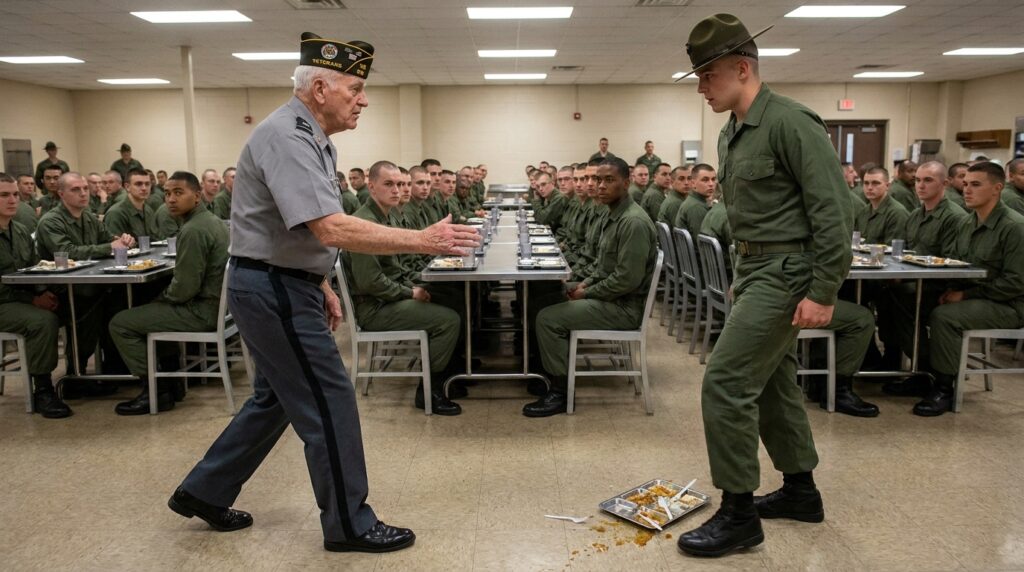
The Instructor stood on the very edge of the lip. His veteran’s cap had been carried away by the wind, exposing his short white hair to the downpour. His gray coat hung loose, the lowest button hole empty, the wool flapping against his shins like a torn flag. His right hand was stained dark with iron rust from the pry-bar, his knuckles bleeding where they had struck the machine’s shield, but his posture was identical to the line he had held in the mess hall on the first afternoon.
From the road behind them, Captain Vance ran forward, his boots slishing through the mud, a squad of third-platoon recruits trailing three paces behind his heels. He stopped at the edge of the subsidence, his eyes darting from the drowned mechanical platform to the old man’s unyielding profile.
“Instructor,” Vance said, his voice dropping its authoritative edge for the first time since the training cycle had initialized. He looked up at the tower, then down at the broken concrete. “The evaluation board… they logged the failure. The automated units are non-functional.”
The old man didn’t answer the Captain. He turned his head slowly, his pale gray eyes tracking down the line of frozen recruits who stood along the wire. They weren’t checking their manuals; they weren’t looking at the modern deployment baselines. They were looking at the space where the machine had tried to pass and had been broken by an iron bar and eighty years of muscle memory.
“Legacy isn’t something you inherit by wearing the cloth, Captain,” the Instructor said, his voice dry, carrying across the silent ridge line like stone sliding over sand. “It’s earned by remembering how to stand.”
He walked past them then, his boots striking the wet clay with that same heavy, rhythmic spacing that didn’t allow for play or hesitation. Miller pulled himself up by the chain-link wire, his fingers stinging from the zinc dust, and snapped into a rigid, textbook military stance as the old man cleared the gate. Every recruit from Third Platoon followed his movement, their heels clicking together in a synchronized, sharp echo that silenced the last hum of the failing winches.
The power dynamic of the entire installation had settled into the earth. The modern manuals remained in the administrative lockers, but the line was drawn in the clay, and everyone knew which stone held the roof.








