
CHAPTER 3: THE COLD LIGHT OF CLINIC G
The corridor of Block C smelled of damp concrete and the low, flat hum of oxidized iron radiator pipes that hadn’t been cleared since the previous winter. Flakes of old green primer paint hung from the doorframes like dead skin, curling under the weight of the humidity. Miller kept his boots tracking exactly three feet behind the Instructor’s measured stride. Every time his left foot struck the concrete, his bruised sternum throbbed, a dull reminder of the old man’s palm.
They stopped before a heavy steel door marked Clinic G: Evaluative Services. The Instructor reached out, his thick, scarred fingers turning the tarnished brass handle with a slow, deliberate twist. The door groaned on its hinges, a high-pitched dry scream of metal against metal that set Miller’s teeth on edge.
Inside, the light was even harsher than the mess hall—a stark, desaturated white that exposed the yellowing laminate of the desk and the gray hair of the medical technician sitting behind it. The technician, a tired-looking man named Hauer with a faded blue lanyard around his neck, didn’t look up from his clipboard.
“Stripping down to the waist, Instructor,” Hauer said, his voice flat, exhausted by decades of routine. “Captain’s office called ahead. Urgent post-incident assessment. You know the drill.”
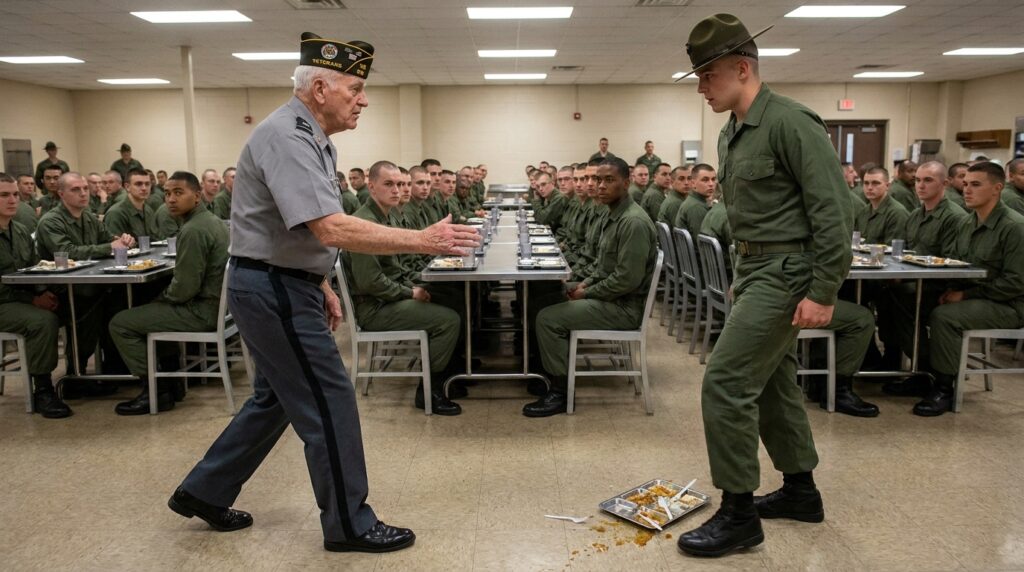
The old man didn’t answer. He raised his hands, unpinning his veteran’s cap with smooth, mechanical efficiency, placing it down on the rusted edge of an instrument cart. Then, his thick fingers moved to the gray wool tunic. One by one, the silver buttons slid through their stiff buttonholes until he reached the bottom. His fingers paused on the loop of rough copper wire. With a small, practiced tug, he unhooked the wire from the lower hem.
As the wool parted, Miller caught his breath, his eyes widening as he stood by the door.
The Instructor’s torso wasn’t just old; it was an archaeological map of violence. The skin was the color of old parchment, stretched tight over a ribcage that looked like a welded cage of iron reinforcement bars. Across his collarbone ran a jagged, silver-white ridge—the unmistakable furrow of a high-velocity fragment wound that had torn through muscle and healed poorly. Below his left rib, a circular, puckered indentation sat like a crater in dry earth. But it was his back that made Miller step closer, forgetting the pain in his own chest.
Two thick, parallel tracks of purple scar tissue ran from his shoulder blades down to his lumbar spine, deep enough that the muscle tissue around them had hardened into dense, protective knots. It looked like he had been caught in a heavy industrial vice, or pinned beneath the iron chassis of a collapsing vehicle.
“Sit,” Hauer said, finally looking up as he reached for a blood pressure cuff. The tech’s eyes caught Miller standing by the door. “Recruit, pick up that intake jacket from the bin. The purple folder on the lower shelf. Don’t just stand there airing your teeth.”
Miller moved his boots across the linoleum, his hand dropping to the lower wire shelf of the desk. He pulled the thick, manila folder toward himself. As he did, his thumb brushed against the top corner of the paper. There, stamped in a faded, dark purple ink that had bled into the cardboard over twenty years, was a symbol: an inverted triangle enclosing three small, perfectly aligned drill holes.
The stamp had no words, no classification markers, and no department name. It looked ancient, an institutional ghost hidden in plain sight. Miller’s thumb lingered on the ink, noting how the texture of the paper beneath the stamp was slightly warped, as if it had been exposed to moisture or chemical wash before being filed away in the damp archives of Block C.
“Pulse is forty-eight,” Hauer muttered, his fingers pressed against the Instructor’s thick wrist, right over the faded 402 tattoo. The tech didn’t sound surprised; he sounded like a mechanic reading the idle speed of an engine that refused to die. “A bit high for you, isn’t it, Vance?”
“The meatloaf was greasy,” the old man said, his chest rising and falling in a slow, unbothered rhythm. He didn’t look at the file in Miller’s hand, but his head turned slightly, his gaze tracking the reflection of the room in the dark, scratched glass of the medicine cabinet.
“Captain Vance wants a full structural clearance,” Hauer said, pulling the velcro cuff from the old man’s arm with a loud, tearing rip. “He asked specifically if the joints are showing signs of structural fatigue. He’s looking for a reason to transition you to an off-site retirement cadre, Vance. You know how the budget works these days. They don’t like paying for iron that doesn’t bend.”
The Instructor stood up, his spine snapping back into its rigid, vertical alignment with a small, audible click from his lower lumbar. He didn’t look like a man who had just been threatened with administrative erasure. He reached for his gray wool tunic, his fingers immediately finding the rough copper wire at the hem, twisting it back into place with a single, unhurried motion that excluded the rest of the room entirely.
“The Captain can look all he wants, Hauer,” the old man said, his voice dropping into that dry, cold register that sounded like iron scraping over gravel. “But he doesn’t own the foundry.”
He turned his head then, his pale gray eyes locking onto Miller’s face, catching the recruit before he could hide the purple stamped folder behind his hip. The silence in the clinic grew heavy, thick with the smell of old iodine and the sharp, chemical reality that whatever line Miller had crossed in the mess hall, it was only the beginning of a very long, very dark road.
“Give the man his folder, kid,” the old man directed quietly. “Then we go see the Captain.”








