
CHAPTER 14: THE MEASURED LINE
The oak double doors of the command chamber did not swing; they yielded with a heavy, pressurized sigh that smelled of linoleum wax and the bitter dregs of stale chicory coffee. Miller kept his chin wedged tightly into the starched hook of his green wool collar, his heels tracking the grey stone lintel with a short, dry click that bounced off the high, limestone pilasters. The morning light coming through the tall eastern windows was thin, desaturated like zinc wash, cutting through the haze of the coal-burning radiators that hummed and leaked brown fluid into their iron trays at the corner of the floor.
Commander Sterling sat motionless behind his slate-topped desk, his hands pinned flat against a leather-bound ceremonial logbook. He was dressed in his full Green Directorate uniform, the silver stars on his epaulets polished until their sharp points looked like needles under the cold electric glare.
But it was the center of his desk that drew Miller’s eye. Sitting directly between the inkwell and the heavy slate blotter was a pristine, uncut steel cylinder pin—a component used only in the old-style field retrieval winches from twenty years ago. The pin was bright, entirely free of gray graphite grease or oxidation, a clean piece of evidence that had been deliberately drawn from the secure vaults of Block C before the watch broke.
“You’re early, Vance,” the Commander said. His voice was a flat, unhurried rumble that had the consistency of dry gravel sliding down a chute. He didn’t look at Miller; his eyes remained fixed on the old Instructor, who stood three paces inside the door.
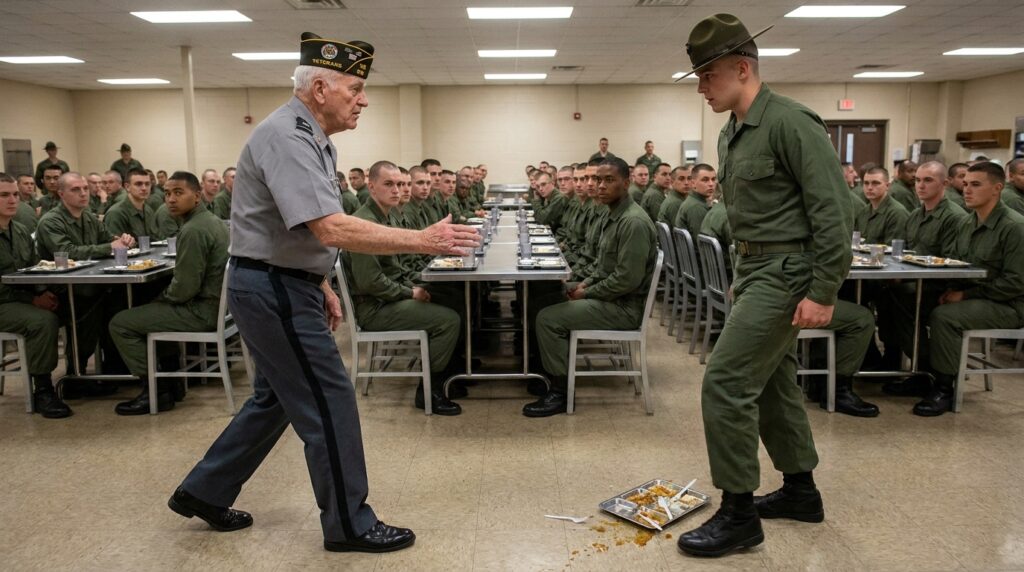
The Instructor had not worn his service cap. His white hair was cut short, stiff like iron wire against his skull, and his gray wool uniform coat was held together by nothing more than the raw bands of salvaged webbed line he had pulled from the container docks. He stood with his hands locked at the small of his back, his spine driven into the floorboards with the absolute, immovable verticality of a pillar that had taken the full weight of a falling roof and refused to split.
“The clock in Block C runs on the line, Sterling,” the Instructor said. The words came out dry, slow, carrying the raw texture of a man who had spent forty years swallowing the soot of the foundries. “It doesn’t slow down for ceremonies.”
Behind them, the door click-shattered the stillness. Captain Vance stepped into the space, his dress utilities crisp, his leather belt starched until it looked like a band of dark iron around his ribs. He didn’t walk to the desk; he moved to the flank of the door, his hand resting on the frame right over the split seam of his right glove where the silver signet ring remained tucked away out of sight.
“The evaluation board has completed the log integration, Commander,” the Captain said. His tone was level, devoid of the administrative heat he had carried into the mess hall. “The metrics for Third Platoon have been certified. The structural failure on the north ridge was logged as an uncoordinated material collapse due to aging drainage vaults.”
Sterling’s fingers didn’t move on the leather logbook. His slate-gray eyes drifted slowly from the Captain’s face down to the uncut cylinder pin on his desk, his thumb tracing the rim of the steel pin with a small, rhythmic motion.
“An aging vault is a clean signature, Captain,” Sterling muttered, his gaze finally shifting to Miller. “It leaves the walls standing. It ensures the new automated assets from the coastal district have a level platform when they initialize the training cycle next week. A clean sheet is what keeps the funding running through the winter freeze.”
“The sheet isn’t clean, Sterling,” Miller said. He didn’t wait for permission to break the lane. He took a half-step forward, his boots leaving a dry, white outline of scrap-iron dust against the dark limestone floor. He reached into his pocket and placed the hand-turned zinc stencil block next to the pristine cylinder pin. The metal landed with a sharp, heavy clank that echoed off the high ceiling. “The bridge plates weren’t aged. They were scrap before the extraction detachment ever reached Sector 4. You signed the requisition for the low-grade structural steel three months before the operation collapsed. The name on the procurement order wasn’t Vance. It was yours.”
The Commander didn’t reach for the stencil. He didn’t look down at the cipher ST-04 that sat between them like an old iron wedge. The stillness in his face didn’t fracture; it grew denser, the skin tightening over his jaw until he looked like nothing more than another piece of the room’s architecture.
“You have fast feet, Recruit,” Sterling said quietly, his voice dropping into a register that was nearly swallowed by the hum of the copper pipes behind his chair. “But fast feet don’t change the load-bearing requirements of this institution. If the board pulls that file, the academy doesn’t just lose its funding. The logistics division from the coast takes the entire district. They’ll clear the cadre, they’ll turn these halls into a parts depot, and they’ll run your platoon until their lungs fill with grey sand.”
He looked up then, his gray eyes locking onto the old Instructor’s weathered cheeks, catching the reflection of the white hair under the light.
“I gave twenty years of administrative labor to keep this roof up, Vance,” the Commander said softly. “I signed the forms that kept the coal in the boilers when the Directorate wanted to shut the gates. I built the desks that kept the next generation from having to sleep in the dry clay.”
“You built the desks out of the men you left under the bridge, Sterling,” the Instructor said. The gravelly rumble of his voice filled the office, cutting through the thin heat of the radiators like an iron wedge through dry timber. He didn’t raise his hand; his thick, scarred knuckles remained locked behind his back. “The line isn’t something you protect by hiding the scrap ledger. It’s protected by staying upright when the machine breaks under your feet. The boy isn’t signing the statement. And the Captain isn’t carrying your manifest.”
Captain Vance took a step away from the doorframe, his heels striking the stone with a single, synchronized thud that cut off any further negotiation. He reached into his split glove, pulled out the silver signet ring with the ivory inlay, and dropped it onto the slate desk next to the stencil block.
“The administrative transfer list for the salt flats has been cleared, Commander,” the Captain said flatly. “The Instructor stays on the line. The recruit stays in Third Platoon. If the evaluation team asks about the file marks on the chronometer, I’ll tell them the rust was cleared by hand.”
Sterling looked down at the ring, then at the three men who held the lane before his desk. They didn’t look like an administrative cadre; they looked like an iron wall that had outlasted the foundry that cast them. Slowly, his hand moved away from the logbook, his fingers dropping into his lap as he sat back into the shadow of his high leather chair.
The change-of-command whistle blew from the parade grounds below—a long, cold mechanical shriek that cut through the morning fog, signaling the start of the next cycle. The Instructor turned on his heel without offering a salute, his gray wool coat billow-flapping against his shins as he led the way out, his boots striking the limestone with that same heavy, unbreakable cadence that told everyone in Block C that the line was still held by iron.








