
CHAPTER 6: THE RETROSPECTIVE RITUAL
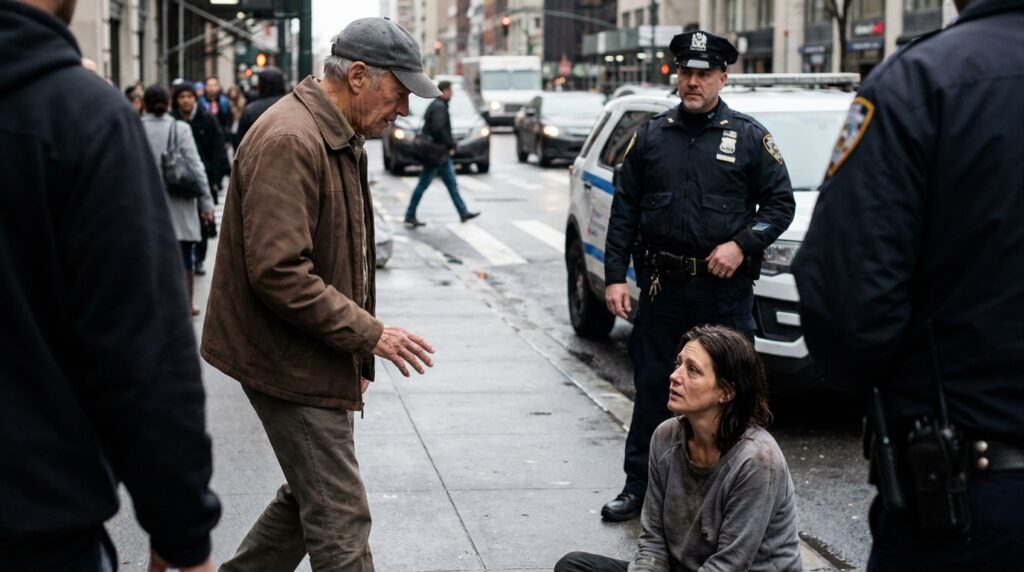
The cold, wet granite of the sidewalk did not change its texture under Arthur Vance’s palms, but the space between his boots and the parking island felt completely altered. The city traffic continued its wet hiss across the four lanes of asphalt, a distant rumble of diesel and rubber that seemed to bounce off an invisible, soundproof perimeter. The desaturated daylight was dying now, catching the frayed edge of Sarah Miller’s gray sleeve as her hand remained pinned to the wet concrete.
Beneath her trembling fingers, the notched brass key lay cold and heavy. Arthur did not pull it away from her. His rough, weathered hand simply rested over hers, his thumb sliding across the smooth, rubbed spine of the metal until he felt the micro-frictional indentation near the base—the specific locker stamp of the Fort Meade supply node. Forty years ago, he had watched her father, Sergeant Thomas Miller, scratch that exact notch into the brass using the file of a standard-issue multi-tool while sitting on an olive-drab crate in the humid twilight of a Georgia staging area. Thomas had been a man who trusted lockers more than banks, a soldier who kept everything that mattered—his service citations, his family records, his quietest memories—locked behind heavy wire mesh, waiting for a future that had ultimately run out of time.
Sarah looked up through the tangled, dark strands of her hair. Her face was a landscape of pale exhaustion, her skin grayed by the harsh climate of the street, but her eyes held a sudden, sharp lucidity that cut through the haze of the afternoon. A tear had tracked a clean line through the grit on her cheek, reflecting the silent, rhythmic red strobe of the police cruiser across the avenue. “He told me you’d be watching the sector,” she whispered, her voice cracking like dry timber under a heavy boot. “Before he went into the VA hospital… he said if the grid ever fell completely apart, I should look for the olive cap near the transit canal. I thought he was just dreaming about the old unit.”
Arthur felt a tightening behind his ribs, a dull, physical ache that had nothing to do with age and everything to do with the heavy ballast of a command he had never truly surrendered. He had spent six months tracking her pattern, walking this desaturated downtown corridor every Tuesday and Friday, keeping his distance to preserve her fierce, frayed pride while ensuring the local predators kept their radius wide. He had known her name before she hit the concrete; he had known her father’s voice before the kids on the corner were even a thought in the city’s lineage.
The middle-aged police officer stood completely immobilized two paces away, his massive frame trapped in the absolute collapse of his own authority. His uniform cap was tilted slightly from the wind, the dark wool fabric of his sleeves looking thin, almost fragile against the immense, historical weight radiating from Arthur’s posture. His eyes remained fixed on the white laundry tag inside Sarah’s collar, then drifted to his own dull brass belt buckle with its non-standard logistics stamp. The code matched the key. The code matched the man.
“Colonel,” the officer said, the word coming out not as a municipal protocol, but as a quiet, involuntary exhalation from the back of a throat that had forgotten how to salute. He took a half-step backward, his boots scraping softly through the wet sand on the curb. His right hand fell completely away from his holster, hanging limp at his side. “I didn’t… I didn’t verify the sequence. The district office just flagged this island for immediate clearance due to the transit shifts. I was just clearing the line.”
Arthur rose from the pavement with a slow, deliberate grace that defied the decades. He didn’t brush the wet grit from his brown cotton trousers. He stood at his full height, his spine locking into an unyielding, vertical plumb line that seemed to draw the entire street into alignment around him. He looked at the officer, his gaze level and absolute beneath the olive brim of his cap.
“The line is cleared, son,” Arthur said. The gravel in his voice was no longer conversational; it was the metered, low-frequency command that had once stopped heavy machinery in its tracks. “You will return to your vehicle. You will log this location as a secure sector under active veteran oversight. Then you will clear the avenue so this citizen can gather what remains of her dignity.”
The officer’s jaw moved once, a silent, subvocal hesitation passing through his features before his shoulder muscles went rigid. He didn’t argue. He didn’t ask for identification. The discipline etched into his own leather gear was too deep to ignore the presence of a man who had helped build the very depot he had served under. He snapped his heels together with a sharp, metallic click against the concrete barrier, his chin lifting by a single, respectful inch before he turned on his heel and walked back across the asphalt toward the idling cruiser.
Arthur looked back down at Sarah, who had begun gathering the split plastic bags, her fingers moving with a calmer, steadier rhythm now that the pressure had been driven from the sidewalk. The notched brass key was back in her pocket, tucked safely against the frayed knit of her sweater.
“Stand easy, Sarah,” Arthur said softly, his hand resting on the olive brim of his cap as the police cruiser pulled away into the gray city dusk. “The street is secure.”








