
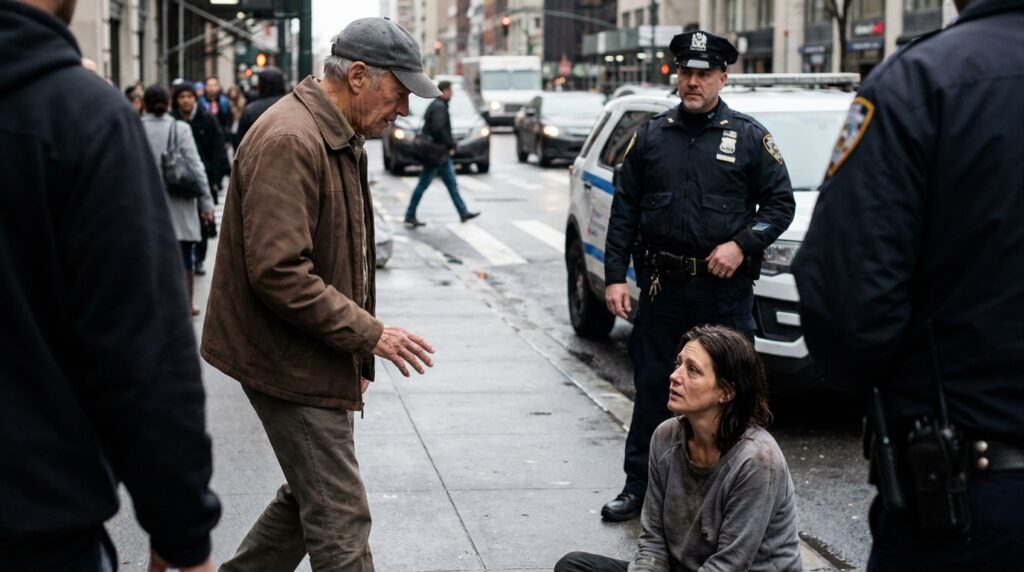
CHAPTER 3: THE WEIGHT OF THE ASPHALT
The lead boy didn’t wait for an answer. His left hand came up in a fast, loose arc meant to shove Arthur’s shoulder back, a careless display of physical leverage intended to re-establish control of the perimeter. It was a motion born of soft years and soft targets—wide, telegraphed, and heavily reliant on the assumption that an old man’s joints were as brittle as dry pine.
Arthur didn’t flinch. He didn’t drop into a theatrical stance. As the boy’s palm neared the frayed lapel of his brown jacket, Arthur simply shifted his center of gravity backward by two precise inches, letting the forward momentum of the youth slide past his chest. In the same micro-second, his right hand moved. It was a movement stripped of any superfluous flourish, an economy of motion preserved from a decade spent drilling men on the sun-baked dirt of Georgia bases. His fingers, rough and thick-knuckled, met the boy’s extended wrist.
He didn’t grip it to strike. He simply applied a downward, twisting pressure against the radial nerve while his left palm stepped into the meat of the boy’s elbow, deflecting the kinetic energy cleanly into the empty air toward the concrete barrier.
The boy’s sneakers lost their purchase on the grease-slicked granite. With a sharp gasp of interrupted breathing, his entire upper body lurched forward, his balance evaporating as his shoulder checked the cold edge of the parking barrier. He didn’t fall, but his momentum was thoroughly spent, his posture reduced to a clumsy, defensive scramble as he tried to regain his footing against the grit. The absolute lack of impact made the redirection worse; it felt less like a fight and more like running full speed into a rotating iron gate.
“Back off,” the second youth muttered, though he took a step away from the concrete barrier rather than toward it. His hands hung near the zipper of his technical jacket, his fingers twitching against the slick synthetic fabric. The performative confidence that had filled the space thirty seconds ago had gone entirely thin, replaced by the sudden, heavy silence of an unpredictable calculation.
Arthur didn’t pursue the advantage. He remained anchored in the interaction lane, his feet spaced exactly at shoulder width, his hands returning to a resting position at his sides. His breath remained steady, a quiet, rhythmic exhalation that barely misted in the damp canal air. Underneath the faded olive brim of his cap, his eyes remained level, observing the three of them not with anger, but with the cold, diagnostic assessment of a commander reviewing an undisciplined detail.
Below his waist, the woman let out a small, ragged breath. Her fingers were still locked around the split plastic bag, but her head had turned slightly. For the first time, Arthur saw her profile clearly in the desaturated gray light. Her eyes were wide, fixed on the scuffed leather of his boots. From the loose, sagging pocket of her worn gray sweater, the corner of a heavy, notched brass key protruded, its edges bright where the lacquer had been rubbed away by years of nervous handling. It was a specific pattern—a master locker key from the old supply depots at Fort Meade, a piece of brass that shouldn’t have been within five hundred miles of this sidewalk.
Arthur’s heart gave a single, heavy thud against his ribs, a dull ache that felt like an old wound waking up before a hard rain. He knew that key. He had signed the inventory ledger for the unit lockers that held those keys forty years ago, when a young, green sergeant named Miller had sworn to keep his family safe after their final deployment.
Across the four lanes of asphalt, the door of the municipal police cruiser finally swung open. The hinge gave a high, metallic squeak that cut through the low thrum of the idling engine. The middle-aged officer stepped down onto the roadway, his polished leather boots making a deliberate, heavy crunch against the scattered gravel. He didn’t draw his belt tools, but his hand rested casually on the top of his holster, his fingers tapping against the black polymer grip as he adjusted his uniform cap against the salt wind.
“Everything alright over here?” the officer called out. His voice was loud, flat, carrying the practiced authority of a man used to clearing a sidewalk by presence alone. He began walking across the traffic lanes, his eyes scanning the three youths before lingering on Arthur’s plain brown jacket with an expression of mild, bureaucratic annoyance. To him, the old man was an unnecessary complication—an interfering civilian who had turned a simple vagrancy clearing into an incident that required a written report.
The lead boy was back on his feet now, his face flushed red beneath his clean-shaven temples. He rubbed his right wrist where Arthur’s thumb had left a pale, momentary impression against the skin. “Old man’s crazy,” he spat, though his voice lacked its previous volume. He kept his distance from Arthur, his heels pinned against the safety of the curb. “We were just telling her to move her garbage, and he jumped us.”
The officer stopped at the edge of the sidewalk, his shadow falling across the wet granite between the boys and the parking island. The cold light caught the smooth, dark sheen of his uniform. He looked at the woman on the pavement, then at the split plastic bags, and finally turned his full weight toward Arthur.
“Sir,” the officer said, his voice dropping into a firmer, disciplinary register. “You need to step away from these men and let me handle the block. You shouldn’t be getting involved in this.”
Arthur looked at the officer’s clean-shaven jaw, then down at the small, notched brass key resting in the woman’s pocket. The world around them seemed to slow down, the textures of the city turning brittle and heavy, waiting for the first line of real authority to break the gray afternoon.








