
CHAPTER 2: TESTING THE BOUNDARIES
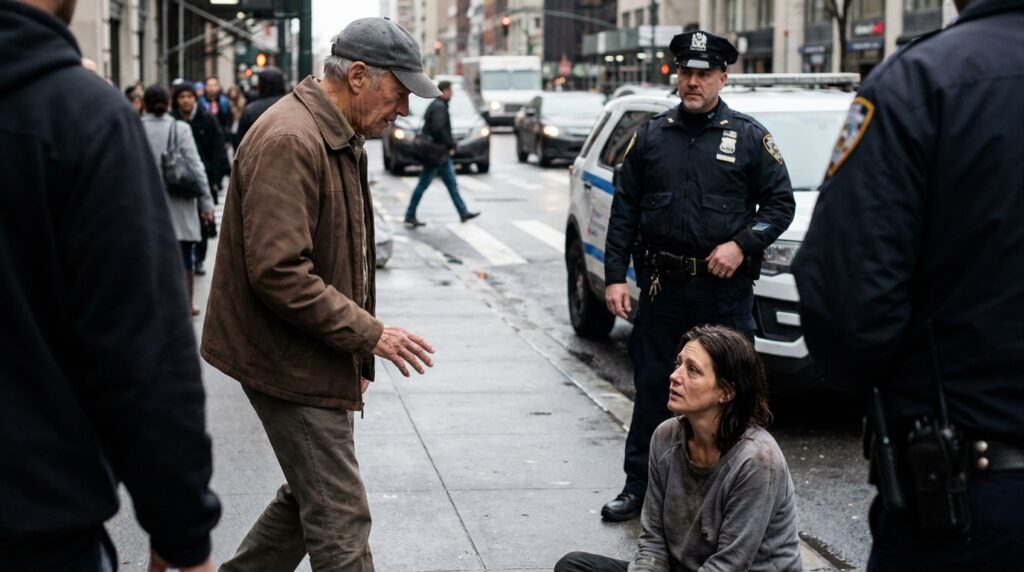
“I’m moving it, I’m moving it,” the woman whispered. Her voice was an uneven vibration, dry as winter grass. She didn’t look up at the three boys shadowing her, nor did she look toward the heavy, dark boots pinned against the corner of her rain-soaked cardboard box. Her small, cracked hands scrambled over the wet granite, trying to bundle three loose, water-damaged paperbacks and a plastic container back into the split seam of her gray sweater.
Arthur Vance stood less than five paces away, his boots anchoring him to the perimeter of the parking island. The desaturated daylight caught the pale, silvered edges of his gray hair where it escaped the brim of his veteran cap. To anyone watching, he was a static figure, an old man caught in the typical paralysis of a city sidewalk witnessing a typical city cruelty. But beneath the heavy brown cotton of his jacket, his chest rose and fell in short, silent cycles.
His eyes were not on the boys. They were fixed on the woman’s frayed collar.
As she leaned forward, the worn knit of her gray top parted slightly at the nape of her neck, revealing a faded, hand-stitched laundry tag—white thread on black cotton, marking a military surplus issuance number from an enlistment sequence forty years old. The sight of it sent a cold, precise spike of adrenaline through Arthur’s veins, sharper than the salt wind coming off the canal. His fingers inside his pocket tightened around the loose brass insignia clutch until the metal dug deep into the meat of his thumb.
The largest of the three youths, a boy with an expensive, unblemished technical jacket and clean-shaven temples, leaned his weight forward. He wasn’t looking for a fight; he was looking for compliance, the easy satisfaction of seeing a marginalized life recede further into the shadows. “You got five seconds before the rest of this goes into the gutter, lady. The trucks are backing in.”
“The trucks don’t come until four,” she muttered, her fingers hitching on a torn page.
“What did you say?” The boy took a half-step closer, his shoulder checking the air, his heavy-soled shoe grinding down harder on the wet cardboard. The structural fibers of the box gave way with a sickening, fibrous crunch.
Across the street, the idling police cruiser exhaled a plume of gray exhaust into the cold air. The silhouette behind the wheel shifted slightly, the paper coffee cup rising toward the driver’s mouth, slow and indifferent. The municipal grid was working exactly as it was designed to—ignoring what was inconvenient until it became a reportable metric.
Arthur felt the familiar, heavy pulse in his temples—the old rhythmic counting he used to employ before the artillery parameters were set. He noticed the layout of the sidewalk with absolute spatial clarity: the slick patch of grease near the boy’s left heel, the concrete barrier offering three inches of solid elevation behind the woman’s back, the loose gravel scattered across the granite that would rob an aggressive stride of its traction. The boys were balanced on their toes, their weight distributed for intimidation, not impact. They were soft. They were accustomed to the silence of bystanders.
He took a slow, deep breath, letting the cold air clear the taste of diesel from his throat. The texture of the world around him felt remarkably fragile—the fraying edges of the woman’s sleeves, the thin vinyl of the boys’ jackets, the brittle social contract that kept this city from tearing itself apart.
He didn’t yell. He didn’t raise his hands. He simply closed the distance between his position and the parking island, his rubber soles making no sound against the wet granite as he stepped directly into the path of the boy’s next forward movement.
The third youth, standing slightly to the rear, noticed the shadow first. He reached out, tapping the leader’s elbow with a single, gloved finger. “Hey. Watch out.”
The leader turned his head, his brow furrowing as his eyes drifted up from the pavement, past the worn brown cotton of Arthur’s jacket, finally settling on the shadowed bill of the olive veteran cap. A small, mocking smile began to form at the corner of his mouth, the instinctual reaction of a young predator encountering something it deemed ancient and defenseless.
“You lost, old man?” the boy asked, his voice dropping into a performative drawl meant to entertain his friends. He didn’t remove his boot from the woman’s ruined box.
Arthur remained perfectly still, his hands now resting loosely at his sides, out of his pockets. The brass clutch was gone from his fingers, left behind in the dark fabric of his coat, but his palms were steady, slightly curved, ready for the weight of whatever the street was about to demand.
“The woman asked you to let her clear her things,” Arthur said. His voice was quiet, almost conversational, but it carried a strange, resonant timber that didn’t vibrate in the throat—it seemed to come from the diaphragm, heavy and metered, bypassing the ambient hiss of the traffic like a low-frequency hum.
The boy laughed, a short, sharp barking sound, and took a full step toward Arthur, bringing their chests within six inches of contact. The smell of cheap vape smoke and mint gum rolled off him. “And who the hell are you supposed to be? Her lawyer?”
Below them, the woman froze, her fingers still tangled in the split plastic bag. She didn’t look up at Arthur, but her shoulders went rigid, her breathing suspending entirely as the circle of the street grew tighter, colder, and absolutely silent.








